

Download Simcore Processing Modflow 11.0.6 – Groundwater Modeling Interface Software
Simcore Processing Modflow 11.0.6 is a sophisticated graphical user interface designed to support the preparation, execution, and visualization of groundwater flow and transport simulations. Developed to streamline the complex workflows associated with MODFLOW and a suite of related environmental modeling codes, it is an essential tool for professionals in environmental engineering, hydrogeology, and water resource management. This software enhances the utility of standard groundwater modeling packages by providing an integrated environment for data management, model setup, and results analysis.
Overview of Processing Modflow in Groundwater Simulation
Processing Modflow (PM) serves as an advanced graphical user interface (GUI) supporting the widely recognized MODFLOW family of groundwater modeling software, originally developed by the U.S. Geological Survey (USGS). The initial development of MODFLOW by McDonald and Harbaugh laid the groundwork for sophisticated numerical simulation of groundwater systems. Processing Modflow builds upon this foundation, offering a user-friendly graphical environment that simplifies the preparation of input files, management of model data, and visualization of simulation outputs. Its development history is closely tied to the evolution of MODFLOW itself, with continuous updates to support newer versions and related codes, ensuring its relevance in contemporary hydrogeological studies and environmental engineering projects.
Supported Groundwater Models and Their Applications
Processing Modflow offers extensive support for a variety of USGS groundwater modeling codes, significantly expanding the capabilities available to hydrologists and environmental engineers. Its core strength lies in its ability to interface with multiple models, facilitating comprehensive analysis of groundwater systems.
- Groundwater Flow Simulation: It supports critical MODFLOW versions, including MODFLOW-2005, the advanced MODFLOW-NWT (for non-linear unstressed transient simulations), and MODFLOW-OWHM (integrating aquifer-stream-soil-vadose zone processes). These models are foundational for understanding aquifer behavior and simulating groundwater movement.
- Solute Transport Modeling: For analyzing the movement of contaminants or dissolved substances in groundwater, PM integrates with MT3DMS and MT3D-USGS. These packages are essential for assessing environmental risks and planning remediation strategies.
- Variable-Density Groundwater Flow: When simulating flows in areas with significant salinity gradients, such as coastal aquifers, SEAWAT provides the necessary capabilities, seamlessly supported by Processing Modflow.
- Particle Tracking: To visualize groundwater flow paths and determine travel times, PM supports MODPATH, enabling users to track the movement of hypothetical particles through the simulated aquifer.
- Parameter Estimation: The software integrates with powerful tools like PEST (and its extensions BeoPEST) and other parameter estimation software. This functionality is crucial for model calibration, where model parameters are adjusted to match observed field data, leading to more reliable simulations.
Data Management and Visualization Features of Processing Modflow
Processing Modflow provides a robust suite of features designed to simplify the complex task of preparing and interpreting groundwater model data. The software emphasizes intuitive graphical interaction to manage diverse datasets and visualize simulation results effectively.
- Data Import Versatility: The interface supports importing data from a wide array of common formats, including comma-separated values (CSV), shapefiles (for spatial data), and ASCII Raster files, ensuring compatibility with existing datasets and GIS workflows.
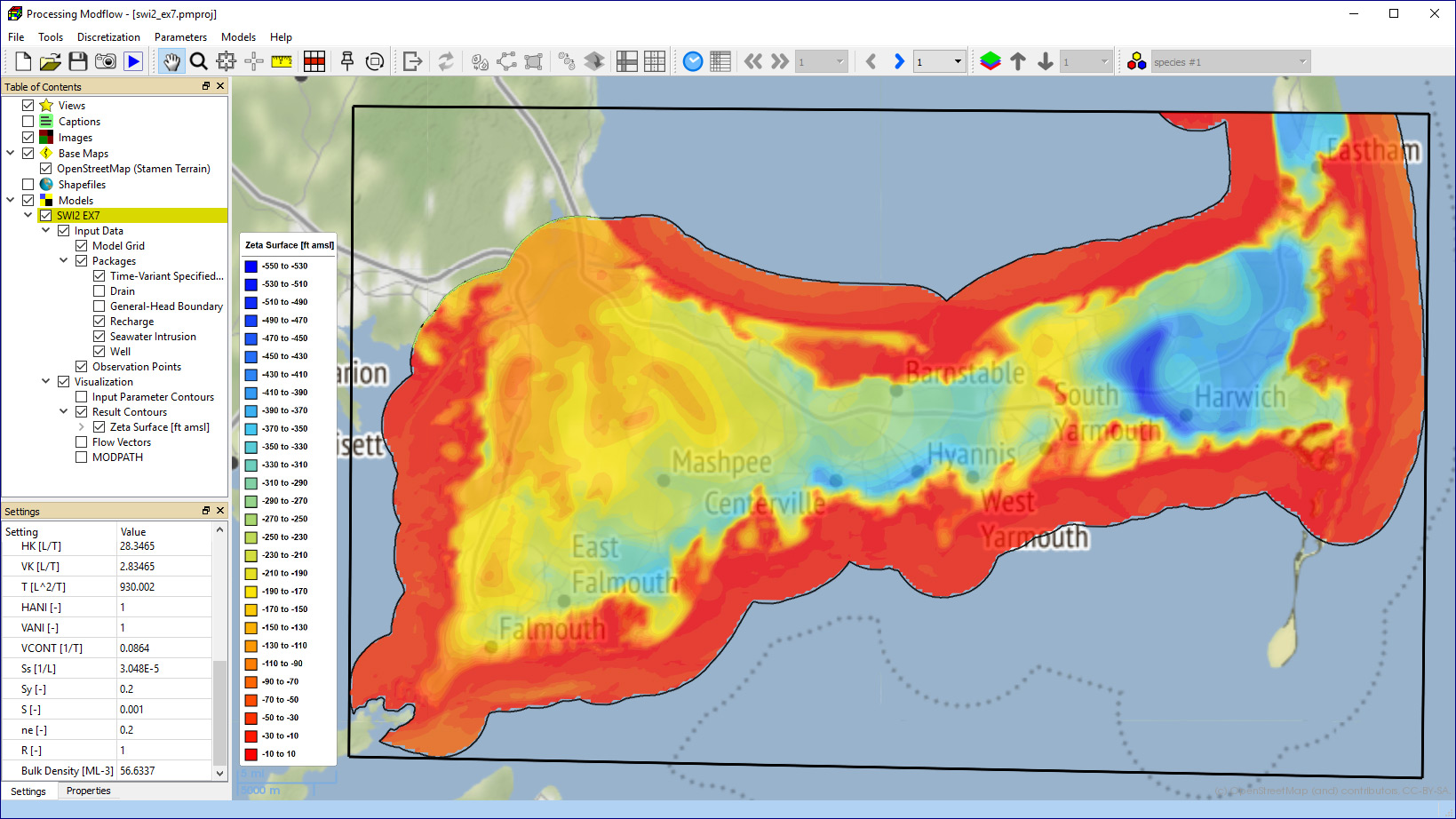
- Graphical Visualization: Users can visualize model grids, imported shapefiles, and online maps directly within the software. This allows for a clear representation of the project area, geological layers, boundary conditions, and the model domain.
- Results Display: Simulation outputs, such as heads, drawdowns, and concentrations, can be graphically displayed and analyzed. This visual feedback aids in understanding model behavior and identifying trends or anomalies.
- User Interface Streamlining: The GUI is designed to facilitate model setup by allowing users to define model parameters, boundary conditions, and stress periods through interactive tools rather than manual text file editing, which significantly reduces errors and speeds up the modeling process.
- Export Capabilities: Processed data and visualization outputs can be exported in various formats, supporting further analysis or integration into reports and presentations.
Integration and Extended Capabilities for Complex Hydrological Modeling
Beyond basic groundwater flow and transport, Processing Modflow facilitates the integration of multiple hydrological processes, offering a more holistic approach to environmental system modeling. This capability is vital for tackle complex, real-world challenges.
- Surface-Water and Groundwater Coupling: The software supports coupling surface water and groundwater models through applications like GSFLOW. This integrated approach allows for the simulation of interacting surface water bodies (rivers, lakes) and subsurface flow systems, providing a comprehensive view of watershed dynamics.
- Parameter Integration: The integration with parameter estimation tools, such as PEST and BeoPEST, is a key differentiator. These tools enable automated model calibration by systematically adjusting model parameters to match observed field data, leading to more accurate and reliable hydrological simulations.
- Multidisciplinary Modeling: By supporting a broad range of codes and offering integration capabilities, Processing Modflow enables multidisciplinary hydrological modeling. This allows professionals to construct comprehensive models that address various interconnected environmental factors, from water quality to resource availability.
Practical Use Cases and Industry Applications
Simcore Processing Modflow 11.0.6 is utilized across various sectors within environmental engineering and hydrogeology for a wide range of practical applications. Its comprehensive feature set makes it suitable for projects requiring detailed groundwater analysis and management.
- Groundwater Resource Management: Professionals use the software to assess sustainable groundwater abstraction rates, forecast aquifer responses to pumping, and plan for water supply augmentation.
- Contamination Assessment and Remediation: The integration with solute transport models like MT3DMS allows for the simulation of contaminant plumes, their migration pathways, and the effectiveness of different remediation strategies. This is crucial for environmental impact studies and site cleanup projects.
- Environmental Impact Studies: Before commencing large infrastructure projects (e.g., mining, construction, or agricultural development), the software is used to predict potential impacts on local groundwater resources and quality.
- Academic and Research: Researchers in universities and institutions employ Processing Modflow for studying complex hydrogeological phenomena, developing new modeling techniques, and educating students in groundwater simulation.
- Regulatory Compliance: The ability to create detailed, defensible groundwater models using standardized codes helps organizations meet regulatory requirements for environmental protection and water resource management.
Comparative Advantages of Processing Modflow
Processing Modflow distinguishes itself from other groundwater modeling GUIs through its broad compatibility, extensive data integration features, and focus on streamlining complex simulation workflows for environmental and hydrogeological professionals.
While other interfaces might focus on a single MODFLOW version or a limited set of related codes, Processing Modflow offers a unified environment for multiple USGS groundwater modeling packages. This multi-model support, including flow, transport, variable-density flow, and particle tracking, significantly reduces the need to switch between disparate software applications. Furthermore, its comprehensive data management tools, supporting diverse input formats and offering powerful visualization capabilities for both input data and model results, provide a more integrated and efficient user experience compared to less feature-rich alternatives.
Frequently Asked Questions
What types of groundwater models does Processing Modflow support?
Processing Modflow supports a wide range of groundwater models, including MODFLOW versions (MODFLOW-2005, MODFLOW-NWT, MODFLOW-OWHM), solute transport models like MT3DMS and MT3D-USGS, variable-density flow models such as SEAWAT, and particle tracking software like MODPATH. It also integrates parameter estimation tools like PEST for model calibration.
How does Processing Modflow help with data visualization and management?
Processing Modflow offers an intuitive graphical interface that allows importing various data formats including CSV, shapefiles, and ASCII Raster. It enables visualization of model grids, online maps, and shapefiles side by side with simulation results, facilitating comprehensive data management and a more efficient modeling workflow.
Can Processing Modflow be used for integrated surface water and groundwater modeling?
Yes, Processing Modflow supports integrated hydrological modeling by incorporating tools like GSFLOW that couple surface water and groundwater processes, enabling comprehensive watershed and aquifer system simulations for environmental engineering projects.




Reviews
There are no reviews yet.