

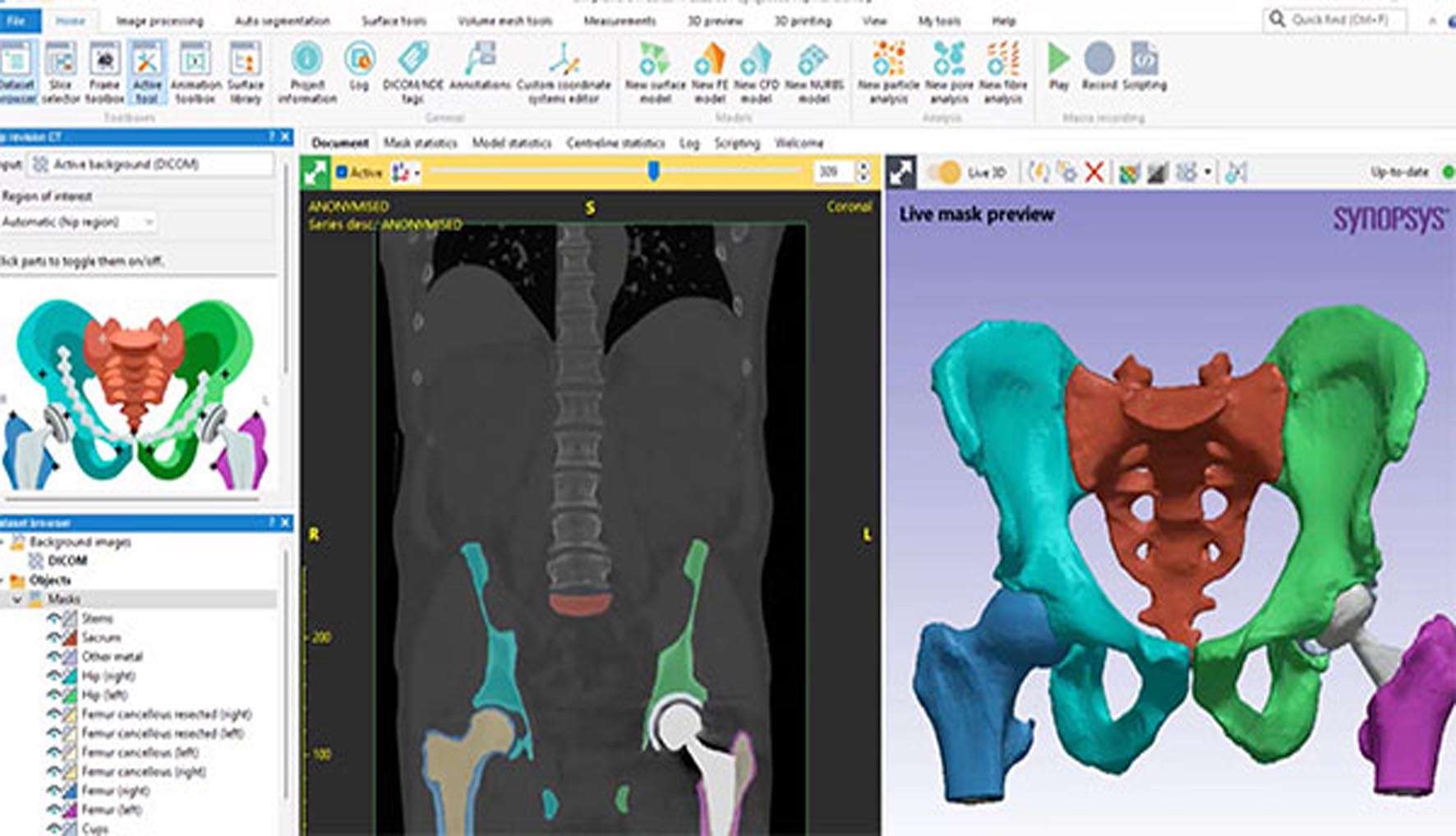
Download Synopsys Simpleware 2025.06 – Advanced 3D Image Processing and Model Generation Software
Synopsys Simpleware 2025.06 is a specialized 3D image processing platform designed for converting volumetric imaging data into high-quality computational models. Developed by Synopsys, Inc., this software bridges medical imaging and engineering workflows for professionals in biomedical engineering, medical device research, materials science, additive manufacturing, geosciences, and academic research. Its core capability lies in generating simulation-ready and design-ready models directly from scan data, facilitating advanced analysis and manufacturing processes.
Comprehensive 3D Image Processing for Biomedical and Scientific Applications
Synopsys Simpleware, originally known as ScanIP, is a pivotal tool for transforming raw volumetric imaging data from modalities such as CT, MRI, micro-CT, and SEM into precise 3D models. Unlike traditional CAD software, Simpleware operates directly on image stacks, enabling engineers and researchers to extract detailed anatomical or material information for downstream applications. This approach makes it invaluable across various scientific fields, including healthcare, materials science, and even geosciences, by providing direct access to the complexities within scan data.
Advanced Segmentation and AI-Driven Imaging Enhancements in 2025.06
The 2025.06 release of Synopsys Simpleware introduces significant advancements in image segmentation, a critical step in isolating specific structures within volumetric data. The software offers a suite of segmentation tools, encompassing AI-assisted methods, manual delineation, and threshold-based techniques. New AI-driven features, including a smart segmentation assistant, custom model training capabilities, generative model completion, and anomaly detection, streamline the process of creating accurate digital representations. These enhancements address the inherent challenges of segmenting complex biological tissues or material structures, offering improved efficiency and precision.
High-Quality Mesh Generation and CAD Integration for Simulation and 3D Printing
Simpleware excels in generating high-quality surface and volume meshes derived from segmented image data, preparing models for advanced simulation and additive manufacturing. It supports various mesh types, including STL for surface models and tetrahedral, hexahedral, or polyhedral elements for volumetric meshing required in finite element analysis (FEA) and computational fluid dynamics (CFD). The software also provides robust CAD integration options, enabling users to fit NURBS surfaces to image data for reverse engineering and to export clean, simulation-ready meshes compatible with leading CAE solvers.
Specialized Modules and Industry-Specific Workflows
To cater to diverse engineering needs, Synopsys Simpleware offers specialized modules that extend its functionality. Modules such as +FE prepare models for finite element analysis, while +CAD and +NURBS facilitate advanced modeling and reverse engineering tasks. The +PHYSICS module aids in setting up simulation boundary conditions directly on image-derived models. These integrated capabilities support complex workflows across industries, from biomechanics research and implant design to materials science characterization and the preparation of models for custom manufacturing.
Emerging Technologies and Workflow Integration
Synopsys Simpleware 2025.06 is at the forefront of adopting emerging technologies to enhance user workflows. It now supports quantum imaging data, enabling work with novel data sources. The platform also provides 4D spatio-temporal analysis for dynamic processes and advanced processing for multispectral CT data. For modern collaborative environments, Synopsys offers a cloud-native SaaS version alongside powerful GPU acceleration and distributed processing for handling very large datasets. Furthermore, extended reality (XR) export features enable immersive visualization and collaboration on complex 3D models.
Practical Use Cases in Medical, Research, and Industrial Fields
The practical applications of Synopsys Simpleware are vast and span multiple critical sectors. In healthcare, it is used for creating patient-specific anatomical models for surgical planning and implant design, as well as for biomechanical simulations to understand tissue and bone behavior. In materials science and additive manufacturing, it assists in analyzing material defects and preparing complex geometries for 3D printing. Beyond these, its capabilities extend to geosciences for reservoir characterization and academic research requiring precise digital models derived from scientific imaging.
Performance and Scalability for Handling Large and Complex Datasets
Synopsys Simpleware is engineered to manage and process extremely large and complex volumetric datasets, often exceeding 1 TB. The software leverages GPU acceleration for rapid data processing and interactive manipulation. For demanding analyses, it supports distributed computing, allowing tasks to be spread across multiple processors or machines for enhanced speed and scalability. Intelligent caching mechanisms ensure smooth, interactive performance even when working with massive datasets, making large-scale imaging projects manageable and efficient.
Frequently Asked Questions
How does Synopsys Simpleware handle segmentation of complex 3D medical images?
Synopsys Simpleware offers AI-assisted, manual, and threshold-based segmentation tools designed to accurately identify different tissues and structures from volumetric medical scans such as CT and MRI. The 2025.06 version includes AI-driven smart segmentation assistants that suggest optimal strategies based on the image characteristics, improving accuracy and efficiency.
What types of mesh generation does Simpleware support for simulation?
Simpleware supports high-quality mesh generation including surface meshes (STL) with adaptive smoothing and volume meshes that are finite element-ready with tetrahedral, hexahedral, and polyhedral elements. These meshes can be exported directly to major CAE solvers like ANSYS, ABAQUS, and COMSOL for simulation.
Can Simpleware integrate with CAD software and support reverse engineering workflows?
Yes, Simpleware includes modules for CAD integration and advanced NURBS surface fitting that allow users to combine scan data with CAD models and perform reverse engineering tasks. This integration supports accurate model generation for design validation and manufacturing.






Reviews
There are no reviews yet.