

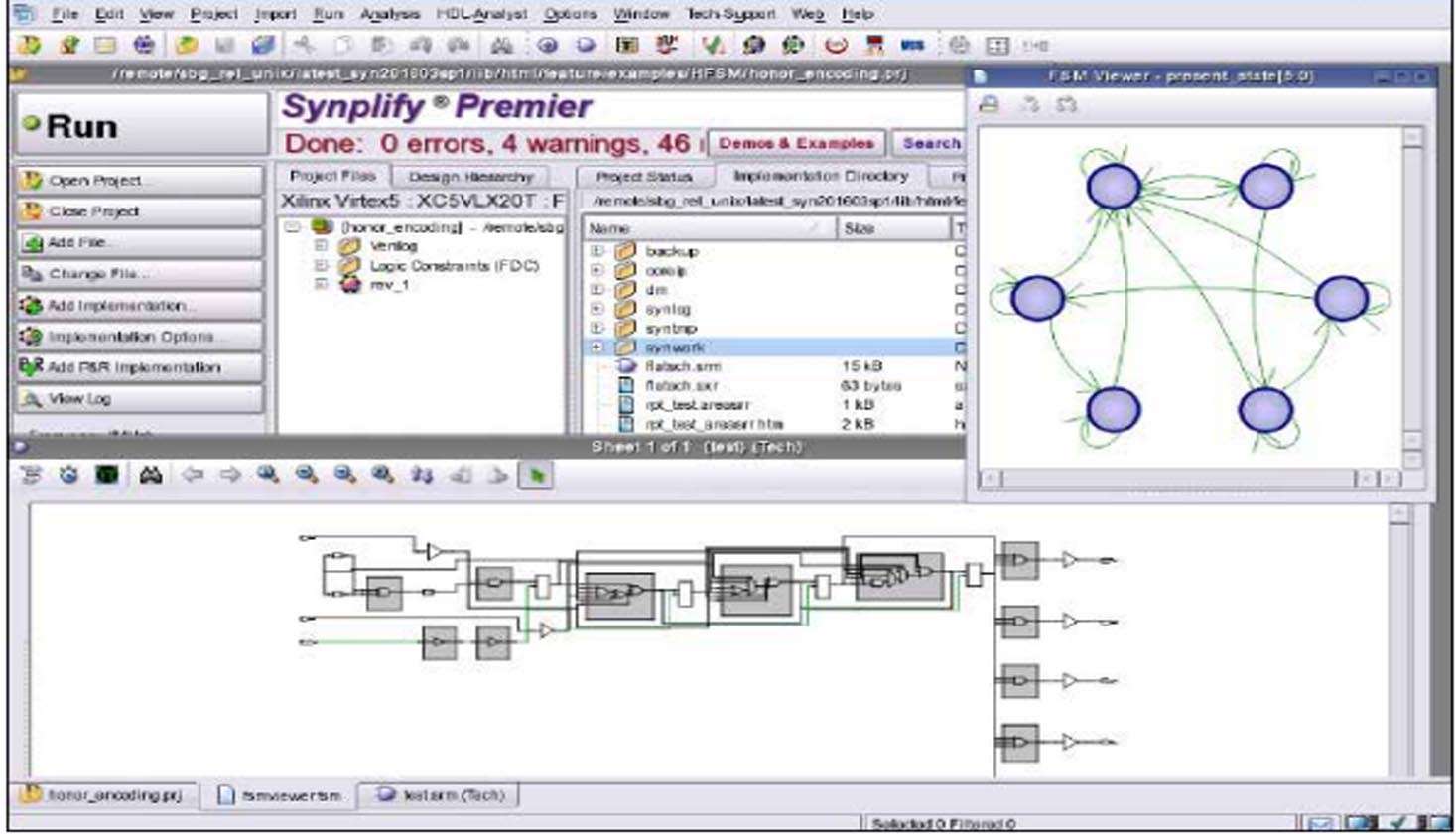
Download Synopsys Synplify FPGA 2025.06 – Advanced FPGA Synthesis and Implementation Tool
Synopsys Synplify FPGA 2025.06 is a high-performance FPGA synthesis and implementation tool developed by Synopsys, Inc. This advanced software is engineered for FPGA design engineers and embedded system developers working across the semiconductor design industry. It provides critical capabilities for translating hardware description language (HDL) code into optimized FPGA designs, supporting major vendor families and enabling efficient development for complex digital systems.
Synplify FPGA in Modern FPGA Design and Industries
Synopsys Synplify FPGA serves as a cornerstone tool in modern electronic design automation (EDA), specifically within the FPGA design workflow. It is integral to industries such as semiconductor manufacturing, where it aids in the design of complex integrated circuits. Embedded systems developers rely on Synplify FPGA for creating efficient hardware accelerators and control logic. Furthermore, its capabilities extend to ASIC prototyping, allowing engineers to test and validate ASIC designs on FPGAs before tape-out. Academic institutions also utilize Synplify FPGA for research in digital design and reconfigurable computing, providing students and researchers with a powerful platform for experimentation and learning.
Core Synthesis and Optimization Technologies in Synplify 2025.06
The Synplify FPGA 2025.06 release incorporates a suite of advanced synthesis and optimization technologies designed to accelerate development cycles and enhance design quality. Key among these are:
- Multi-core parallel synthesis algorithms: Leveraging modern processors, these algorithms distribute the synthesis workload across multiple cores for significantly faster compile times.
- AI-driven synthesis engine: This innovative technology employs machine learning to analyze design characteristics and apply optimal synthesis strategies, aiming to improve Quality of Results (QoR) by up to 15-25%.
- Timing-driven physical synthesis: The tool intelligently performs synthesis and optimization concurrently with physical design considerations, ensuring designs meet stringent timing requirements.
- Power optimization methods: Features such as clock gating and operand isolation are automatically applied to reduce dynamic power consumption without compromising performance.
- Incremental compilation: For iterative development, incremental compilation allows engineers to re-synthesize only the modified portions of a design, drastically reducing compile times between design changes.
High-Level Synthesis and Design Analysis Capabilities
Synplify FPGA 2025.06 supports multiple design entry methodologies, extending beyond traditional RTL code to include High-Level Synthesis (HLS). This capability allows for design creation using C/C++ and SystemC, which are then automatically synthesized into RTL. The tool provides robust design analysis features, including:
- Pragma-based optimization in HLS: Designers can guide the HLS process with pragmas embedded in the high-level code, influencing loop unrolling, pipelining, and memory allocation for optimized hardware.
- Graphical debug environments: Integrated graphical interfaces offer cross-probing capabilities, linking RTL code directly to the synthesized netlist and simulation waveforms for easier debugging.
- Interactive timing analysis tools: Comprehensive timing reports and interactive analysis tools help engineers understand and resolve timing violations efficiently.
- Constraint management: Unified tools simplify the creation, editing, and management of design constraints for timing, area, and power.
Support Across Leading FPGA Vendor Families
A significant advantage of Synopsys Synplify FPGA is its extensive support for a broad spectrum of FPGA vendors and their diverse device families. This flexibility ensures that engineers can utilize the tool across various hardware platforms. Key supported vendors and families include:
- Xilinx: Comprehensive support for architectures such as Versal, UltraScale+, 7-series, and Spartan families.
- Intel (formerly Altera): Coverage includes the latest Agilex series, as well as Stratix, Arria, Cyclone, and Max families.
- Microchip (formerly Microsemi/Actel): Support extends to PolarFire, SmartFusion, IGLOO, and ProASIC families.
- Lattice Semiconductor: Includes support for Certus-NX, CrossLink-NX, ECP5, and MachXO families, among others.
Verification, Prototyping, and Debugging Integration
Synplify FPGA 2025.06 integrates advanced features for design verification, prototyping, and debugging, streamlining the overall design flow. The tool includes capabilities to ensure design correctness and facilitate complex system development:
- Built-in formal verification and equivalence checking: These technologies help mathematically prove the correctness of the synthesized logic against specifications, reducing the need for extensive simulation.
- Multi-FPGA prototyping and partitioning flows: For designs too large to fit on a single FPGA, Synplify FPGA assists in partitioning the design across multiple devices, simplifying the prototyping process.
- Integration with vendor debug cores: The tool offers seamless integration with common vendor-specific debugging cores, such as Xilinx’s Vivado Debug suite and Intel’s SignalTap, allowing for in-system debugging using familiar environments.
Innovations and Enhancements in the 2025.06 Release
The Synplify FPGA 2025.06 release introduces several cutting-edge innovations and enhancements that further solidify its position as a leading synthesis solution. These advancements are designed to address the increasing complexity and performance demands of modern FPGA designs:
- Synplify AI Engine: This represents a significant leap with machine learning integrated directly into the synthesis process, offering accelerated convergence on timing and QoR targets.
- Enhanced 3D-IC FPGA support: With the growing adoption of 3D-IC architectures, Synplify FPGA 2025.06 provides improved support, including advanced die-to-die optimization capabilities for multi-chip integration.
- Quantum-safe cryptographic IP libraries: To address emerging security threats, the release includes optimized IP for quantum-safe cryptography, essential for secure embedded systems.
- LLVM 17-based compiler updates in HLS: The High-Level Synthesis flow benefits from an updated compiler backend leveraging LLVM 17, offering improved performance and optimization for C/C++/SystemC designs.
- Unified visual constraint management and cloud-native workflows: Enhancements to constraint management provide a more intuitive graphical interface, while cloud-native support enables elastic scaling of compute resources for synthesis tasks on platforms like AWS, Azure, and Google Cloud.
System Configuration Recommendations for Optimal Performance
To fully leverage the advanced capabilities of Synopsys Synplify FPGA 2025.06, particularly its AI-driven features and handling of large designs, appropriate system configurations are recommended. For standard RTL synthesis and GUI-based development, systems with ample RAM and multi-core processors will provide a responsive experience. For computationally intensive tasks such as AI synthesis, HLS compilation, and managing large-scale designs or 3D-IC implementations, high-performance workstations or cloud-based elastic compute environments are advised. These configurations ensure that synthesis and optimization processes complete efficiently, minimizing design iteration times.
Frequently Asked Questions
What FPGA vendors and devices are supported by Synopsys Synplify FPGA 2025.06?
Synplify FPGA 2025.06 supports a wide range of FPGA vendors, including Xilinx (Versal, UltraScale+, 7-series, Spartan), Intel (Agilex, Stratix, Arria, Cyclone, Max), Microchip (PolarFire, SmartFusion, IGLOO, ProASIC), and Lattice (Certus-NX, CrossLink-NX, ECP5, MachXO). This broad support enables flexible design entry across industry standard FPGA platforms.
How does the AI-driven synthesis in Synplify FPGA 2025.06 improve FPGA design?
The AI-driven synthesis engine in Synplify FPGA 2025.06 uses machine learning algorithms to predict optimal synthesis strategies based on the design characteristics. This enhancement improves quality of results by 15-25%, enabling faster timing closure and better area and power optimizations compared to traditional synthesis approaches.
Can Synplify FPGA 2025.06 be integrated into cloud-based FPGA design workflows?
Yes, the 2025.06 release introduces cloud-native flow capabilities with direct integration into AWS, Azure, and Google Cloud platforms. This allows elastic compute scaling for synthesis workloads, supporting large designs and accelerating compile times in cloud environments.




Reviews
There are no reviews yet.