

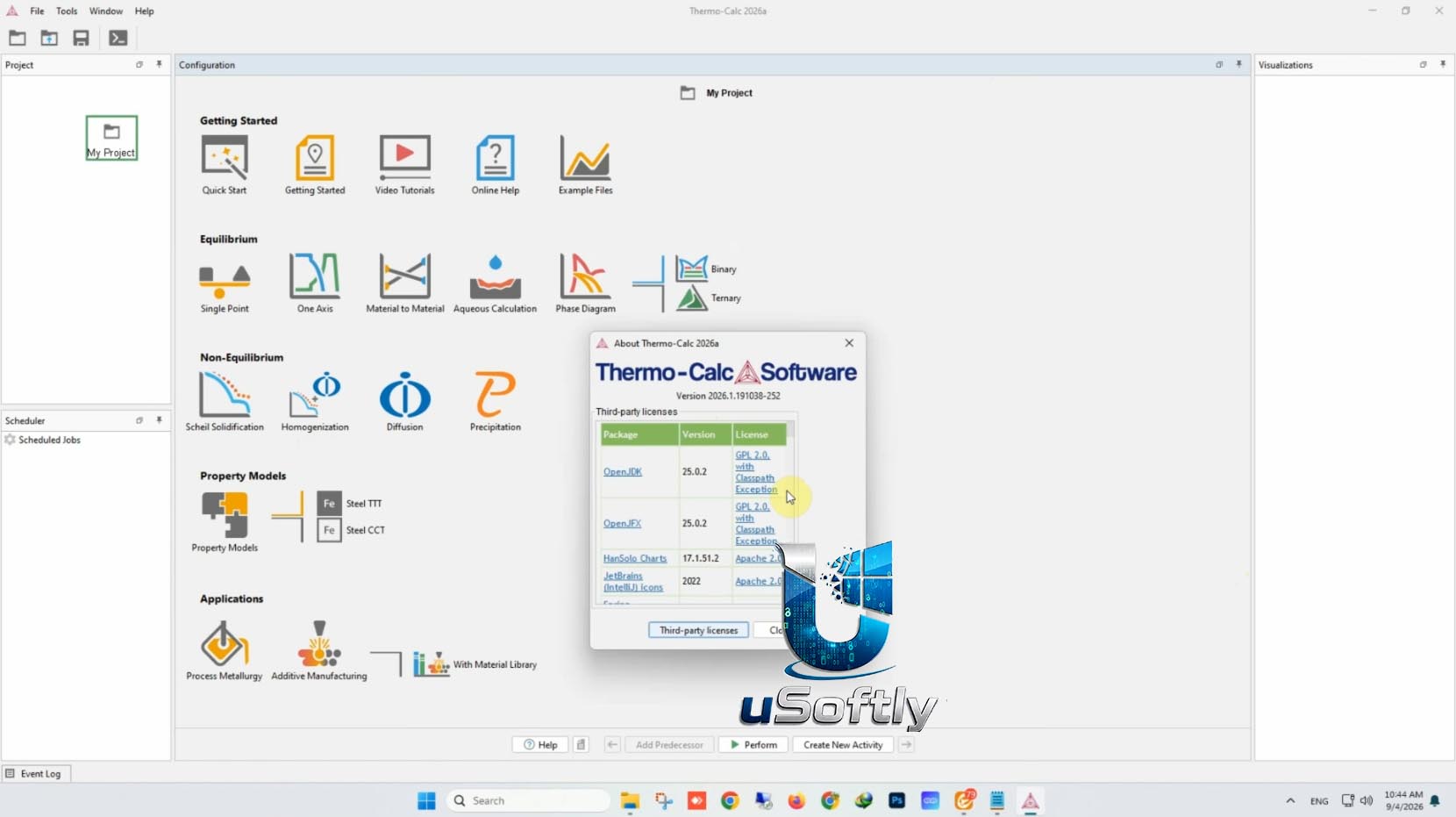
ThermoCalc 2026a – Powerful Software for Thermodynamic and Phase Diagram Calculations
Thermo-Calc is the world-leading software for thermodynamic calculations based on the CALPHAD (CALculation of PHAse Diagrams) method. It is a powerful platform that integrates a robust calculation engine with a large selection of high-quality, critically assessed thermodynamic and kinetic databases.
The 2026a release is a major update that introduces new calculators, significantly expanded databases, and enhanced performance across multiple modules.
Installation Guide
Primary Users
Thermo-Calc 2026a is designed for materials scientists, metallurgists, chemists, and engineers in both academic and industrial R&D settings. It serves professionals who need to:
-
Calculate thermodynamic properties and phase diagrams for multi-component systems to understand material behavior at different temperatures and compositions
-
Simulate and optimize materials processing, including solidification, heat treatment, and additive manufacturing, to reduce experimental trial and error
-
Predict material properties such as phase fractions, transformation temperatures, driving forces, diffusion coefficients, and thermophysical properties
-
Model complex kinetic phenomena like diffusion, precipitation, and phase transformations using add-on modules
-
Select optimal materials and process parameters for a wide range of applications, from steels to high-entropy alloys
Key Features & Capabilities
1. New Aqueous Calculator for Corrosion Studies
This release introduces a user-friendly Aqueous Calculator in the Graphical Mode, making it much easier to set up advanced corrosion calculations, including Pourbaix diagrams . Previously, these calculations were complex and mainly accessible in Console Mode. The new calculator is designed to be used with the redesigned TCAQ4 Aqueous Solutions Database, which includes thousands of phases and eliminates the previous need to append multiple databases.
2. Additive Manufacturing Module Enhancements
The Additive Manufacturing Module now includes a new heat source for Electron Beam Melting (EBM). This addition expands the software’s capabilities for simulating and optimizing this important 3D printing technique
3. Precipitation Module (TC-PRISMA) Updates
Two new settings have been added to the Precipitation Module to significantly reduce simulation file sizes and speed up post-processing time, improving workflow efficiency for studies involving precipitates
4. Diffusion Module (DICTRA) and Process Metallurgy Updates
The Diffusion Module has been updated to allow mobility adjustments directly in Graphical Mode, offering greater control over simulations . The Process Metallurgy Module has also been updated to be compatible with the new database versions
5. Steel Model Library Performance Improvement
The Steel Model Library’s CCT (Continuous Cooling Transformation) Diagram Model now includes a new custom setting that can speed up calculation times for simulations of competing morphology growth
6. 8 New Database Versions
The 2026a release comes with updates to 8 key databases , expanding the range of materials and properties that can be modeled:
-
Aqueous Solutions (TCAQ4): A complete redesign for corrosion studies
-
Steel and Fe-Alloys (TCFE15 & MOBFE9): Adds 12 new elements and significant improvements for modeling tramp elements in steels
-
Permanent Magnetic Materials (TCPMAG3): Enables modeling of SmCo-based magnets and adds thermophysical properties like electrical resistivity and thermal conductivity
-
Titanium and TiAl-based Alloys (TCTI7 & MOBTI6): Adds 12 new elements to expand applicability for novel functional materials
-
Metal Oxide Solutions (TCOX15): A new version for slag and oxide systems
-
High Entropy Alloys (MOBHEA4): The mobility database now includes oxygen, important for understanding the behavior of these complex alloys





Reviews
There are no reviews yet.