

Download V-Ray Next 4.30.23 for Unreal Engine 4.23-4.25 – Advanced Photorealistic Rendering Integration
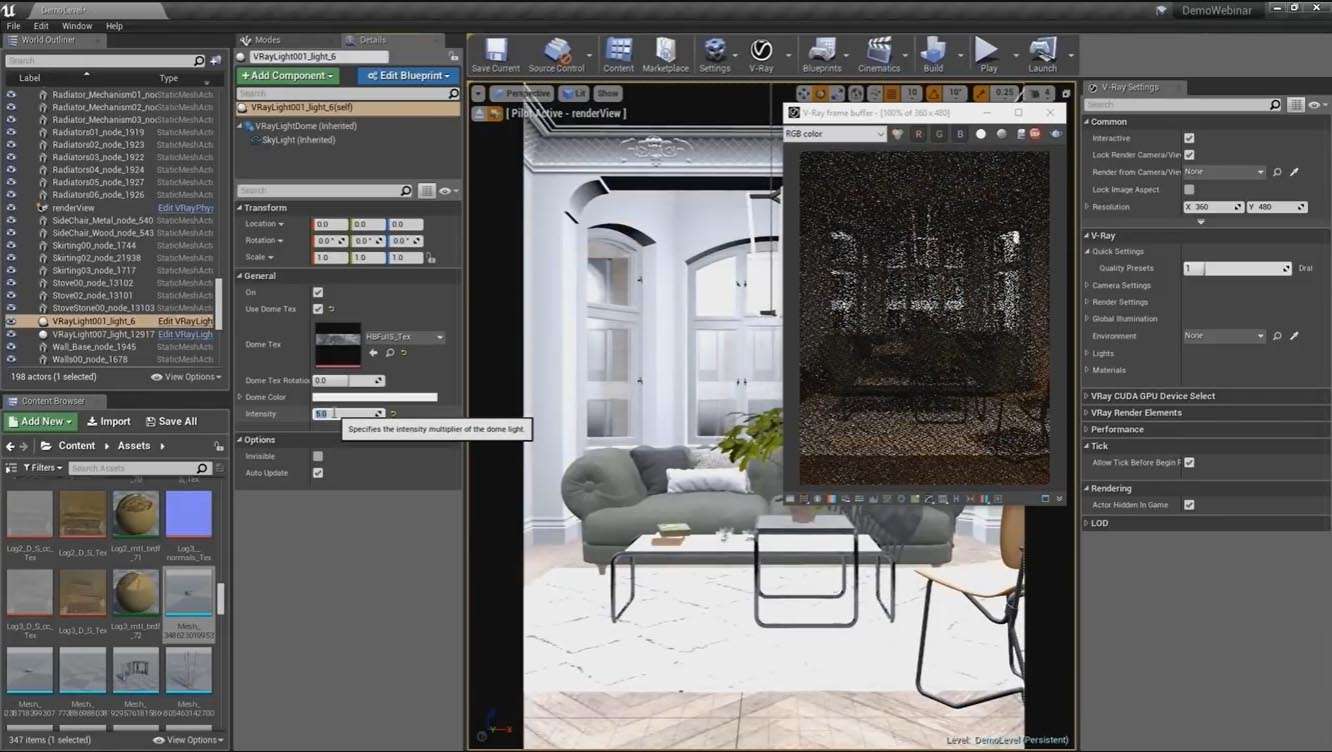
V-Ray Next 4.30.23 is a specialized rendering plugin developed by Chaos, designed to deeply integrate Chaos’s industry-leading photorealistic rendering capabilities into Unreal Engine versions 4.23 through 4.25. This plugin enables a hybrid rendering workflow, allowing professionals in architectural visualization, virtual production, automotive design, product visualization, VFX, and game development to leverage both real-time interactivity and production-quality path tracing within the familiar Unreal Editor environment. Its purpose is to bridge the gap between interactive visualization and photorealistic rendering, streamlining workflows for complex visual projects.
V-Ray Next Integration in Unreal Engine: Hybrid Rendering for Real-Time and Production Quality
The V-Ray Next plugin for Unreal Engine facilitates a powerful hybrid rendering approach. It allows users to harness Unreal Engine’s real-time capabilities for interactive scene exploration, design iteration, and VR experiences, while simultaneously providing access to V-Ray’s advanced offline rendering engine for photorealistic outputs. This seamless integration within the Unreal Editor environment means that professionals can switch between these modes fluidly, optimizing their pipeline from initial design to final render. The plugin is specifically engineered to exploit this synergy, offering a unified platform for diverse visualization needs.
Advanced Lighting and Material Systems Empowering Photorealism
- The plugin offers comprehensive V-Ray material and shader support, enabling the realistic representation of complex surfaces. This includes advanced shaders such as car paint finishes and subsurface scattering for translucent materials.
- Lighting tools are robust, featuring V-Ray Sun & Sky for naturalistic daylight simulation, dome lights for image-based lighting with HDRI, and the ability to import and utilize photometric lighting data for accurate scene illumination.
- Advanced Global Illumination algorithms, including Brute Force and Light Cache, are available for simulating indirect lighting, creating more natural and immersive environments. The system also supports the simulation of realistic caustics for light refractions and reflections.
Efficient Workflow with Direct .vrscene Import and Performance Enhancements
V-Ray Next for Unreal Engine streamlines the asset pipeline through direct import of .vrscene files. This feature significantly enhances workflow efficiency by allowing users to bring scenes created in industry-standard applications like 3ds Max, Maya, SketchUp, and Rhino directly into Unreal Engine. The import process maintains visual fidelity, preserving materials, lighting, and camera settings. Furthermore, version 4.30.23 includes performance optimizations such as faster scene loading times, improved material translation accuracy, and enhanced GPU rendering capabilities, accelerating the overall production process.
Application Scenarios Across Industries and Creative Fields
- Architectural visualization professionals can create immersive and interactive walkthroughs, and virtual reality experiences with stunning visual fidelity.
- Virtual production teams can integrate V-Ray’s rendering precision into real-time LED volume setups, achieving photorealistic backgrounds and virtual sets for film and broadcast.
- Automotive and product visualization studios can develop dynamic, photorealistic configurators and marketing renders that showcase designs with exceptional detail.
- VFX artists can utilize the plugin for pre-visualization tasks and for producing pixel-exact final rendering outputs that match offline render quality.
- Game developers can integrate V-Ray for rendering high-quality cinematic cutscenes or specific in-game elements where absolute photorealism is paramount, enhancing visual storytelling.
Latest Updates and Improvements in Version 4.30.23
Version 4.30.23 introduces several targeted improvements for V-Ray Next for Unreal Engine. These include enhanced compatibility with Unreal Engine’s evolving versions, specifically improving material translation from DCC applications into the Unreal Engine environment. User interface enhancements contribute to a more intuitive experience within the Unreal Editor. Additionally, this release offers expanded GPU rendering support, providing faster render times for users leveraging NVIDIA CUDA-enabled graphics cards and accelerating the iterative design process.
Frequently Asked Questions
How does V-Ray Next enhance rendering quality within Unreal Engine?
V-Ray Next integrates production-quality path-traced rendering into Unreal Engine’s real-time environment, allowing users to switch between fast interactive previews and high-quality final renders. It provides advanced lighting, materials, and global illumination algorithms for photorealistic visual fidelity.
Which versions of Unreal Engine are compatible with V-Ray Next 4.30.23?
V-Ray Next 4.30.23 is fully compatible with Unreal Engine versions 4.23 through 4.25, with optimized performance and stability improvements for UE 4.24 and 4.25.
Can V-Ray scenes from other software be directly used within Unreal Engine using this plugin?
Yes, V-Ray Next allows direct import of .vrscene files created in 3ds Max, Maya, SketchUp, and Rhino, maintaining full visual fidelity and enabling seamless workflow integration.






Reviews
There are no reviews yet.