

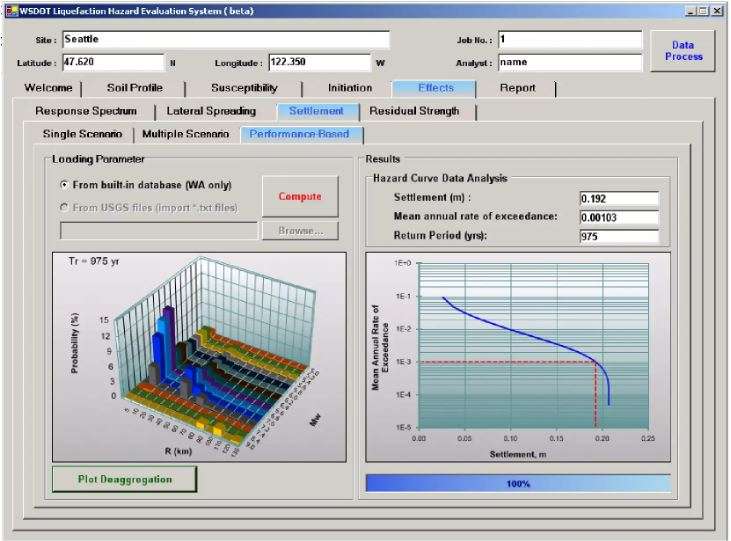
Download WSDOT Wsliq 1.0 – Advanced Soil Liquefaction Analysis Tool
WSDOT Wsliq 1.0 is a specialized civil engineering software developed by the Washington State Department of Transportation (WSDOT) for performing comprehensive soil liquefaction analysis. This tool is designed to assist geotechnical and civil engineers in evaluating the risks and potential impacts of soil liquefaction, a critical phenomenon that occurs during seismic activities. By understanding these risks, professionals can enhance the structural safety of infrastructure in earthquake-prone areas.
Understanding Soil Liquefaction and Its Risks
The Phenomenon of Liquefaction
Soil liquefaction is a process where saturated granular soils, such as sands and silts, lose their shear strength and stiffness under rapid cyclic loading, often induced by earthquakes. When liquefaction occurs, the soil behaves like a viscous liquid, leading to a loss of bearing capacity. This phenomenon can cause significant ground deformation, settlement, and lateral spreading, posing severe risks to foundations and overlying structures.
Importance in Civil Engineering
Studying liquefaction is crucial in the design of civil engineering projects, especially in seismic zones. Geotechnical engineers must assess the liquefaction potential of soil sites to ensure the stability and safety of buildings, bridges, dams, and other critical infrastructure. Failure to account for liquefaction can lead to catastrophic structural failures during seismic events, underscoring the necessity of advanced analysis tools like Wsliq.
Main Features of WSDOT Wsliq 1.0
Comprehensive Soil Profile Modeling
Wsliq allows engineers to define detailed soil profiles, accurately representing the subsurface conditions. Users can input data for various soil layers, including their thickness, material type, and relevant geotechnical properties. The software provides visualization tools to help engineers understand and review the layered soil structure.
Liquefaction Susceptibility Assessment
The software integrates multiple established models to assess the potential for liquefaction initiation. This assessment is based on a combination of soil characteristics, such as grain size distribution and relative density, and site-specific seismic conditions. Wsliq helps quantify the likelihood of liquefaction occurring under expected seismic loads.
Initiation Predictions Based on Seismic Activity
Wsliq offers capabilities to predict the onset of liquefaction by analyzing seismological data. The software considers factors like earthquake magnitude, peak ground acceleration, and duration of shaking to estimate when liquefaction thresholds might be reached. This predictive power is vital for dynamic risk assessments.
Impact Evaluation of Liquefaction
Beyond predicting initiation, Wsliq evaluates the potential consequences of liquefaction. The software can model the effects of soil-structure interaction under liquefied conditions, assessing potential settlement, lateral displacement, and reductions in bearing capacity. This helps engineers design appropriate mitigation strategies to protect structural integrity.
Applications of Wsliq in Civil Engineering
Case Studies and Practical Use Cases
Wsliq can be applied to a wide range of civil engineering projects, including the design of new buildings, bridges, and transportation infrastructure in seismically active regions. For instance, it can be used to assess the liquefaction risk for a proposed bridge foundation or to evaluate the stability of slopes and levees susceptible to seismic-induced liquefaction. The software aids in making informed decisions regarding foundation type, ground improvement techniques, and structural design parameters to ensure resilience.
Integration with Other Engineering Tools
While Wsliq focuses on specialized liquefaction analysis, its output can be integrated with broader civil and geotechnical engineering workflows. Data generated by Wsliq, such as soil profiles and seismic parameters, can inform analyses performed in other software packages used for structural design, seismic hazard analysis, or groundwater modeling. This compatibility ensures a cohesive approach to complex infrastructure projects.
Comparative Considerations with Similar Software
Compared to more general-purpose geotechnical analysis tools, WSDOT Wsliq 1.0 provides a focused approach to soil liquefaction analysis. Its strength lies in its specialized models and its development within the context of WSDOT’s engineering practices, potentially offering outputs tailored to regional considerations and specific regulatory requirements. While other software might offer broader geotechnical capabilities, Wsliq’s dedicated functionality ensures depth in liquefaction risk assessment.
Conclusion and Recommendations
Next Steps for Downloading and Using the Software
WSDOT Wsliq 1.0 serves as an indispensable tool for civil and geotechnical engineers involved in seismic risk assessment. Its detailed modeling capabilities for soil liquefaction analysis help ensure the development of safer and more resilient infrastructure. Engineers seeking to mitigate earthquake-related ground failure risks should consider incorporating Wsliq into their design process.
Frequently Asked Questions
What is the primary function of WSDOT Wsliq 1.0?
WSDOT Wsliq 1.0 is a software tool designed for soil liquefaction analysis, helping engineers evaluate the risks associated with the liquefaction of soil during seismic activities. It provides essential insights for improving structural safety in earthquake-prone environments.
How does Wsliq determine liquefaction susceptibility?
Wsliq utilizes various established models to assess liquefaction potential based on factors such as soil profile characteristics, historical earthquake data, and site-specific conditions. It combines these inputs to quantify the likelihood of liquefaction occurring under seismic loading.
In what fields can WSDOT Wsliq 1.0 be applied?
Wsliq is primarily used in civil engineering, specifically within geotechnical applications, where analysis of soil behavior during earthquakes is critical for infrastructure safety. Its applications are crucial for projects involving foundations, slopes, and earth structures in seismically active zones.





Reviews
There are no reviews yet.