

Download X-Ability Winmostar 11.15 – Molecular Modeling and Quantum Chemistry Software
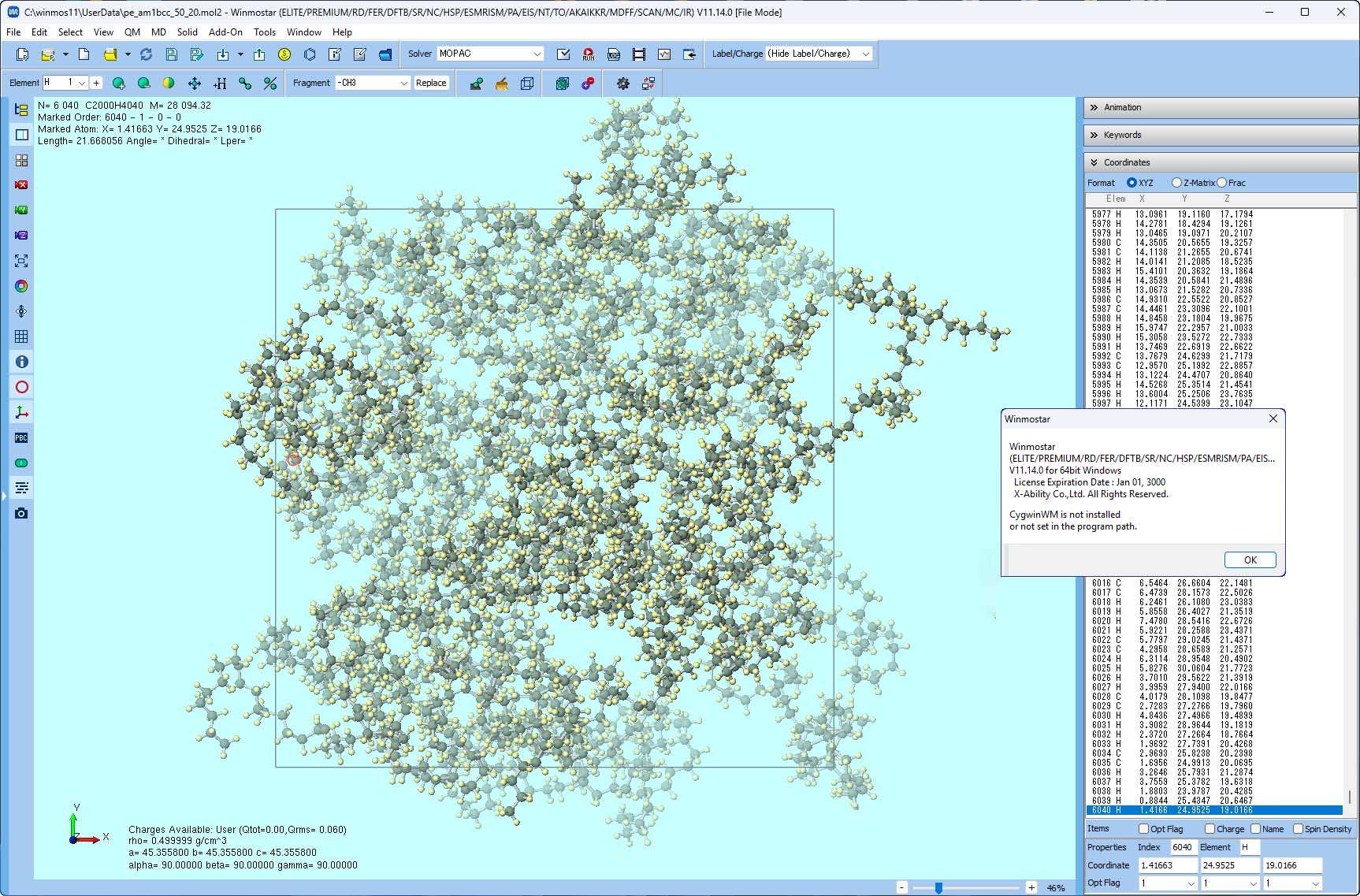
X-Ability Winmostar 11.15 is a comprehensive graphical user interface (GUI) designed for molecular modeling and quantum chemistry simulations. Developed as a versatile platform, it acts as a unified front-end for several powerful backend computational engines. This software is instrumental for chemists, materials scientists, physicists, and researchers engaged in advanced scientific simulations and data analysis.
Overview of X-Ability Winmostar and Its Role in Computational Chemistry
Winmostar serves as a crucial tool in computational chemistry, bridging the gap between complex theoretical calculations and user-friendly operation. It simplifies the process of setting up, running, and analyzing simulations involving molecular and crystal structures. By integrating multiple leading computational engines, Winmostar provides researchers with a flexible and efficient environment for exploring chemical phenomena at the atomic and molecular level.
Integrated Simulation Engines and Supported Computational Methods
A key strength of X-Ability Winmostar is its extensive support for a variety of computational engines, enabling a broad spectrum of scientific calculations. The software facilitates structured workflows for both quantum chemistry and molecular dynamics simulations through its integrated backends:
- GAMESS (General Atomic and Molecular Electronic Structure System): Widely used for ab initio quantum chemistry calculations, enabling the study of molecular electronic structures and reaction pathways.
- MOPAC (Molecular Orbital Package): A semi-empirical quantum chemistry calculation software package beneficial for rapid estimations of molecular properties and geometries.
- Quantum ESPRESSO: An integrated suite of open-source computer codes for electronic-structure calculations and materials modeling using density-functional theory, density-functional perturbation theory, and more.
- LAMMPS (Large-scale Atomic/Molecular Massively Parallel Simulator): A widely recognized molecular dynamics simulator for materials science applications, capable of parallel execution.
- GROMACS (GROningen MAchine for Chemical Simulations): A high-performance molecular dynamics simulation package, often used for biomolecular systems and materials.
This multi-engine support allows researchers to select the most appropriate computational method for their specific problem without needing to learn and interface with each standalone program individually.
Graphical Interface for Structure Creation and Calculation Setup
Winmostar’s intuitive graphical user interface (GUI) significantly streamlines the preparation of simulation inputs. Users can visually create and edit molecular and crystal structures without the need for manual text file manipulation, which is common in standalone computational chemistry tools. The GUI provides tools for:
- Drawing and manipulating 3D molecular structures.
- Building and refining crystal lattices.
- Setting up quantum chemistry calculation parameters, such as basis sets, functionals, and SCF convergence criteria.
- Configuring molecular dynamics simulation parameters, including force fields, boundary conditions, and thermostat/barostat settings.
This design accelerates the initial phases of research, making complex simulations more accessible to a wider range of scientific professionals.
Advanced Visualization and Analysis of Simulation Results
Interpreting simulation outcomes is critical in scientific research, and X-Ability Winmostar offers robust visualization capabilities to analyze various physical quantities derived from calculations. The software can graphically represent:
- Spectra, including infrared (IR) and ultraviolet-visible (UV-Vis) absorption spectra.
- Electronic band structures and density of states (DOS) plots for solid-state materials.
- Thermodynamic properties and reaction profiles.
- Electron density distributions and molecular orbitals.
- Output from molecular dynamics simulations, such as trajectories, radial distribution functions, and temperature plots.
These visualization tools aid in understanding complex data, validating theoretical models, and drawing meaningful scientific conclusions.
Automation and Workflow Management for Efficient Research
Efficiency is paramount in modern scientific research, and Winmostar incorporates features for automation and workflow management. The software handles file management tasks and allows seamless switching between different computational resources, supporting both local computations and remote execution on high-performance computing (HPC) clusters. This functionality enables researchers to:
- Submit jobs to remote servers without manual file transfer or command-line operations.
- Manage calculation queues and monitor job progress.
- Automate repetitive tasks, thereby saving valuable researcher time.
- Run demanding simulations that may exceed the capabilities of local hardware.
By integrating these automation capabilities, Winmostar enhances productivity and allows scientists to focus on interpretation and discovery.
Applications and Case Studies in Scientific Research
X-Ability Winmostar is applied across various scientific disciplines that rely on molecular simulation and computational analysis. Its versatility makes it suitable for a wide array of research projects, including:
- Investigating reaction mechanisms and transition states in chemistry.
- Predicting material properties, such as electronic, optical, and mechanical characteristics.
- Studying the behavior of biomolecules and their interactions.
- Designing new materials with specific functionalities.
- Analyzing spectroscopic data to characterize chemical compounds.
- Exploring thermodynamic stabilities and phase transitions.
The software empowers researchers to tackle complex problems by providing a unified platform for diverse simulation methodologies, facilitating deeper insights into chemical and physical systems.
Frequently Asked Questions
What computational engines does Winmostar support?
Winmostar supports several powerful computational engines including GAMESS, MOPAC, and Quantum ESPRESSO for quantum chemistry calculations, and LAMMPS and GROMACS for molecular dynamics simulations. This allows diverse simulation types within one interface, offering flexibility for various research needs.
Can Winmostar run calculations on remote servers?
Yes, Winmostar enables users to run calculations locally or remotely on computing servers. This capability is crucial for utilizing high-performance computing resources, facilitating complex and large-scale simulations that might not be feasible on standard desktop hardware.
What types of results and properties can Winmostar visualize?
Winmostar can visualize a wide range of physical quantities such as infrared and UV-Vis spectra, band structures, density of states, thermodynamic properties, electronic densities, and molecular dynamics distributions. These visualization features are essential for interpreting and validating simulation outputs effectively.







Reviews
There are no reviews yet.