

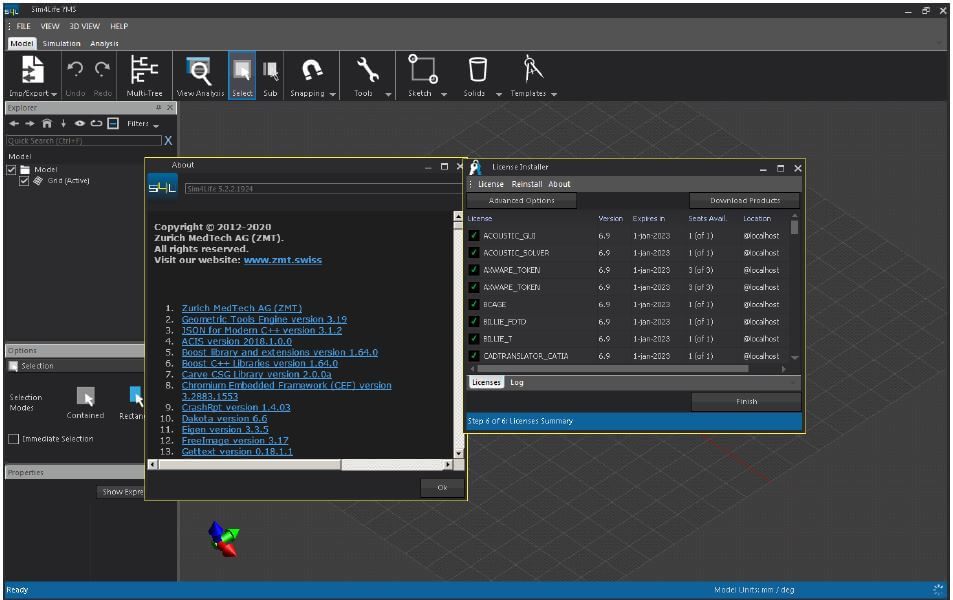
Download ZMT Sim4Life 2025 v9.0 – Advanced Multiphysics Simulation Platform for Medical Applications
ZMT Sim4Life 2025 v9.0 is a specialized multiphysics simulation platform designed by ZMT Zurich MedTech AG for advanced applications in biomedical engineering and medical device development. This powerful software integrates various physical simulation capabilities to enable researchers and developers to accurately model the complex interactions between medical devices, therapies, and biological systems. Its advanced computational approach is critical for innovation in the life sciences sector.
Key Multiphysics Capabilities
ZMT Sim4Life offers an integrated environment for a wide range of physics simulations essential for medical research and product development. These capabilities allow for comprehensive analysis of device performance and biological responses.
- Electromagnetic Solver: Facilitates detailed simulations of electromagnetic fields, crucial for analyzing exposure from medical devices like MRI scanners and therapeutic applicators.
- Thermal Solver: Enables the simulation of heat transfer and temperature distribution, vital for assessing thermal effects of medical devices on tissues.
- Acoustic Solver: Supports the modeling of acoustic wave propagation and interactions, relevant for ultrasound-based therapies and diagnostic imaging.
- Particle Transport: Allows for simulations of particle dynamics, such as radiation therapy or nanoparticle drug delivery, providing insights into their behavior within biological environments.
Integration with Anatomical Models
A core strength of ZMT Sim4Life lies in its robust integration with detailed anatomical and physiological models. This integration is fundamental for creating realistic and patient-specific simulations.
- Virtual Population (ViP): ZMT Sim4Life incorporates extensive anatomical and physiological models that represent a diverse virtual population, enabling studies on varied patient demographics.
- Tissue Properties Database: The software includes a comprehensive database of tissue electromagnetic and thermal properties, ensuring simulation accuracy when modeling interactions with different biological materials.
- Patient-Specific Modeling: Users can import patient scan data (e.g., MRI, CT) to create highly personalized models, enhancing the relevance of simulation outcomes for individual patient care.
Innovative Features in Version 9.0
The latest release, ZMT Sim4Life 2025 v9.0, introduces several cutting-edge features designed to accelerate research and improve the accuracy of medical computations.
- AI-Powered Model Reduction: This feature leverages artificial intelligence to create reduced-order models from full simulations, significantly speeding up parameter studies and optimization tasks.
- Digital Twin Capabilities: Advanced digital twin functionalities allow for the creation of virtual replicas of patients or devices, integrating real-world data for enhanced predictive analysis and personalized treatment planning.
- Quantum Biology Extension: For specialized research, this version offers extensions to explore quantum mechanical effects in biological systems, opening new avenues for fundamental scientific inquiry.
- Organ-on-Chip Simulation: ZMT Sim4Life supports the simulation of microfluidic devices and cell-based assays, aiding in the development of organ-on-chip technologies for drug testing and disease modeling.
Applications in Medical Device Development
ZMT Sim4Life is instrumental in addressing complex challenges across the entire lifecycle of medical device development, from early concept to regulatory approval.
- MRI Safety Analysis: Ensuring the safe operation of medical devices in or near MRI environments by simulating electromagnetic field interactions and potential heating effects.
- Neuromodulation Studies: Modeling the effects of electrical or magnetic stimulation on neural tissues for the design and optimization of devices used in deep brain stimulation or pain management.
- Drug Delivery Systems: Simulating the transport and efficacy of targeted drug delivery mechanisms, including nanoparticles and infusion pumps, within specific anatomical regions.
- Implantable Devices: Analyzing the performance and biological interaction of implantable sensors, pacemakers, and other electronic medical devices.
Regulatory and Clinical Tools
The platform is equipped with specialized tools to support the rigorous demands of medical device research, development, and regulatory compliance.
- Compliance Support: ZMT Sim4Life provides features that align with regulatory requirements from bodies like the FDA and European authorities, facilitating the documentation and validation processes.
- Clinical Trial Preparation: Its advanced modeling and simulation capabilities can support the design of clinical trials by predicting device performance and patient responses, potentially reducing the need for extensive in vivo testing.
- Pre-Clinical Assessment: The software enables thorough pre-clinical evaluation of device safety and effectiveness through validated computational methods.
Conclusion
ZMT Sim4Life 2025 v9.0 stands as a pivotal tool for advancing medical technologies. By enabling sophisticated multiphysics simulations, integrating anatomical accuracy with innovative AI-driven features, and supporting regulatory compliance, it empowers biomedical engineers and researchers to accelerate the development of novel medical devices and treatments, ultimately improving patient outcomes.
Frequently Asked Questions
What industries can benefit from ZMT Sim4Life?
ZMT Sim4Life is primarily used in biomedical engineering, particularly among medical device developers, pharmaceutical researchers, and regulatory specialists. It is suitable for any field that requires advanced simulation of medical technologies and their interactions with biological systems, ensuring a broad applicability for specialized research.
How does AI improve the capabilities of ZMT Sim4Life?
The latest version incorporates AI-powered model reduction, which allows for the rapid generation of reduced-order models from full simulations. This innovation significantly speeds up parameter studies and complex analyses, improving overall efficiency and making intricate simulations more feasible within practical timelines.
What is the significance of the digital twin feature in Sim4Life?
The digital twin feature of ZMT Sim4Life integrates clinical imaging with personalized modeling, which aids in customized treatment planning and enhances the predictive accuracy of medical simulation outcomes. This allows for a more tailored approach to patient care and device evaluation.







Reviews
There are no reviews yet.