

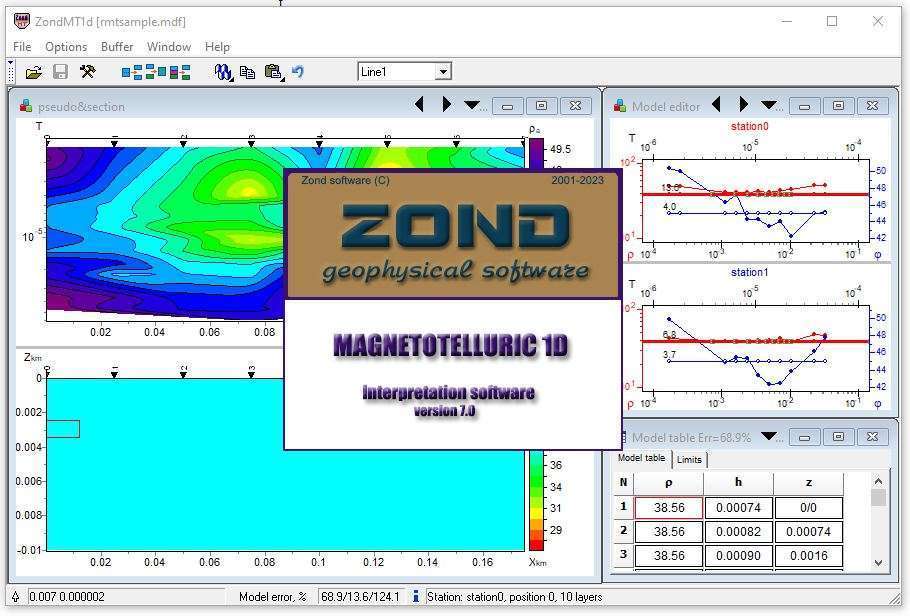
Download ZondMT 1D 7.0 – Advanced Magnetotelluric Data Interpretation Tool
ZondMT 1D 7.0 is a specialized geophysical software developed by Zond Software, designed for the one-dimensional inversion of magnetotelluric (MT) data. This tool is essential for geophysics professionals and researchers engaged in geological exploration and environmental studies, providing detailed assessments of the Earth’s subsurface electrical resistivity. The primary goal of ZondMT 1D download is to offer a powerful platform for accurate geophysical modeling and magnetotelluric data interpretation.
Overview of ZondMT 1D
Purpose and Functionality
ZondMT 1D is engineered for the in-depth analysis of magnetotelluric (MT) data, a geophysical exploration technique that uses natural electromagnetic fields to image subsurface structures. Its core function is to perform one-dimensional inversion, transforming measured electromagnetic field data into a profile of electrical resistivity values. This process is crucial for understanding geological formations, identifying mineral deposits, and assessing environmental subsurface conditions. The software leverages the principles of electromagnetic wave propagation and the skin effect to determine resistivity at various depths based on frequency analysis.
Key Features and Capabilities
Inversion Algorithms and Customization
The software offers a range of inversion algorithms to suit diverse geological scenarios and data qualities. Users can select from methods such as smoothed inversion, which creates a geologically plausible resistivity model, and focusing inversion, designed to enhance the resolution of vertical boundaries within geoelectrical models. ZondMT 1D enables extensive customization of inversion settings, allowing professionals to incorporate a priori geological information, define model constraints, and adjust parameters to optimize the geophysical models derived from the data.
Data Handling and Formats Support
ZondMT 1D demonstrates significant versatility in handling geophysical data. It supports a wide array of common data formats, including EDI, USF, MT, AVG, and J formats, facilitating seamless integration into existing geophysical workflows. The software is capable of processing both natural source magnetotellurics (NSAMT) and controlled source audio-magnetotellurics (CSAMT) data. This broad compatibility ensures that users can import data from various sources and instruments with minimal preprocessing, enhancing the efficiency of magnetotelluric data interpretation.
Real-World Applications
Geological and Environmental Studies
In geological surveys, ZondMT 1D is instrumental in mapping subsurface stratigraphy, identifying potential hydrocarbon reservoirs, and detecting conductive ore bodies. Environmental applications include assessing groundwater contamination plumes, mapping landfill sites, and studying the effects of subsurface pollution. For academic research projects, the software provides a robust platform for exploring complex geological structures and validating geophysical theories through precise electrical resistivity modeling.
Integration with Other Zond Software
ZondMT 1D is part of a suite of geophysical software solutions developed by Zond Software. It can be integrated with other tools, such as ZondST (for 2D magnetotelluric inversion) and ZondVES (for vertical electrical sounding analysis), to enable comprehensive, multi-dimensional geophysical investigations. This integration allows for cross-validation of results and a more holistic understanding of subsurface properties when combining different electromagnetic and electrical methods.
Visualization and Reporting Tools
Data Presentation Features
Effective visualization is central to ZondMT 1D’s functionality, providing users with multiple tools to analyze and present their findings. The software offers detailed plots of apparent resistivity and phase, impedance tensors, and inversion outputs, including resistivity cross-sections and depth profiles. Advanced features for noise suppression and the modeling of geological boundaries are integrated into the visualization process. While primarily facilitating 1D inversion, the results can be compiled to give insights that contribute to geological section visualizations.
User Experience and Interface Design
ZondMT 1D prioritizes user comfort and accessibility without compromising its advanced capabilities. The software features an intuitive graphical user interface that simplifies complex geophysical analysis tasks. Setup for new users is streamlined, with clear options for data import, parameter selection, and inversion execution. The deliberate design aims to make sophisticated magnetotelluric data interpretation accessible to both experienced geophysicists and those new to the field, supported by clear presentation of geophysical models.
Conclusion
ZondMT 1D 7.0 stands as a comprehensive and user-friendly tool for professionals involved in geophysical exploration and scientific research. Its advanced inversion algorithms, extensive data format support, and robust visualization capabilities make it an invaluable asset for accurate electrical resistivity modeling and magnetotelluric data interpretation. For those seeking reliable geophysical software to undertake detailed subsurface analysis, exploring the functionalities offered by ZondMT 1D is highly recommended.
Frequently Asked Questions
What types of data formats does ZondMT 1D support?
ZondMT 1D supports various data formats, including EDI, USF, MT, AVG, and J formats, allowing for integration with other geophysical data systems. This broad compatibility ensures that data from different acquisition instruments and processing software can be readily imported for analysis within the ZondMT 1D environment, simplifying the workflow for users with diverse data sources.
How does ZondMT 1D handle noise in data interpretation?
ZondMT 1D incorporates robust noise suppression techniques and models to enhance data quality during the inversion process, which improves accuracy in results. The software includes tools for identifying and mitigating outliers and systematic errors in the magnetotelluric data, leading to more reliable geophysical models and interpretations of subsurface electrical resistivity.
Can ZondMT 1D perform joint inversions with other methods?
Yes, ZondMT 1D can conduct joint inversions using data from other sources, such as VES data, improving the reliability of geological interpretations. This capability allows geophysicists to integrate information from different electromagnetic and electrical methods, creating a more robust and comprehensive understanding of the subsurface geology than what could be achieved with a single data type.






Reviews
There are no reviews yet.