

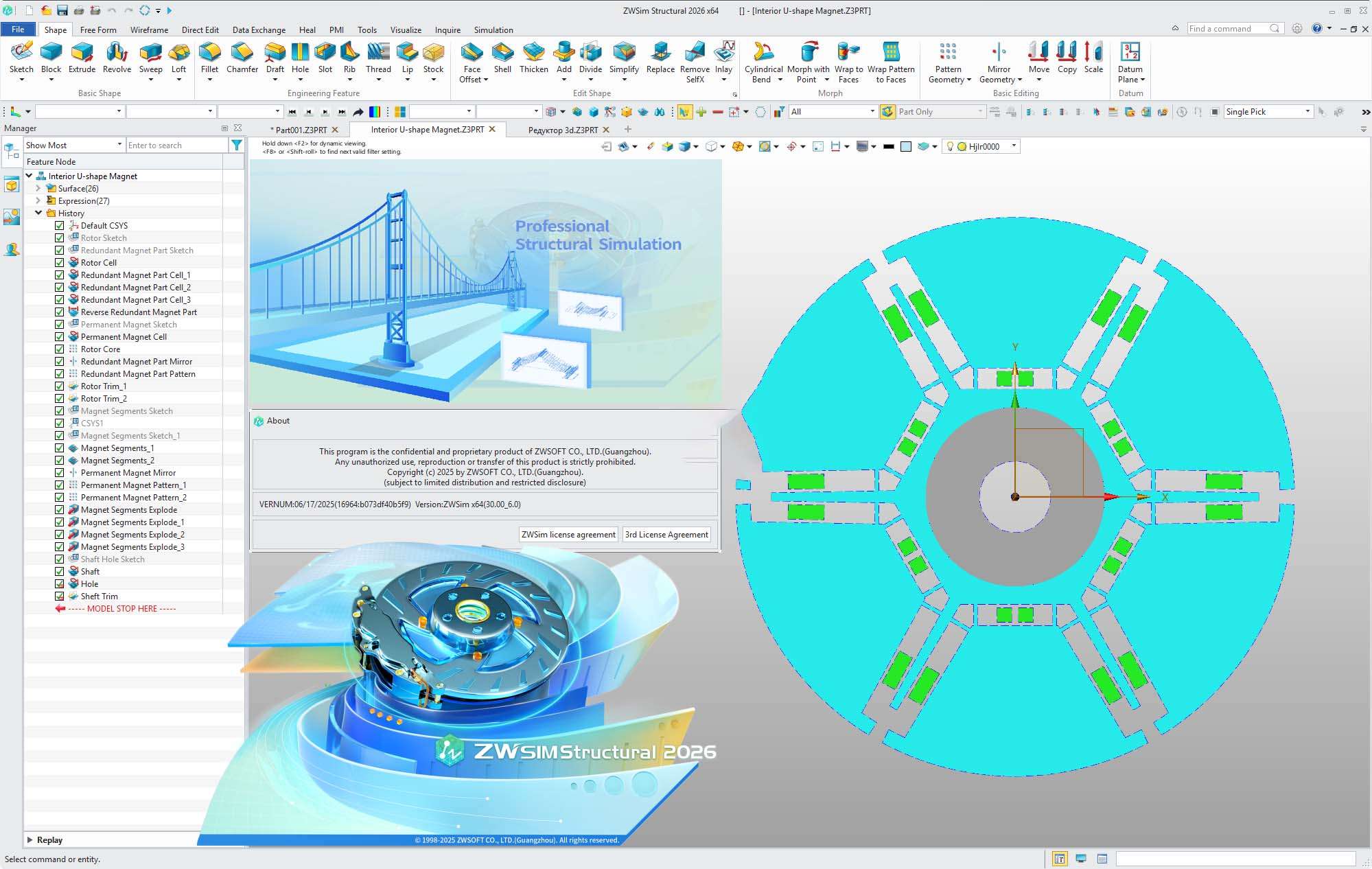
Download ZwSoft ZWSim Structural 2026 – Advanced Finite Element Structural Analysis Software
ZwSoft ZWSim Structural 2026 is an advanced Computer-Aided Engineering (CAE) application developed by ZwSoft, specifically designed for structural analysis using the finite element method (FEM). This software is a critical tool for professionals in civil engineering, construction, and mechanical engineering, enabling comprehensive simulation of structural strength and behavior. ZWSim Structural distinguishes itself by integrating geometry modeling and simulation environments, streamlining the workflow from design to analysis.
Overview of ZwSoft ZWSim Structural and Its Role in Civil Engineering
Developed by ZwSoft, a company recognized for its CAD and CAE solutions, ZWSim Structural 2026 serves as a powerful platform for engineers to predict how structures will perform under various conditions. In civil engineering, it is instrumental in assessing the stability and integrity of buildings, bridges, and other infrastructure. The software’s integrated approach allows engineers to seamlessly transition between creating or modifying structural designs and performing detailed finite element analyses, thereby enhancing efficiency and reducing potential errors in the design process.
Comprehensive Linear and Nonlinear Structural Analysis Capabilities
ZWSim Structural 2026 offers a wide array of analytical tools to thoroughly evaluate structural integrity. It supports fundamental linear analyses, including static load cases, stability assessments to predict buckling, modal analysis for understanding natural frequencies and vibration characteristics, and spectral response analysis for seismic or dynamic events. Beyond linear behavior, the software delves into complex nonlinear analyses. These capabilities are essential for simulating scenarios involving large deformations, intricate contact interactions between components, the influence of nonlinear material properties, and the overall behavior of structures under extreme loads.
Thermal and Fatigue Analysis for Structural Performance Evaluation
To ensure complete structural reliability, ZWSim Structural 2026 provides specialized modules for thermal and fatigue simulations. Thermal load simulation capabilities allow engineers to analyze heat transfer within structures and predict the effects of thermal expansion, which can induce significant stresses. Furthermore, the software is equipped to perform fatigue life predictions, crucial for components subjected to cyclic or dynamic loading patterns, such as those found in bridges, machinery, or aerospace applications, thereby assessing the long-term durability and safety of engineered designs.
Modeling Elements, Contact Types, and Mesh Generation Features
The efficacy of any finite element analysis hinges on accurate modeling and meshing. ZWSim Structural 2026 supports a diverse range of structural elements, including beams, rods, shells, and solids, allowing for precise representation of various structural components. It features robust tools for modeling contact conditions and connections, accurately simulating how different parts interact under load. The software’s comprehensive mesh generation tools include options for 1D, 2D, and 3D meshes, as well as hybrid meshes, complemented by mesh quality control features to ensure the accuracy and reliability of the simulation results.
Visualization, Reporting, and Interoperability with Other Engineering Tools
Interpreting simulation results is made straightforward with ZWSim Structural 2026’s advanced visualization tools. Users can analyze results through sophisticated contour maps, dynamic animations, and detailed graphs, providing clear insights into structural behavior. The software also facilitates comprehensive report generation, summarizing key findings for documentation and review. Crucially, ZWSim Structural demonstrates strong interoperability, supporting over 20 file formats including Nastran BDF for import and export, enabling seamless data exchange with various CAD, CAE, and PLM systems commonly used in engineering workflows.
Real-World Applications and Case Studies in Civil Engineering and Structural Design
ZWSim Structural 2026 finds practical application across numerous engineering challenges. In civil engineering, it is employed for detailed building stability assessments, intricate bridge design analysis, and evaluating the impact of thermal loads on large structures. For construction components, its fatigue testing capabilities are vital for ensuring long-term performance and safety. Mechanical engineers also leverage the software for analyzing machine parts, complex assemblies, and systems experiencing dynamic or thermal stresses, making it a versatile tool for ensuring the reliability and safety of engineered products and infrastructure.
Frequently Asked Questions
What types of structural analyses can be performed using ZwSoft ZWSim Structural 2026?
ZWSim Structural supports a wide range of analyses including linear static, stability (buckling), modal and vibration analysis, nonlinear large deformation and contact analyses, thermal load simulations, and fatigue life assessments under cyclic loads. This comprehensive suite ensures engineers can thoroughly assess structural integrity under diverse operational and environmental conditions.
How does ZwSoft ZWSim Structural handle material definitions and composite analysis?
The software allows users to define custom material properties and maintain material libraries for easy reuse. It supports complex composite material analyses such as laminates, facilitating accurate simulations for advanced structural materials commonly found in modern engineering designs.
Can ZwSoft ZWSim Structural integrate with other CAD and CAE tools?
Yes, ZWSim Structural supports over 20 file formats, including Nastran BDF export/import, facilitating smooth data exchange and interoperability with various CAD, CAE, and PLM systems. This compatibility is key for seamless integration into existing engineering workflows.





Reviews
There are no reviews yet.