

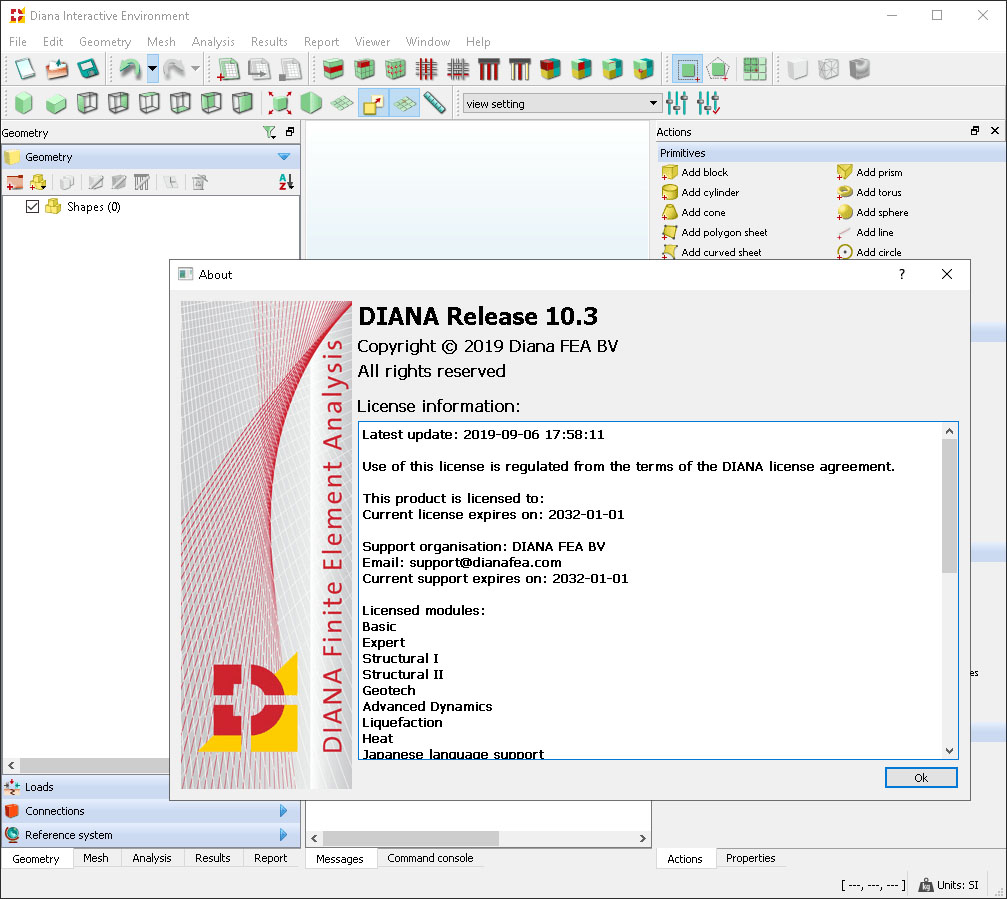
Download DIANA FEA – Advanced Finite Element Analysis Software
DIANA FEA is a specialized finite element analysis (FEA) software developed by DIANA FEA B.V. for civil and structural engineering disciplines. It is engineered to provide reliable and accurate simulations for complex challenges within geotechnical, structural, and tunneling engineering. This software is designed for engineers and researchers who require robust tools for in-depth analysis of structures and earthworks.
Introduction to DIANA FEA Software
Overview and Background
DIANA FEA has a history of providing advanced computational tools for the civil engineering sector. Developed by DIANA FEA B.V., the software plays a crucial role in enabling engineers to assess the behavior of complex structures and soil conditions. Its reliability has led to its adoption in significant engineering projects worldwide, where precise analysis is paramount for safety and efficiency.
Key Capabilities of DIANA FEA
Finite Element Simulation and Analysis
DIANA FEA offers a comprehensive suite of capabilities for performing detailed finite element simulations tailored to civil engineering demands. The software supports flexible analysis for both linear and nonlinear problems, allowing for the accurate prediction of structural responses under various loading conditions, including extreme events.
- Advanced linear and nonlinear static and dynamic analyses
- Robust capabilities for time-dependent phenomena
- Extensive element libraries for diverse structural and geotechnical modeling
Industry Applications
Geotechnical, Structural, and Tunneling Engineering
The software excels in specialized applications across critical civil engineering fields. Its features are particularly beneficial for complex projects requiring detailed geotechnical simulation, precise structural analysis, and the modeling of underground excavations.
- Geotechnical Engineering: Stability analysis of slopes, dams, and foundations; ground-structure interaction; consolidation and creep analysis.
- Structural Engineering: Analysis of bridges, high-rise buildings, and specialized structures; assessment of concrete, steel, and composite materials; performance-based design.
- Tunneling Engineering: Simulation of excavation processes; analysis of tunnel linings and soil-structure interaction; seismic response analysis of underground structures.
Modeling Features and Technical Specifications
Material Modeling and Element Libraries
DIANA FEA provides advanced modeling tools that allow engineers to represent a wide range of material behaviors with high fidelity. The software’s extensive element libraries support the construction of accurate models for diverse engineering scenarios, facilitating detailed simulations.
- Extensive library of advanced material models for concrete, soil, rock, steel, and more.
- Support for user-defined material behavior through scripting or specialized interfaces.
- A comprehensive range of finite elements, including specialized elements for shells, solids, beams, and interfaces.
- Advanced meshing capabilities for generating high-quality finite element meshes.
Software Compatibility and Integrations
CAD Integration and File Formats
To ensure seamless integration into existing engineering workflows, DIANA FEA offers compatibility with various Computer-Aided Design (CAD) applications. This interoperability allows users to import and export geometrical data, facilitating a smooth transition from design to analysis.
- Import and export of common CAD file formats (e.g., STEP, IGES).
- Direct links or interface capabilities with popular pre-processors and post-processors.
- Support for standardized data exchange formats to ensure consistency across different software packages.
Real-world Use Cases of DIANA FEA
Applications in Major Engineering Projects
DIANA FEA has been instrumental in addressing complex engineering challenges in numerous high-profile projects. Its ability to simulate intricate phenomena and provide reliable results makes it a preferred choice for demanding applications.
- Structural Analysis: Used for the design and assessment of long-span bridges, accounting for nonlinear material behavior and dynamic loads.
- Geotechnical Simulation: Applied to analyze the stability of deep excavations and tunnels in challenging soil conditions, preventing potential collapses.
- Earthquake Engineering: Employed to simulate seismic responses of critical infrastructure, ensuring resilience against seismic events, particularly relevant in geotechnically unstable regions.
Conclusion and Future Developments
DIANA FEA stands as a powerful and accurate specialized finite element analysis tool for civil engineers. Its advanced nonlinear modeling capabilities, extensive material libraries, and robust geotechnical simulation features make it indispensable for complex projects. DIANA FEA B.V. continues to develop the software, aiming to enhance its simulation accuracy, expand its application scope, and further improve user workflows to meet the evolving demands of the civil and structural engineering industries.
Frequently Asked Questions
What types of problems can DIANA FEA analyze?
DIANA FEA is capable of analyzing a diverse range of engineering problems, including structural defects, geotechnical issues, and applications in tunneling and earthquake engineering. Its versatility makes it suitable for both linear and nonlinear analyses, providing engineers with comprehensive simulation capabilities for various scenarios.
How does DIANA FEA integrate with other software?
DIANA FEA offers compatibility with various CAD software, allowing users to easily import and export design files. This integration enhances workflows by enabling seamless data transfer between design and analysis stages, ensuring that complex designs can be accurately modeled and simulated.
What makes DIANA FEA suitable for complex engineering simulations?
DIANA FEA utilizes advanced modeling techniques and element libraries tailored for precise engineering simulations. Its ability to handle various material behaviors and provide highly accurate results, particularly in nonlinear analyses and complex geotechnical scenarios, distinguishes it from other analysis tools.






Reviews
There are no reviews yet.