

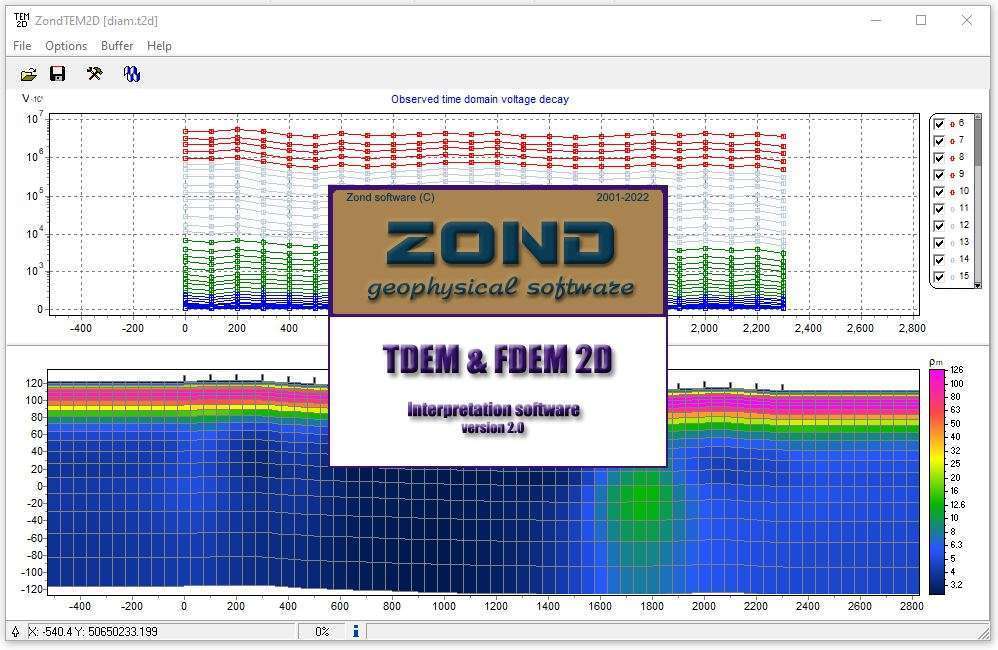
Download ZondTEM 2D – Advanced Software for Transient Electromagnetic Studies
ZondTEM 2D 2.0 2023, developed by Zond Software, is a specialized application designed for geophysical data acquisition and analysis within the Environmental & Earth Sciences sector. This software is critical for professionals engaged in transient electromagnetic (TEM) studies, offering advanced tools for interpreting subsurface geological conditions. Its primary function is to analyze complex 2D TEM data, making it an essential component for geological problem-solving in diverse environments.
Overview of ZondTEM 2D
What is ZondTEM 2D?
ZondTEM 2D is a sophisticated software solution engineered by Zond Software for the interpretation of transient electromagnetic data. It plays a crucial role in geophysics by providing powerful algorithms and user-friendly interfaces for analyzing subsurface geological structures. The software is specifically designed to handle the complexities inherent in 2D TEM surveys, offering significant benefits for both airborne and ground-based geophysical investigations.
Key Applications in Geophysics
The primary utility of ZondTEM 2D lies in its application to a wide range of geophysical challenges. It supports detailed geological and environmental studies by enabling precise interpretation of electromagnetic data. The software is adept at processing information from both specialized ground-based surveys and comprehensive airborne TEM systems, making it a versatile tool for various exploration and research objectives in the field of geophysics.
Technical Features and Capabilities
ZondTEM 2D offers a robust suite of technical features designed for effective geophysical data interpretation. Its capabilities include advanced inversion algorithms that process transient electromagnetic data to reveal subsurface properties. The software emphasizes a user-friendly control system, allowing geophysicists to manage complex datasets with efficiency. A key feature is its ability to integrate and utilize a priori data, enhancing the accuracy and reliability of the resulting geological models.
- Advanced 1D/2D inversion algorithms for TEM data
- User-friendly graphical interface for data visualization and interpretation
- Support for integrating prior geological or geophysical information to refine models
- Tools for quality control and data editing to ensure accuracy
Types of TEM Acquisition Systems Supported
Versatility in data input is a cornerstone of ZondTEM 2D’s design, ensuring compatibility with a wide array of transient electromagnetic survey methodologies. This broad support allows geophysicists to integrate data from various sources without significant reformatting or preprocessing hurdles. The software’s adaptability accommodates different survey configurations, enabling comprehensive analysis irrespective of the specific acquisition equipment used in the field.
- Coincident loop systems
- HMD (Horizontal Magnetic Dipole) transmitter and receiver configurations
- VMD (Vertical Magnetic Dipole) configurations
- Fixed loop systems with various transmitter and receiver setups
- Support for both airborne and ground-based TEM survey data
Comparative Analysis with Similar Software
When compared to general geophysical data analysis software, ZondTEM 2D distinguishes itself through its specialized focus on transient electromagnetic data interpretation. While other software may offer broader geophysical functionalities, ZondTEM 2D provides optimized algorithms and visualization tools specifically tailored for TEM surveys. Its emphasis on user-friendliness in handling complex 2D inversions and its ability to incorporate a priori information present distinct advantages for geophysicists working with this particular dataset type.
Real-World Applications and Case Studies
ZondTEM 2D has been instrumental in solving critical geological and environmental problems across various projects. Its application spans mineral exploration, groundwater resource assessment, and geological hazard studies. For instance, the software has been used to delineate conductive targets indicative of ore bodies, map aquifer boundaries for water management, and identify subsurface structures that could pose risks for infrastructure development.
- Mineral Exploration: Identifying and characterizing conductive ore bodies.
- Groundwater Studies: Mapping aquifer extents and detecting potential contamination plumes.
- Environmental Site Assessment: Investigating subsurface contaminant distribution.
- GeotechnicalInvestigations: Analyzing shallow geological structures for construction projects.
Conclusion and Getting Started
ZondTEM 2D 2.0 2023 from Zond Software stands as a powerful and specialized tool for transient electromagnetic data analysis, offering geophysicists advanced capabilities for interpretation and problem-solving. Its comprehensive features, support for diverse acquisition systems, and focus on usability make it a valuable asset for professionals in geological and environmental sciences. For those seeking robust solutions in geophysical data analysis, ZondTEM 2D presents a compelling option for detailed subsurface investigations.
Frequently Asked Questions
What is ZondTEM 2D used for?
ZondTEM 2D is used for transient electromagnetic data analysis in geophysical studies, providing insights for geological problems through its advanced interpretation algorithms. It assists professionals in understanding subsurface conditions for a variety of applications, from mineral exploration to environmental assessments.
How does ZondTEM 2D handle different TEM acquisition systems?
The software supports various TEM acquisition systems, including coincident loops and fixed loops, allowing versatility for different geophysical surveys. This broad compatibility ensures that data acquired from different field setups can be effectively processed and analyzed within the ZondTEM 2D environment.
What are the visualization features in ZondTEM 2D?
ZondTEM 2D includes a range of visualization options, enabling users to present data effectively and intuitively, facilitating better interpretation of geological information. These features allow for the clear display of inversion results, model parameters, and raw data, aiding in the identification of significant subsurface features.





Reviews
There are no reviews yet.