
Download Shake2000 v2.0 – Advanced Seismic Response Analysis Software
Shake2000 v2.0 is a specialized seismic analysis software developed by a team associated with the University of California, Berkeley. This application is designed for civil engineers and scientists to conduct detailed evaluations of soil behavior during seismic events. Its primary function is to simulate and analyze the effects of earthquakes on soil structures, providing critical data for infrastructure safety and design.
Introduction to Shake2000
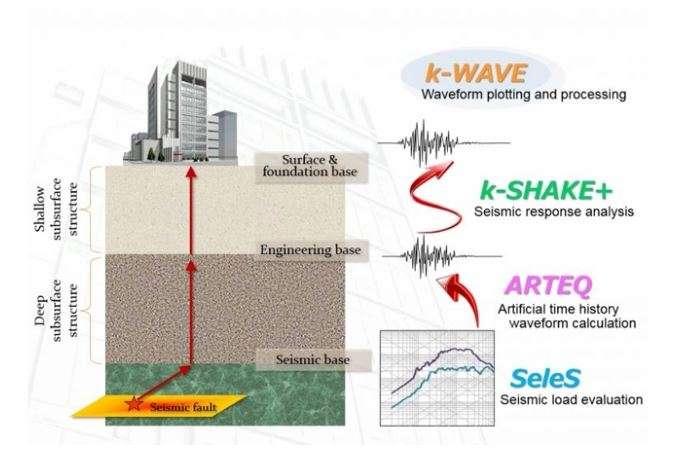
Shake2000 is a robust software tool engineered for seismic response analysis, a critical discipline within civil engineering. Developed in an academic context, it leverages advanced computational methods to predict how soil layers will behave under seismic loading. The software is instrumental in understanding ground motion amplification and earthquake effects on the built environment, catering to professionals who require precise simulation capabilities.
Applications in Civil Engineering
In civil engineering, Shake2000 plays a vital role in geotechnical earthquake engineering. It supports projects requiring rigorous seismic hazard assessment, such as the design of foundations for buildings, bridges, and dams. The software aids in evaluating liquefaction potential and assessing site-specific seismic response, ensuring that structures are designed to withstand relevant earthquake forces. Its application is particularly relevant in regions prone to seismic activity.
Software Architecture and Key Features
Shake2000 is structured around distinct components designed for comprehensive seismic analysis. The software package typically includes:
- ShakeEdit: This component serves as the primary graphical user interface (GUI). It facilitates the visual input of data, such as soil properties, earthquake records, and geometric configurations. ShakeEdit also enables the graphical display and interpretation of the analysis outputs.
- Shake Programs: These are the core computational engines responsible for performing the seismic response analysis. They process the input data and execute complex numerical simulations to generate results. The underlying algorithms are designed to handle intricate soil dynamics.
- Data Management: Tools for creating, editing, and saving analysis projects, ensuring efficient workflow for engineers managing multiple sites or scenarios.
- Output Visualization: Features for visualizing results, including time histories of ground motion, response spectra, and stress-strain curves, aiding in the comprehension of soil behavior.
Non-Linear Analysis Capabilities
A key differentiator of Shake2000 is its robust capability for non-linear analysis. Traditional linear analysis methods often simplify soil behavior, which can lead to inaccuracies under strong seismic shaking. Shake2000 addresses this by incorporating advanced algorithms that can simulate the complex, stress-dependent, and strain-dependent properties of soil. This non-linear approach allows for more realistic modeling of soil dynamics, accurately capturing phenomena such as shear strain accumulation and pore-water pressure generation, which are crucial for assessing potential damage and performance.
Integration and Compatibility
Shake2000 is designed for compatibility with modern operating systems, typically supporting various versions of Microsoft Windows. While specific integrations with other third-party engineering tools are not widely detailed, its output data, often in standard formats, can be imported into other software for further analysis or reporting. The user interface, managed by ShakeEdit, is intended to streamline the workflow for engineers who may also use other specialized civil engineering applications in their design processes.
Real-World Use Cases
Professionals in geotechnical and seismic engineering utilize Shake2000 for various critical applications. For instance, it has been employed in seismic site response studies for critical infrastructure projects, where understanding soil amplification is paramount to ensuring structural integrity during earthquakes. Researchers also leverage Shake2000 to investigate the fundamental mechanisms of soil behavior under seismic loading, contributing to advancements in earthquake engineering practice and the development of more resilient structures. Its application in academic research helps train the next generation of engineers in advanced seismic analysis techniques.
Conclusion
Shake2000 v2.0 represents a significant tool for civil engineers and scientists focused on seismic response analysis. Its advanced non-linear analysis capabilities, coupled with an intuitive interface, provide a powerful platform for simulating earthquake effects on soil dynamics. For technical professionals seeking to enhance their understanding of seismic hazards and improve the safety and performance of infrastructure in earthquake-prone regions, exploring the capabilities of Shake2000 is highly recommended.
Frequently Asked Questions
What is Shake2000 used for?
Shake2000 is a seismic analysis software designed to help civil engineers and researchers evaluate soil responses to seismic activities. It is particularly useful for assessing the effects of earthquakes on soil dynamics, providing essential data for the design and safety evaluation of structures in seismically active areas.
How does Shake2000 handle non-linear analysis?
Shake2000 incorporates advanced non-linear analysis capabilities, allowing users to simulate the realistic behavior of soil under varying stress and strain conditions during seismic events. This is crucial for accurate modeling, as it accounts for the complex material properties of soil that change dynamically during an earthquake.
What is the role of ShakeEdit in Shake2000?
ShakeEdit serves as the graphical interface for Shake2000, enabling users to enter data visually and view output results graphically. This makes data handling more intuitive and simplifies the process of setting up complex analyses and interpreting the resulting simulations for users.




Reviews
There are no reviews yet.