

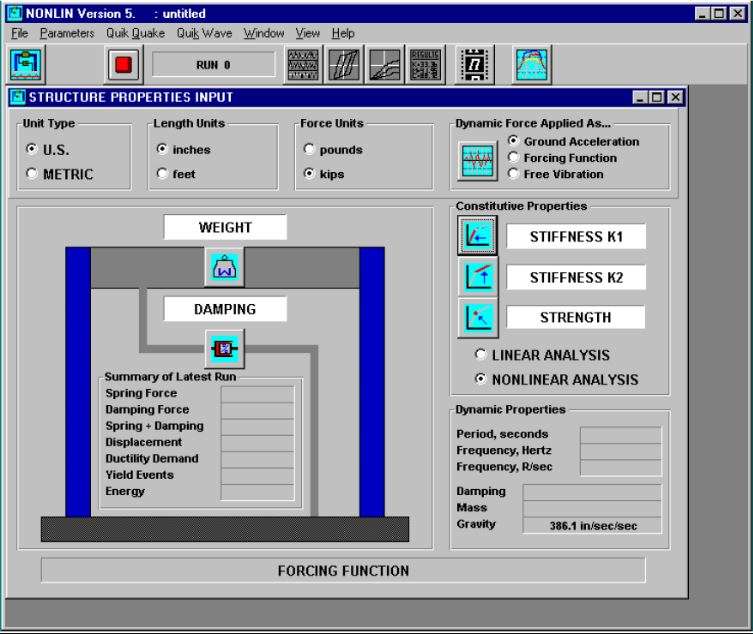
Download Nonlin 7.14 – Advanced Nonlinear Structural Analysis Software
Nonlin 7.14 is a specialized civil engineering software designed for conducting advanced nonlinear structural analysis. Developed to meet the demands of structural engineers, particularly those in earthquake engineering, it facilitates the detailed simulation of structural responses under dynamic loading conditions. The primary objective of Nonlin 7.14 is to provide engineers with robust tools to accurately model and predict the behavior of structures when subjected to complex and severe forces.
Introduction to Nonlin 7.14
Overview and Objective
Nonlin 7.14 serves as a critical tool for civil and structural engineers engaged in complex design and analysis projects. Its core function is to perform nonlinear structural analysis, which is essential for understanding how structures behave under conditions that exceed their elastic limits. This is particularly vital in fields like earthquake engineering, where dynamic loading simulations are paramount for ensuring safety and structural integrity. The software aims to bridge the gap between theoretical models and real-world structural responses influenced by material nonlinearities and large deformations.
Key Features and Capabilities
Nonlinear Behavior Analysis
Nonlin 7.14 is engineered to handle the complexities of nonlinear structural behavior. It accurately models structures that exhibit properties beyond linear elasticity, including material yielding and permanent deformation. The software can simulate bilinear behavior, a common characteristic in many structural materials under stress, allowing for more realistic predictions of structural performance during extreme events.
Loading Scenarios
The software offers versatile capabilities for analyzing structures under various demanding loading conditions. Users can input and simulate responses to earthquake acceleration records, defining specific seismic inputs crucial for dynamic analysis. Beyond seismic inputs, Nonlin 7.14 supports the definition of arbitrary load histories, providing flexibility to model a wide range of dynamic loading scenarios that may not conform to standard earthquake patterns.
Data Visualization and Output
Interpreting complex analysis results is made more accessible through Nonlin 7.14’s comprehensive data visualization tools. Engineers can observe the structural response in real-time via animated simulations that depict the structure’s movement and deformation throughout the analysis period. Further insights are provided through detailed graphs that illustrate energy dissipation patterns, which are critical for assessing structural stability during seismic events. The software also generates plots for hysteretic behavior, offering a clear depiction of the material’s stress-strain relationship over time.
Applications in Civil Engineering
Real-world Use Cases
Nonlin 7.14 is instrumental in numerous civil engineering applications, particularly in projects requiring rigorous assessment of seismic performance. It is widely used in the design and retrofitting of buildings, bridges, and other critical infrastructure located in earthquake-prone regions. Studies focusing on the dynamic behavior of structures under simulated seismic events frequently employ such software to validate design methodologies and predict performance under extreme conditions.
Integration with Other Tools
To enhance workflow efficiency, Nonlin 7.14 can often be integrated with other specialized software common in the civil engineering domain. While specific integration details may vary, it typically works alongside finite element analysis pre-processors and post-processors. This allows engineers to leverage powerful modeling and pre-analysis capabilities, then import geometry and material data into Nonlin for in-depth nonlinear dynamic analysis before exporting results for further reporting or visualization.
Comparison with Similar Software
Alternative Solutions for Nonlinear Analysis
The field of nonlinear structural analysis includes several software packages, each with distinct strengths. While OpenSees is a powerful, open-source platform known for its extensive element library and scripting capabilities, Nonlin 7.14 may offer specialized features for simplified definition of specific nonlinear models and advanced visualization, particularly for earthquake analysis. Competitors might also differ in their user interface, computational speed, and the specific types of nonlinear material models they support, making the choice dependent on project-specific requirements and user expertise.
Conclusion and Further Recommendations
Why Choose Nonlin 7.14?
Nonlin 7.14 stands out for its focused capabilities in nonlinear structural analysis, especially for dynamic loading and earthquake simulations. Its provision of animated visualizations and detailed energy dissipation plots offers engineers crucial insights into structural performance during extreme events. For civil engineers and researchers specializing in seismic design and dynamic response analysis, Nonlin 7.14 presents a valuable tool for ensuring the safety and resilience of structures in seismically active zones.
Frequently Asked Questions
What is Nonlin 7.14 used for in civil engineering?
Nonlin 7.14 is software designed for performing nonlinear structural analysis, particularly useful for simulating the behavior of structures under dynamic loads such as earthquakes. It allows engineers to model material nonlinearities and large deformations, providing a more accurate prediction of structural performance compared to linear analysis methods.
Does Nonlin support various loading conditions?
Yes, Nonlin allows for analysis under multiple loading conditions, including earthquake input, free vibration, and arbitrary load definitions. This flexibility enables engineers to simulate a wide range of scenarios relevant to structural engineering practice.
How can I visualize results in Nonlin 7.14?
Users can visualize results through animated simulations of loading periods, as well as graphs depicting earthquake acceleration, velocity, and energy dissipation. The software also provides visualizations of hysteretic behavior, offering a comprehensive understanding of the structural response.






Reviews
There are no reviews yet.