

Download Synopsys IC Compiler II vP-2019.03 – Advanced Place and Route Software for Semiconductor Design
Synopsys IC Compiler II vP-2019.03 is a next-generation place and route software designed by Synopsys, Inc., specifically for advanced integrated circuit (IC) physical design. This Electronic Design Automation (EDA) tool is critical for semiconductor companies, enabling engineers to navigate the complexities of modern chip development. It addresses key challenges in performance, power, area, and time-to-market, supporting the rigorous demands of advanced node technologies and large-scale chip designs found in consumer electronics, automotive, and IoT sectors.
Overview of Synopsys IC Compiler II in Semiconductor Design
Synopsys IC Compiler II plays a pivotal role in the physical design stage of semiconductor development. It translates logical circuit designs into physical layouts, a process essential for manufacturing. The software is engineered to handle the intricate requirements of advanced node technologies, such as FinFETs, while ensuring designs perform optimally across various operating conditions through multi-corner multi-mode (MCMM) analysis. Its hierarchical infrastructure is specifically developed to manage the immense complexity and scale of modern, multi-billion transistor chip designs, facilitating efficient place and route operations.
Advanced Place and Route Technologies in IC Compiler II
IC Compiler II incorporates a suite of advanced technologies to deliver high-quality results in physical design. Its hierarchical infrastructure is a cornerstone, enabling significant scalability and parallelism for processing massive designs. Core functionalities include density-aware placement algorithms that distribute components optimally across the chip, and multi-objective global optimization techniques that balance competing design goals. The tool provides sophisticated routing convergence, ensuring all connections are made efficiently and reliably. Furthermore, its advanced clock tree synthesis (CTS) capabilities, coupled with simultaneous clock and data optimization (CCD), are critical for managing timing across the design.
Optimization Techniques and Power Management Features
Achieving optimal power consumption is paramount in modern IC design, and IC Compiler II offers comprehensive solutions. Its optimization techniques are FinFET-aware, enabling precise power management for advanced semiconductor processes. The software integrates machine learning algorithms to accelerate design closure by learning from past design iterations and predicting outcomes, thereby enhancing efficiency. Critical power management features include sophisticated IR drop optimization to ensure stable voltage delivery across the chip and a robust timing engine for accurate performance analysis and optimization, all contributing to reduced overall power usage.
Integration with Semiconductor Design Flows and Industry Use Cases
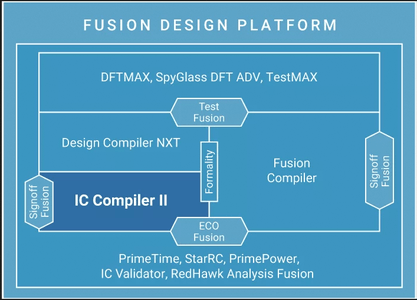
Synopsys IC Compiler II is designed to integrate seamlessly within broader semiconductor design flows. It works in conjunction with other Synopsys tools for timing analysis and ECO signoff, leveraging PrimeTime delay calculation for accurate performance metrics. This integration ensures a smooth transition from physical design to signoff verification. The software finds extensive application in the development of high-performance processors, complex SoCs for consumer electronics, advanced driver-assistance systems (ADAS) in automotive, and power-efficient chips for the Internet of Things (IoT). Professionals leverage IC Compiler II to achieve superior Quality of Results (QoR), which is essential for gaining a competitive edge in rapidly evolving semiconductor markets.
Support for Multi-Corner Multi-Mode Architectures
Modern semiconductor designs must perform reliably under a wide array of conditions. IC Compiler II’s support for multi-corner multi-mode (MCMM) architectures is a key enabler for this. This functionality allows for the comprehensive analysis and optimization of timing, power, and signal integrity across various process variations (corners), operating voltages, and temperatures. By simulating and optimizing for exhaustive scenarios, designers can ensure their chips meet stringent specifications across all expected operating states, preventing performance degradation or functional failures in real-world applications.
Scalability and Productivity Enhancements
Handling increasingly large and complex chip designs requires robust scalability. IC Compiler II employs a parallel optimization framework that significantly enhances its ability to process massive designs efficiently. This framework distributes computational tasks across multiple cores or machines, reducing turnaround times. Innovations in design planning and early design exploration tools within IC Compiler II also contribute to productivity. These features allow engineers to explore different design strategies and make informed decisions early in the process, setting up the design for success and optimizing overall engineering workflow efficiency.
Frequently Asked Questions
What is Synopsys IC Compiler II used for in chip design?
Synopsys IC Compiler II is used for the physical design phase of semiconductor chip development, specifically for place and route operations that optimize the placement of components and signal routing to meet performance, power, and area goals. It translates logical designs into physical layouts ready for manufacturing.
How does IC Compiler II handle multi-corner multi-mode (MCMM) analysis?
IC Compiler II supports MCMM architecture, enabling design optimization and verification across multiple process, voltage, temperature corners, and operational modes to ensure robust performance and power characteristics under varying conditions. This comprehensive analysis helps guarantee a chip’s reliability across its intended lifecycle.
What role does machine learning play in IC Compiler II?
The software incorporates machine learning to accelerate design closure by predicting optimal placement and routing strategies, improving efficiency, and reducing overall design cycle time. This AI-driven approach helps in achieving better design outcomes more rapidly.






Reviews
There are no reviews yet.