

Download GAMS 51.2.1 – High-Level Optimization Software
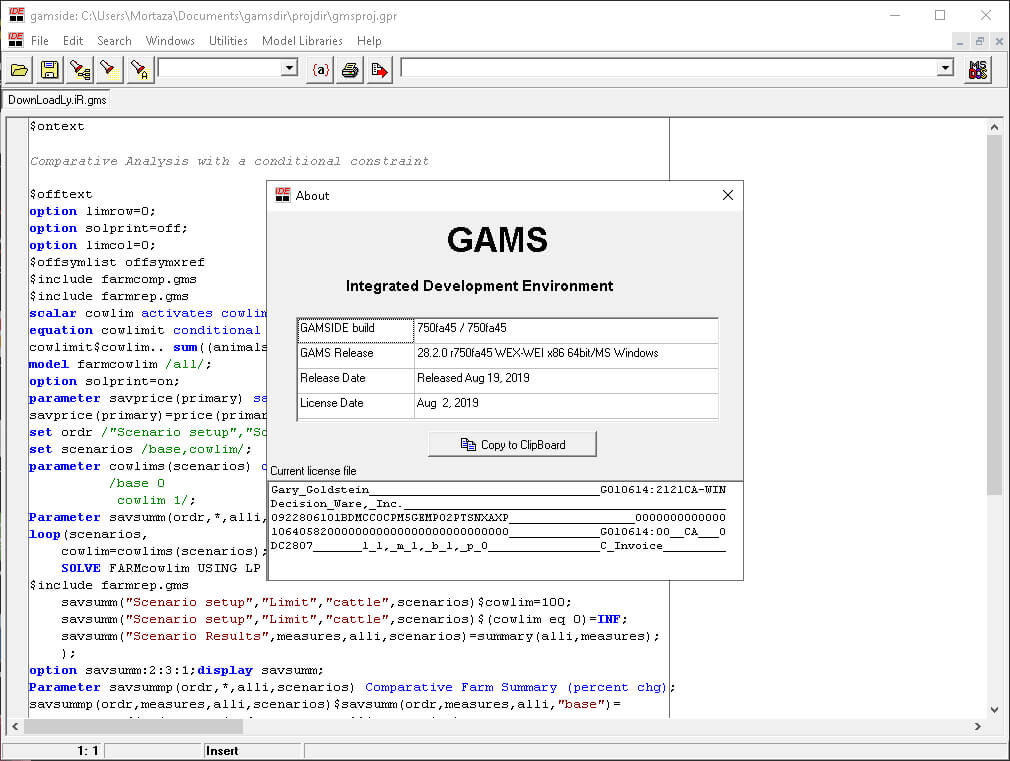
GAMS (General Algebraic Modeling System) is a sophisticated modeling system developed by GAMS Development Corporation, designed for mathematical programming and optimization. This high-level system is instrumental for professionals in Operations Research, Economics, Engineering, and Logistics who require robust tools to model and solve complex linear and nonlinear problems. GAMS enables users to construct and execute large-scale optimization models efficiently across various computing environments, making it a powerful asset for tackling intricate quantitative challenges.
Overview of GAMS and Its Applications
What is GAMS?
GAMS, standing for General Algebraic Modeling System, is a specialized software designed for developing and applying mathematical optimization models. Established by GAMS Development Corporation, it has evolved into a critical tool for researchers and practitioners in quantitative fields. The system is built to support a wide array of optimization techniques, facilitating the formulation of complex mathematical structures that represent real-world scenarios. Its broad applicability spans across scientific research and intricate industrial planning processes, providing a scalable platform for modeling and problem-solving.
Key Features and Functional Capabilities
Modeling and Optimization
GAMS excels in its ability to define and solve complex mathematical programming problems. Its high-level syntax allows users to express intricate relationships and constraints clearly, abstracting away much of the underlying computational complexity. The system supports various optimization paradigms, including:
- Linear Programming (LP) for problems with linear objectives and constraints.
- Nonlinear Programming (NLP) for models involving non-linear functions.
- Mixed Integer Programming (MIP) for problems with discrete variables.
- Conic Optimization for problems fitting specific mathematical structures.
These capabilities are powered by an extensive collection of sophisticated solvers that GAMS can interface with, allowing users to select the most appropriate algorithm for their specific problem type. The system also emphasizes clear model documentation, enabling users to understand and manage complex models more effectively.
Automation Features
GAMS incorporates several automation features designed to streamline the modeling and solution process. This includes intelligent memory management, which dynamically allocates resources as needed, preventing common issues associated with large datasets and complex models. Furthermore, GAMS provides robust workflow control capabilities, enabling users to automate sequences of operations, parameter changes, and solution analyses. This automation reduces manual effort, minimizes the potential for errors, and enhances the overall productivity of optimization workflows, allowing users to focus on model development and interpretation rather than routine operational tasks.
Technical Specifications and Platform Compatibility
Supported Platforms
A significant advantage of GAMS is its broad platform compatibility, ensuring accessibility for a diverse range of users and computing infrastructures. The software is designed to run on numerous operating systems and hardware configurations. This includes standard desktop operating systems such as Windows and macOS, as well as various Linux distributions. GAMS also extends its reach to high-performance computing environments, including clusters and supercomputers, allowing for the execution of extremely large-scale optimization problems that demand substantial computational power.
Portability of Solutions
The architectural design of GAMS promotes the portability of optimization models and their associated data across different computing platforms. Models developed on one system can generally be transferred and executed on another without significant modification, provided the necessary solver interfaces are available. This portability is crucial for collaborative projects and for organizations that utilize a mix of computing resources. Users can develop a model on a local workstation and then deploy it on a more powerful server or cloud environment for large-scale computations, ensuring flexibility and continuity in their optimization workflows.
Applications Across Industries
Case Studies and Use Cases
GAMS is a versatile tool employed across numerous sectors to address complex challenges. Its ability to model intricate systems makes it invaluable in scenarios such as:
- Logistics and Supply Chain Management: Optimizing transportation routes, warehouse locations, and inventory management to reduce costs and improve delivery times.
- Economics and Finance: Developing economic equilibrium models, portfolio optimization strategies, and resource allocation frameworks.
- Energy Sector: Modeling energy production, distribution, and consumption, including the integration of renewable energy sources.
- Engineering: Solving design optimization problems, process simulations, and resource planning in various engineering disciplines.
- Agriculture: Planning crop rotation, resource management, and market supply chains.
These applications highlight GAMS’s role in providing data-driven insights and optimal solutions for operational planning and strategic decision-making in complex environments.
Comparison with Competing Technologies
While other mathematical modeling and optimization software solutions exist, GAMS distinguishes itself through its unique combination of features. Its high-level algebraic modeling language offers a more intuitive and structured approach to defining complex mathematical relationships compared to lower-level programming languages or specialized solver interfaces. GAMS’s notable strengths include its seamless integration with a vast array of commercial and academic solvers, its robust cross-platform compatibility from personal computers to supercomputers, and its effective automation capabilities for managing large-scale optimization tasks. These differentiators make GAMS a preferred choice for many organizations prioritizing flexibility, scalability, and efficient workflow management in their optimization endeavors.
Frequently Asked Questions
What types of problems can GAMS solve?
GAMS is designed to solve a wide variety of problems, including linear and nonlinear optimization issues, making it versatile for applications in operations research and engineering. It can handle scenarios ranging from simple linear programs to highly complex mixed-integer nonlinear programs.
How can GAMS improve workflow for mathematical modeling?
By automating complex tasks such as memory management and allowing for incremental changes to models, GAMS significantly enhances the efficiency and effectiveness of mathematical modeling workflows. Its organized syntax and integration with solvers reduce the burden of manual coding and repetitive adjustments.
Is GAMS suitable for large-scale optimization projects?
Yes, GAMS is particularly well-suited for large-scale problems due to its ability to handle complex variable interactions and its support for high-performance computing environments. Its architecture is built to manage substantial datasets and intricate models efficiently.





Reviews
There are no reviews yet.