

Download Cadence Xtensa Xplorer 2023 – Customizable Embedded Processor IDE
Cadence Xtensa Xplorer 2023 is an integrated development environment (IDE) from Cadence Design Systems designed for the configuration, development, and optimization of Xtensa configurable RISC processors. This specialized software is crucial for professionals in semiconductor design, embedded systems, and SoC architecture, enabling the creation of application-specific processors tailored for demanding fields such as AI/ML, DSP, and high-speed communications.
Overview of Cadence Xtensa Xplorer in Embedded Processor Design
Cadence Xtensa Xplorer serves as a comprehensive solution for the entire workflow of designing custom processors. Within the realm of embedded systems development and semiconductor SoC architecture, this IDE empowers engineers to move beyond fixed instruction sets and develop highly optimized, application-specific processing units. Its industrial significance is particularly pronounced in the development of accelerators for AI/ML, advanced digital signal processing (DSP) applications, and complex communication systems.
Processor Architecture Configuration and Hardware Generation
At the core of Xtensa Xplorer’s capabilities lies its advanced processor configuration engine. Users can meticulously define custom processor architectures using the Tensilica Instruction Extension (TIE) language. This allows for the specification of unique instructions, custom registers, and specialized execution units tailored to specific algorithmic needs. The IDE provides an interactive graphical user interface (GUI) that simplifies the selection and configuration of core features and extension packs, making complex customization accessible. Upon definition, Xtensa Xplorer automates the generation of synthesizable Register-Transfer Level (RTL) code and accurate hardware models, streamlining the path from architectural concept to hardware implementation.
Software Development Suite and Debugging Tools
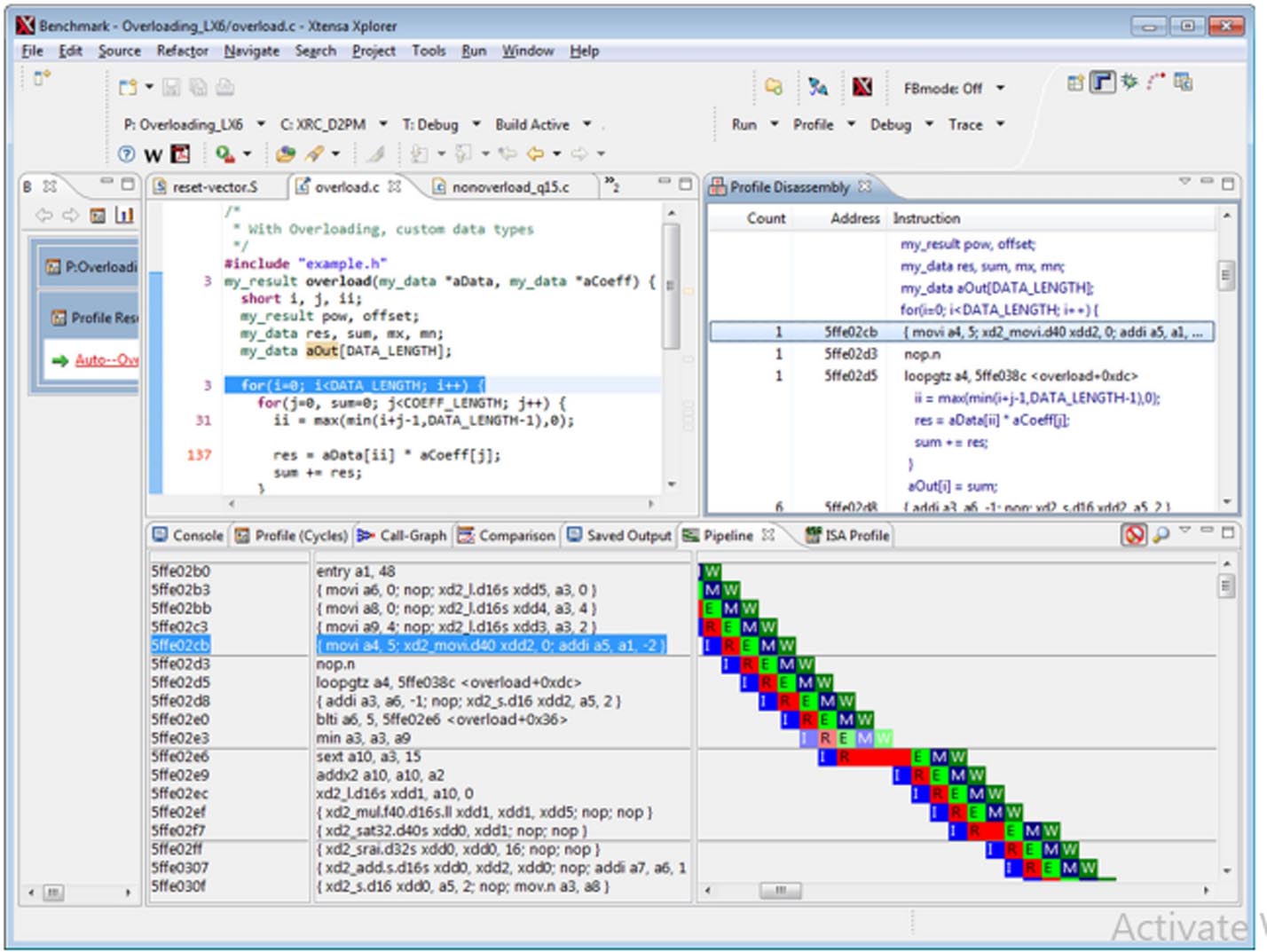
Complementing its hardware design features, Cadence Xtensa Xplorer offers an integrated software development suite. This includes an automatically generated, highly optimized C/C++ compiler, a robust debugger, and advanced profiling tools specifically configured for the custom Xtensa processor. The IDE is built upon the familiar Eclipse framework, providing a rich environment for software development. Advanced debugging features support multi-core debugging scenarios and detailed execution tracing, while specialized profiling tools enable engineers to meticulously analyze and optimize processor performance, instruction cache behavior, and memory usage for maximum efficiency.
System-Level Simulation and Integration with Cadence Tools
To facilitate early verification and system validation, Cadence Xtensa Xplorer supports transaction-level modeling (TLM) using standards like SystemC and TLM-2.0. This capability allows for high-speed simulation of the custom processor within its intended system context, significantly earlier in the design cycle. Furthermore, Xtensa Xplorer integrates seamlessly with Cadence’s broader portfolio of verification and emulation platforms, including formal verification with JasperGold and hardware emulation with Palladium or Z1 systems. This integration enables comprehensive system-level analysis, including complex multi-core and heterogeneous system modeling, ensuring robust verification across the entire design flow.
Use Cases Across Semiconductor Design and Embedded Systems
The unique capabilities of Cadence Xtensa Xplorer make it indispensable for a variety of specialized roles and applications within the semiconductor and embedded systems industries. SoC architects leverage the tool to define domain-specific processors tailored for emerging workloads such as AI/ML inference engines, advanced computer vision algorithms, and high-throughput audio processing. Embedded software engineers utilize it to optimize real-time code executed on custom hardware, while DSP algorithm developers focus on implementing complex signal processing tasks for applications like 5G infrastructure, radar systems, and advanced video codecs. FPGA and ASIC prototyping engineers benefit from the rapid generation of hardware models for faster design iteration and validation. The toolchain also supports detailed performance analysis and power estimation workflows, crucial for energy-constrained embedded devices.
Frequently Asked Questions
What makes Cadence Xtensa Xplorer different from traditional processor IDEs?
Cadence Xtensa Xplorer supports designing and configuring highly customizable processors with extensible instruction sets, offering a distinct advantage over traditional IDEs that work with fixed-set processors like ARM. It provides a complete, integrated workflow that spans from unique hardware architecture customization and automated RTL generation to sophisticated software development and debugging tailored to the custom processor.
Which industries benefit most from using Cadence Xtensa Xplorer?
Industries heavily involved in developing specialized embedded systems for AI/ML inferencing, digital signal processing (DSP), advanced communications, and complex SoC designs are the primary beneficiaries. Semiconductor companies and original equipment manufacturers (OEMs) widely adopt Xtensa Xplorer for the co-design of hardware and software for highly configurable, application-specific IP cores.
How does Cadence Xtensa Xplorer integrate with other Cadence design tools?
Xtensa Xplorer achieves seamless integration with Cadence’s extensive suite of EDA tools. This includes integration with formal verification solutions like JasperGold, hardware emulation platforms such as Palladium/Z1, analog simulation tools like Spectre X, and power analysis tools including Joules, thereby facilitating comprehensive design verification and in-depth system-level analysis.






Reviews
There are no reviews yet.