

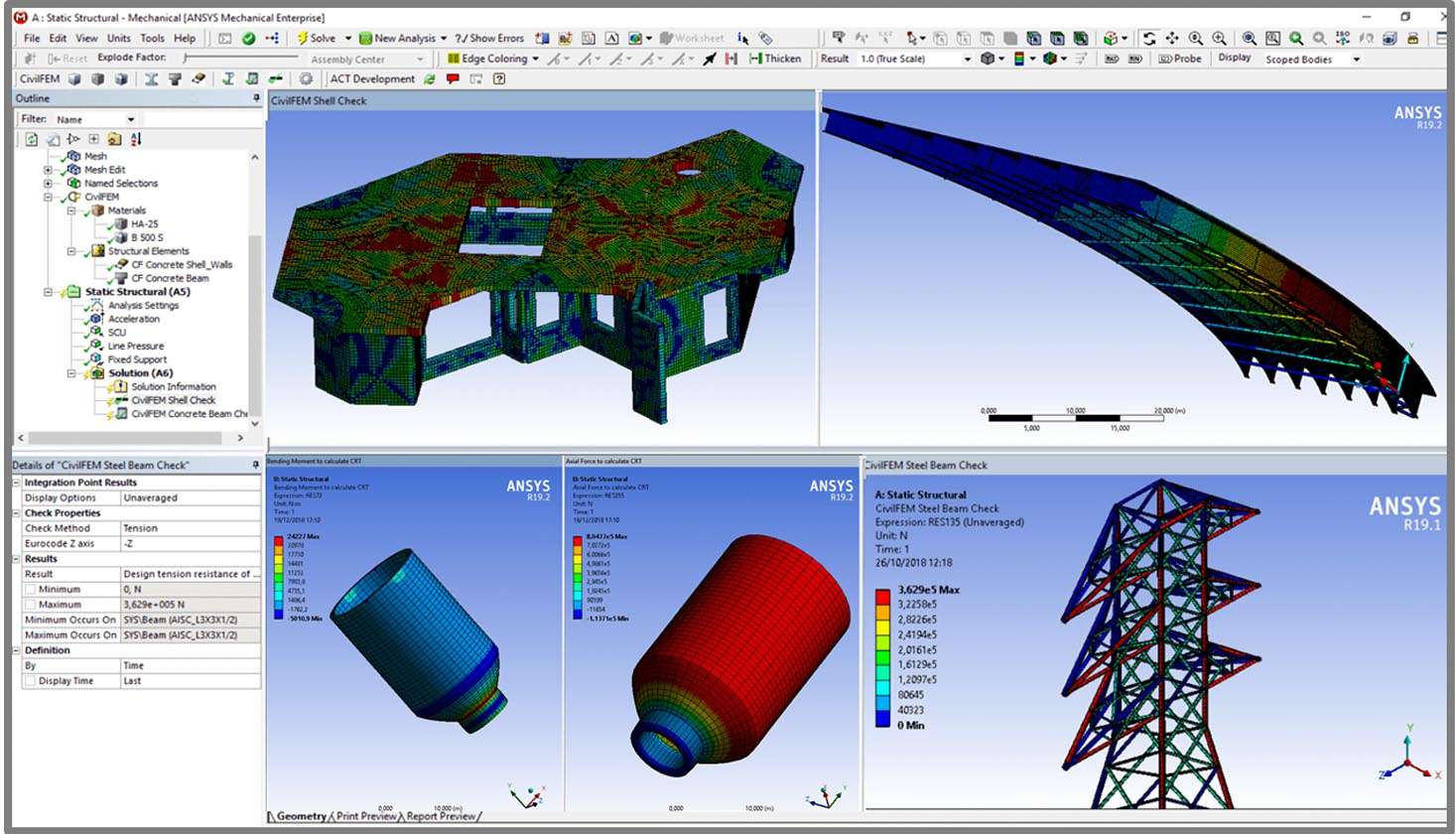
Download CivilFEM 2025 for ANSYS – Advanced Civil Engineering Simulation Software
CivilFEM 2025 for ANSYS is a specialized civil engineering environment developed by Cidoncha Ingeniería y Sistemas S.L., integrated as an enhancement to ANSYS Mechanical by Ansys Inc. This powerful software is designed for professionals in structural engineering, geotechnical engineering, bridge design, and construction engineering, offering advanced finite element analysis (FEA) tailored for civil infrastructure projects. It provides comprehensive tools for simulating and designing complex civil structures, adhering to the latest international codes and standards.
Specialized Civil Engineering Environment Built on ANSYS
CivilFEM 2025 functions as an add-on to ANSYS Mechanical, extending its robust FEA capabilities with a suite of tools specifically developed for civil engineering applications. This integration ensures that users can leverage the established power of ANSYS Workbench while benefiting from specialized functionalities crucial for civil projects. The software targets civil engineers, structural engineers, geotechnical engineers, and academic researchers who require advanced simulation environments for designing buildings, bridges, tunnels, dams, and various types of infrastructure. It supports a broad spectrum of ANSYS versions, ensuring compatibility with evolving engineering workflows.
Comprehensive Civil Design and Analysis Capabilities
CivilFEM 2025 offers an extensive range of analysis and design tools that cater to the intricate demands of civil engineering projects, ensuring compliance with international codes and standards.
Reinforced Concrete and Steel Structure Design
The software includes sophisticated features for reinforced concrete design, automating complex reinforcement layouts and calculations according to standards like ACI 318-24 and Eurocode 2. For steel structures, CivilFEM provides comprehensive checking and design capabilities based on AISC and Eurocode 3, including detailed connection design tools. This enables engineers to efficiently design and verify structural elements for safety and performance.
Advanced Geotechnical and Bridge Analysis
CivilFEM excels in geotechnical analysis, offering advanced soil models to simulate soil plasticity and behavior accurately. It supports analyses of pile foundations, slope stability, and complex soil-structure interactions. For bridge engineering, the software includes specialized tools for analyzing prestressing, cable-stayed bridges, suspension bridges, and dynamic behavior under various load conditions, facilitating the design of resilient and efficient bridge structures.
Dynamic and Nonlinear Structural Assessment
The software enables engineers to perform detailed dynamic analyses, including seismic response spectrum analysis and time-history simulations, to assess structural behavior under earthquake loads. It accurately models nonlinear concrete behavior, construction stages with stage manager capabilities, and fatigue analysis for assessing long-term durability. Buckling analysis features further enhance the assessment of structural stability under critical load conditions.
Integration and Automation within ANSYS Workbench
CivilFEM 2025 is seamlessly integrated within the ANSYS Workbench environment, providing a unified platform for the entire simulation workflow. This integration includes an extended library of material models specifically for civil engineering applications, such as advanced concrete, soil, and rock models. It also supports specialized loading types, including automated climate load generation and detailed construction loads, to simulate real-world conditions accurately. The software automates the generation of code-compliant reports, consolidating results and calculations for efficient documentation and review.
Innovative Features in CivilFEM 2025 Release
The latest release of CivilFEM 2025 introduces cutting-edge features aimed at enhancing efficiency, accuracy, and innovation in civil engineering simulations.
- AI-Powered Reinforcement Optimization: Utilizes artificial intelligence to suggest optimal rebar arrangements, potentially reducing material usage and improving structural integrity.
- Digital Twin Integration: Enables connection to digital twin sensors for real-time monitoring and performance analysis of existing infrastructure.
- Enhanced BIM Interoperability: Features improved support for IFC 4.3 import/export, creating smoother workflows with BIM platforms like Revit and Tekla.
- Advanced Climate Load Generators: Provides sophisticated tools to model the impact of various climate conditions on structures, ensuring long-term durability.
- 3D Printing Structural Analysis: Offers capabilities to simulate and analyze the structural performance of components manufactured using 3D printing technologies.
- GPU-Accelerated Solvers: Leverages graphics processing units to significantly speed up the solution time for large and complex civil engineering simulations.
Industrial Applications and Practical Use Cases
CivilFEM 2025 finds extensive application across the civil engineering sector, supporting a wide array of real-world projects. In structural engineering, it is used for the detailed design of high-rise buildings, stadiums, and commercial complexes, ensuring compliance with seismic and wind load requirements. For bridge engineering, it facilitates the analysis of complex bridge types, including seismic performance and lifecycle durability assessment. Geotechnical engineers utilize CivilFEM for foundation design, slope stability analysis, and tunnel engineering, accurately modeling soil behavior and its interaction with structures. The software also supports academic research and the development of innovative construction techniques, including the analysis of structures intended for 3D printing.
Frequently Asked Questions
What civil engineering codes does CivilFEM 2025 support for structural design?
CivilFEM 2025 supports major international civil engineering codes such as ACI 318-24 for reinforced concrete, Eurocode 2 for concrete design, AISC and Eurocode 3 for steel structures, and ASCE 7-22 for seismic design. These ensure compliance with the latest global standards, providing engineers with confidence in the regulatory adherence and project acceptance of their designs.
Can CivilFEM 2025 integrate with Building Information Modeling (BIM) software?
Yes, CivilFEM 2025 enhances BIM interoperability with support for IFC 4.3 import/export and bidirectional links to major platforms like Revit, Tekla, and ArchiCAD. This enables streamlined workflows between analysis and design teams, facilitating better collaboration and data exchange throughout the project lifecycle.
How does CivilFEM 2025 utilize AI in civil engineering analysis?
CivilFEM 2025 employs AI-powered reinforcement optimization to automatically suggest optimal rebar layouts that can reduce material usage by 10-20%. Additionally, it uses AI-driven model validation to detect common modeling errors, thereby improving the accuracy and efficiency of analyses and reducing the potential for design oversights.




Reviews
There are no reviews yet.