
Download Altair S-TIMBER 2026.0 – Advanced Mass Timber Structural Analysis
Altair S-TIMBER 2026.0 is a specialized structural analysis and design software developed by Altair Engineering Inc., formerly S-FRAME Software Inc. This application is engineered for the unique demands of mass timber and hybrid structural systems. Structural engineers and construction professionals rely on Altair S-TIMBER 2026.0 for detailed analysis and code-compliant design of timber buildings, particularly those incorporating cross-laminated timber (CLT) and glulam components.
Transforming Timber Engineering in Modern Construction
The construction industry is increasingly adopting mass timber as a sustainable and structurally efficient building material. Altair S-TIMBER 2026.0 addresses the growing need for advanced tools capable of accurately modeling the complex behavior of timber. This involves understanding its inherent anisotropy, moisture-induced dimensional changes, creep deformation over time, and fire resistance. The software also facilitates the design of hybrid structures that integrate timber elements with conventional materials like steel and concrete, offering engineers greater flexibility in creating innovative and environmentally responsible designs.
Comprehensive Analysis Types for Timber Structures
Linear and Nonlinear Behavior Modeling
Altair S-TIMBER 2026.0 provides robust capabilities for modeling both the elastic serviceability limits and the nonlinear behaviors characteristic of timber structures. Engineers can accurately assess structural performance under various load conditions by accounting for material nonlinearity, geometric effects such as buckling, and the flexibility of semi-rigid connections. This detailed approach ensures designs are not only compliant but also perform as intended throughout their service life.
Key modeling aspects include:
- Elastic analysis for serviceability limit states.
- Geometric nonlinearity, including P-Delta effects and buckling analysis.
- Material nonlinearity reflecting timber’s stress-strain behavior.
- Modeling of semi-rigid and flexible connections to capture realistic structural responses.
Dynamic, Seismic and Vibration Analysis
Understanding a structure’s response to dynamic forces is critical, especially for seismic regions and tall buildings. Altair S-TIMBER 2026.0 offers advanced analysis types to evaluate these phenomena. This includes modal analysis for determining natural frequencies and mode shapes, response spectrum analysis for seismic design, and time history simulations to observe structural behavior over time under dynamic loading. The software also supports human-induced vibration assessments, crucial for ensuring occupant comfort in timber floor systems.
Seamless Multi-Material and Hybrid Modeling
Modern construction projects frequently involve complex structures that combine different materials. Altair S-TIMBER 2026.0 excels in modeling these hybrid systems, allowing engineers to effectively integrate mass timber components like cross-laminated timber (CLT) and glulam with steel connectors and concrete cores. The software enables detailed modeling of the interface behavior between these dissimilar materials, ensuring accurate load transfer and overall structural integrity. This capability is essential for optimizing the performance and efficiency of hybrid timber-concrete composite floors and mixed-use buildings.
Automated Code Compliance and Design Validation
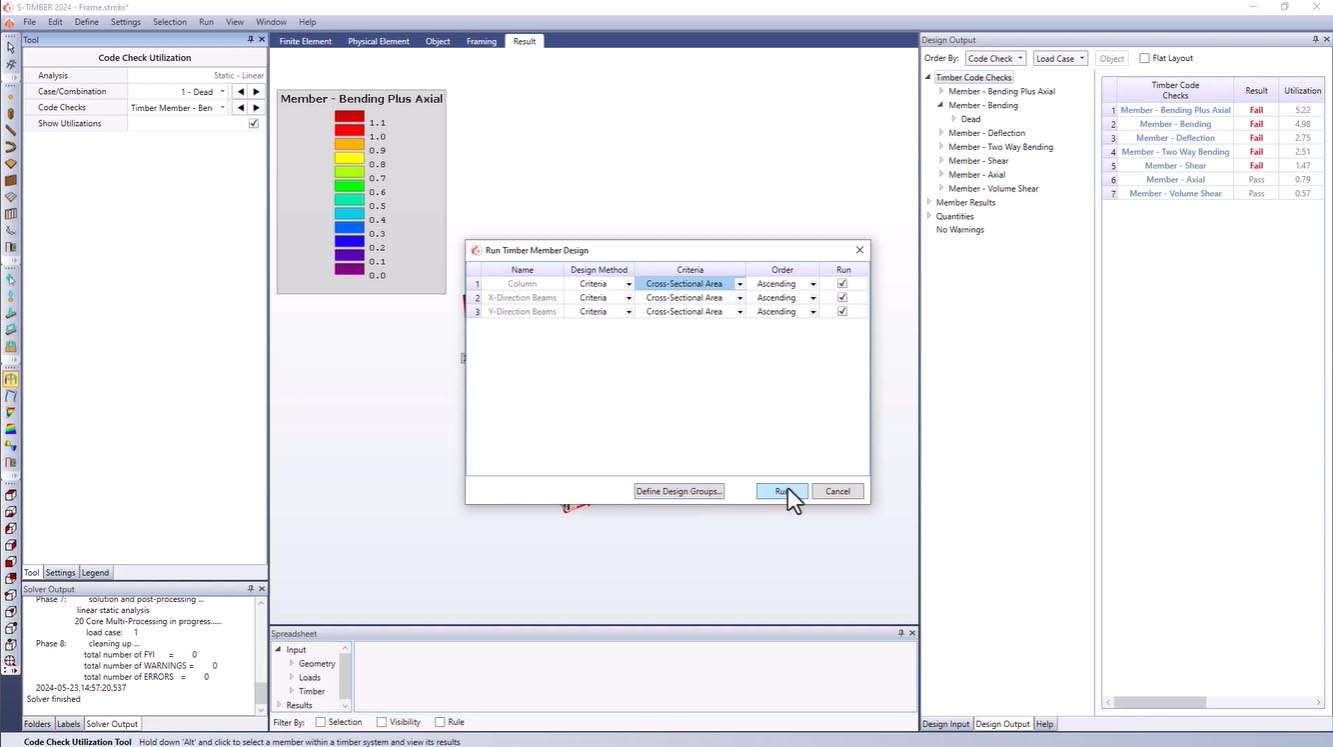
Ensuring structural designs meet regional building codes is a fundamental requirement. Altair S-TIMBER 2026.0 automates the complex process of code compliance checking for timber structures. It incorporates checks based on major international standards, including the National Design Specification (NDS) for Wood Construction, Canada’s CSA O86, and the European Eurocode 5 (EN 1995). The software performs real-time verifications as design modifications are made, providing immediate feedback and generating comprehensive reports that detail compliance with relevant design criteria.
Workflow Integration and Productivity Enhancements
Altair S-TIMBER 2026.0 is designed to enhance the workflow efficiency of structural engineers. It offers deep integration with Altair S-FRAME Analysis, an established structural analysis platform, enabling a fluid transition between modeling and analysis stages. The software supports interoperability with Building Information Modeling (BIM) platforms and detailing tools through robust import and export functionalities. This facilitates rapid model creation, utilizes built-in property calculators for timber sections and materials, and ensures data consistency across the design and construction process.
Customizable Reporting and Documentation
Comprehensive documentation is critical for project delivery and regulatory approval. Altair S-TIMBER 2026.0 allows for the generation of detailed and customizable design reports. These reports can include summaries of member design, explicit code check details, and material takeoffs. The flexibility to export reports in various formats such as PDF, Microsoft Word, and Excel, combined with the inclusion of relevant graphics and tables, streamlines the communication of design intent and results to stakeholders.
Real-World Applications and Case Studies
The capabilities of Altair S-TIMBER 2026.0 are demonstrated through its application in diverse and challenging structural engineering projects. Its specialized features are particularly valuable for designing taller timber buildings that leverage the strength and sustainability of mass timber elements like CLT walls and floors. The software is also instrumental in the engineering of hybrid floor systems, which combine timber beams with concrete slabs for enhanced performance and fire resistance. Furthermore, it supports the development of robust, seismic-resistant timber frames, ensuring safety and resilience in earthquake-prone areas.
Frequently Asked Questions
What analysis capabilities does Altair S-TIMBER 2026.0 offer for mass timber design?
Altair S-TIMBER 2026.0 supports linear elastic, nonlinear material and geometric analysis, dynamic modal and response spectrum analysis, time history simulation, and human-induced vibration assessment. These features allow engineers to evaluate serviceability, stability, seismic performance, and floor vibration comfort in timber and hybrid structures.
Which timber design codes are supported in S-TIMBER?
S-TIMBER 2026.0 includes automated code checks for major regional standards such as the US NDS for Wood Construction, Canada’s CSA O86, and Europe’s Eurocode 5 (EN 1995). It updates compliance checks in real time as the model evolves and generates detailed verification reports.
How does S-TIMBER integrate with other structural analysis or BIM tools?
S-TIMBER integrates natively with Altair S-FRAME Analysis for unified modeling, and supports import/export with common BIM platforms and detailing software. This interoperability streamlines data exchange, preserves material and section definitions, and maintains consistency across workflows.






Reviews
There are no reviews yet.