

Download MedCalc – Advanced Statistical Software for Biomedical Research
MedCalc statistical software is a specialized application designed for the biomedical sciences, developed by MedCalc Software. Initially released for MS-DOS in 1993 and later for Windows in 1996, it has become a vital tool for professionals in biomedical research and medical statistics. The software provides an integrated environment for performing complex statistical analyses and generating data visualizations essential for medical studies.
Introduction to MedCalc and Its Purpose
MedCalc serves as a comprehensive statistical analysis tool specifically engineered for the demands of biomedical research. It assists researchers, clinicians, and statisticians in analyzing complex datasets, interpreting medical research findings, and reporting results accurately. Its background, stemming from early DOS versions, has evolved into a user-friendly Windows interface supporting a wide array of statistical procedures critical for medical publications and diagnostics.
Key Statistical Procedures and Analysis Tools
Parametric and Non-Parametric Statistics
MedCalc offers a robust suite of statistical tests to accommodate diverse research data. The software supports advanced parametric procedures such as Analysis of Variance (ANOVA) and various regression models, enabling in-depth analysis of continuous data. For non-parametric data, it provides essential tests like the Mann–Whitney U test and Wilcoxon signed-rank test, along with Fisher’s exact test, ensuring comprehensive analytical coverage for different data types.
ROC Curve Analysis Capabilities
A significant feature of MedCalc is its specialized support for Receiver Operating Characteristic (ROC) curve analysis. This capability is fundamental in evaluating the performance of diagnostic tests and classification models. Users can generate ROC curves, calculate the area under the curve (AUC) with accompanying 95% confidence intervals, and perform comparisons between different tests. This focus on ROC analysis makes MedCalc an indispensable tool for studies assessing diagnostic accuracy.
Data Management Features
Integrated Spreadsheet Functionality
MedCalc includes an integrated spreadsheet that simplifies data entry and management. This feature allows users to input data directly or import datasets from various common file formats, including Excel, SPSS, and standard CSV files. This compatibility ensures seamless integration into existing research workflows, whether data originates from clinical trials, surveys, or electronic health records.
Data Browsing and Reporting Capabilities
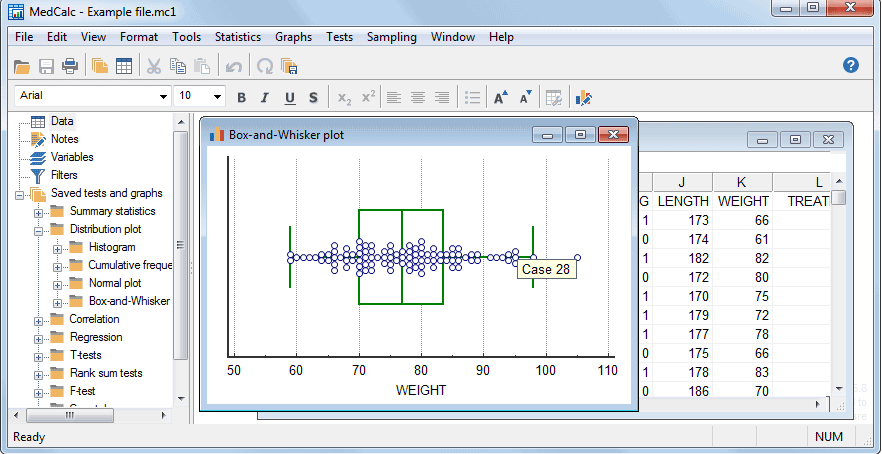
Beyond data analysis, MedCalc provides tools for efficient data browsing and report generation. Users can organize their datasets, add notes, and track revisions. The software facilitates the creation of professional reports that can include statistical results, tables, and graphs, streamlining the documentation process for research publications and presentations.
Applications in Biomedical Research
MedCalc is frequently employed in various biomedical research scenarios. It is instrumental in studies evaluating the efficacy of new drugs, assessing the diagnostic performance of medical imaging techniques, and analyzing survival rates in clinical trials. For instance, researchers utilize MedCalc to perform Bland-Altman plots for agreement analysis between measurement methods or to conduct survival analysis, such as Kaplan-Meier curves, which are critical for understanding patient prognoses.
Comparative Analysis with Other Statistical Software
Compared to broader statistical software packages, MedCalc distinguishes itself through its dedicated focus on biomedical statistics and an exceptionally user-friendly interface for specialized analyses. While other platforms may offer a wider array of highly advanced econometric or scientific modeling functions, MedCalc excels in providing straightforward yet powerful tools for common medical research tasks, particularly its robust and accessible ROC curve analysis capabilities and clear reporting features.
User Interface and Language Support
MedCalc features a well-organized user interface designed for ease of navigation and use. Recent updates have enhanced its accessibility by incorporating support for multiple languages, allowing a broader international audience of researchers to utilize its functionalities effectively. This linguistic flexibility, combined with its intuitive design, lowers the barrier to entry for complex statistical analysis in medical research.
Conclusion and Further Resources
MedCalc statistical software offers a powerful, specialized solution for biomedical statistics and data analysis. Its comprehensive set of tools, particularly its strengths in ROC curve analysis and ease of data management, makes it a valuable asset for researchers aiming to publish accurate and reliable findings. For more detailed information on its features and usage, users are encouraged to consult the official MedCalc user guides and documentation.
Frequently Asked Questions
What types of statistical tests can I perform with MedCalc?
MedCalc supports a wide range of statistical tests, including parametric tests like ANOVA and non-parametric tests like the Mann–Whitney test. Additionally, it provides advanced options for regression analysis and survival statistics, making it suitable for various research designs.
How does MedCalc handle ROC curve analysis?
MedCalc specializes in ROC curve analysis, allowing users to generate ROC charts and calculate the area under the curve (AUC) with 95% confidence intervals. This feature is crucial for evaluating diagnostic tests’ performance and comparing different diagnostic or classification methods.
Can MedCalc import data from other statistical software?
Yes, MedCalc can import data from various statistical packages such as Excel, SPSS, and CSV files, providing flexibility for users transitioning from other platforms or consolidating data from multiple sources.





Reviews
There are no reviews yet.