

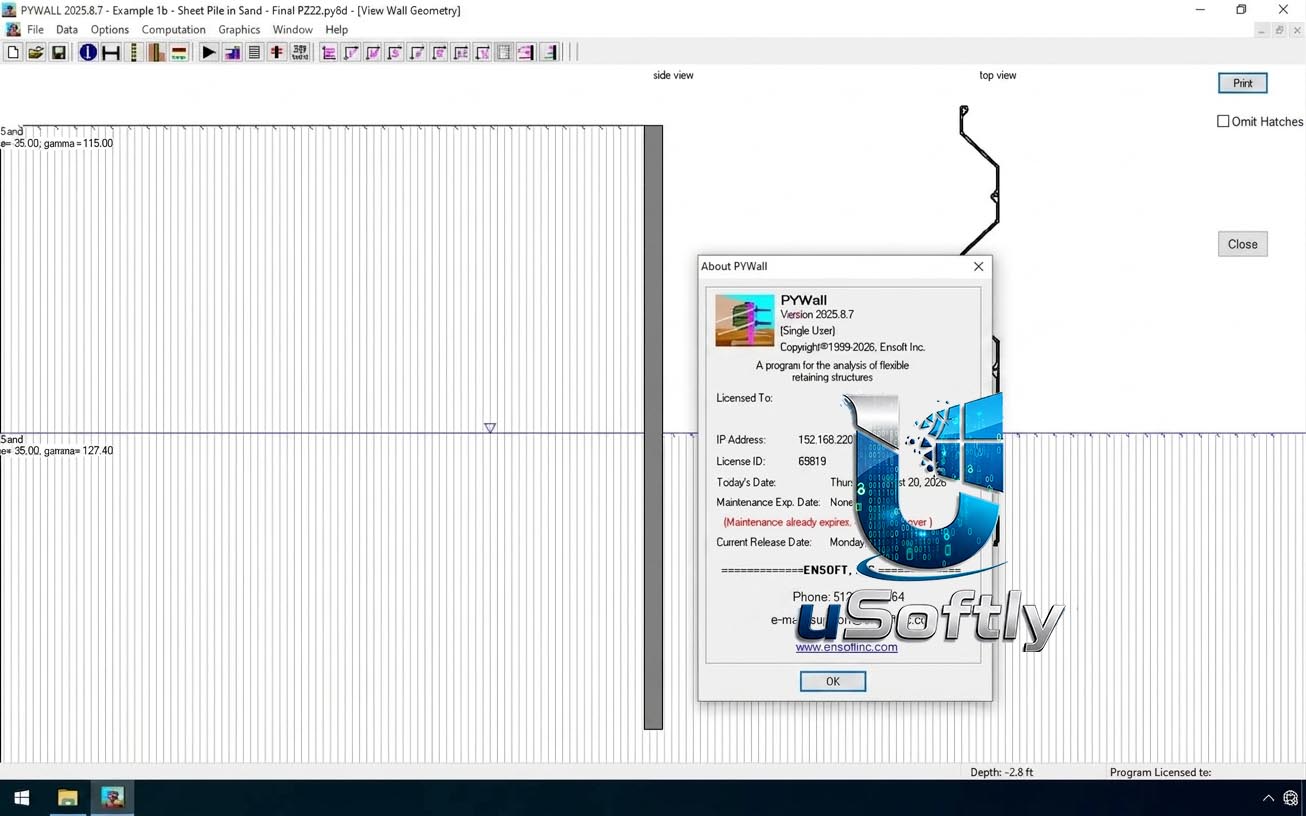
Ensoft PYWall 2025.8.7 – Advanced Finite Difference Software for Flexible Retaining Wall Analysis and Design
PYWall is a powerful finite difference software developed by Ensoft Inc. for the analysis and design of flexible retaining walls. Unlike conventional methods based on limit-equilibrium theory, PYWall employs advanced finite difference techniques that provide more accurate predictions of wall behavior, including deformation patterns and bending moments . The software was first released in 1987 and has been continuously improved through ongoing development and validation against full-scale field tests.
PYWall is used to solve a wide range of retaining wall problems including sheet pile walls, soldier pile walls, tieback walls, and braced excavations . It incorporates nonlinear soil springs based on p-y curves for lateral soil resistance, t-z curves for vertical shaft resistance, and q-z curves for tip resistance, offering a more realistic representation of soil-structure interaction than traditional limit equilibrium methods .
PYWall 2025.8.7 is a recent version of the software, maintaining the platform’s strong reputation among geotechnical professionals. The software is available through Ensoft’s distribution channels and is supported by the company’s extensive documentation and technical support.
Primary Users
Ensoft PYWall 2025.8.7 is designed for geotechnical engineers, structural engineers, and foundation design specialists who need to perform advanced analysis and design of flexible retaining walls. It serves professionals who:
-
Analyze and design sheet pile walls, soldier pile walls, and diaphragm walls supporting earth and water pressures
-
Model complex soil-structure interaction using nonlinear p-y curves for lateral soil resistance
-
Perform seismic analysis of retaining structures using pseudo-static or dynamic approaches
-
Evaluate wall performance under various loading conditions including surcharge, water pressure, and earthquake loads
-
Design wall systems for deep excavations in urban environments where deformation control is critical
Key Features & Capabilities
Analysis Capabilities
-
Finite Difference Method: Solves the beam-column equation for wall deflection, shear, and bending moment using a finite difference formulation
-
Nonlinear Soil Springs: Uses p-y curves (lateral resistance), t-z curves (vertical shaft resistance), and q-z curves (tip resistance) for realistic soil-structure interaction
-
Multiple Analysis Methods: Supports single-curve, multi-curve, and iterative analysis techniques
-
Seismic Analysis: Pseudo-static seismic analysis with equivalent static loads to simulate earthquake effects
-
Construction Staging: Models sequential construction stages such as excavation, strut installation, and backfilling
Modeling Capabilities
-
Multiple Wall Types: Sheet pile walls, soldier pile walls, diaphragm walls, and combined systems
-
Layered Soil Profiles: Supports multiple soil layers with different properties
-
Groundwater and Pore Pressure: Models hydrostatic and non-hydrostatic water pressures
-
Loading Options: Surcharge loads, point loads, distributed loads, and seismic loads
-
Support Systems: Models tiebacks, struts, rakers, and other support elements
Design Capabilities
-
Code Compliance: Supports various international design standards for steel and concrete design
-
Optimization: Optimizes wall thickness, sheet pile sections, and support spacing
-
Limit State Design: Provides both allowable stress and limit state design options
Visualization and Output
-
Graphical Results: Displays wall deflections, bending moments, shear forces, and earth pressures
-
Report Generation: Creates detailed reports with tables, charts, and design summaries
-
Export Options: Exports results to other software or spreadsheet formats
-
3D Visualization: Displays the wall and soil profile in three dimensions for better interpretation





Reviews
There are no reviews yet.