
Download Altair FlightStream 2026 – Advanced Aerodynamic CFD Solver for Aerospace Design
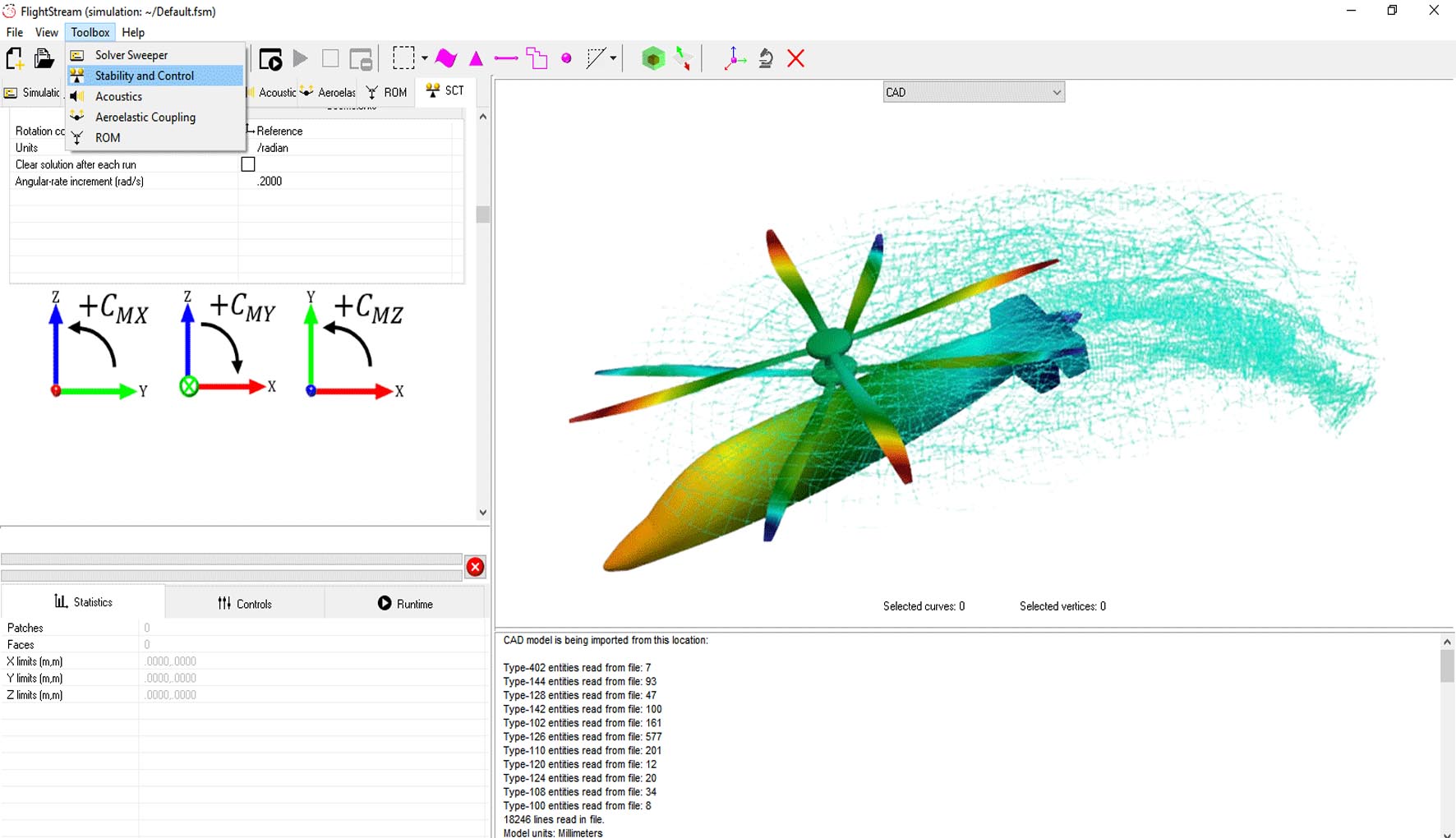
Altair FlightStream 2026 is a specialized Computational Fluid Dynamics (CFD) solver developed by Altair Engineering Inc., engineered for rapid aerodynamic analysis of aerospace vehicles. This software is designed to cater to the demanding needs of aerospace engineers, aerodynamicists, and designers working on conceptual aerospace vehicle design, UAVs, rotorcraft, and eVTOLs. By leveraging a unique Vorticity-Potential Method (VPM), FlightStream enables fast, meshless aerodynamic predictions directly on CAD geometry, facilitating swift design iterations crucial in the aerospace sector.
Innovative Aerodynamic Simulation for Aerospace Applications
Altair FlightStream 2026 distinguishes itself through its innovative Vorticity-Potential Method (VPM), a solver technology that departs from traditional meshing requirements. This meshless approach allows for aerodynamic simulations to be performed directly on native CAD geometry, significantly accelerating the prediction process. The software is primarily targeted at the aerospace engineering field, supporting industries such as aircraft manufacturing, unmanned aerial vehicle (UAV) design, and conceptual vehicle development. Professionals including aerospace engineers and drone designers benefit from its ability to provide quick yet accurate aerodynamic insights during early design stages.
High-Speed and Multi-Physics Aerodynamic Modeling
The capabilities of Altair FlightStream 2026 extend to advanced multi-physics simulations, addressing complex flow phenomena critical for high-performance aerospace applications. The software incorporates viscous boundary layer coupling, providing more accurate predictions of drag and stall characteristics. Notably, the 2026 release introduces capabilities for hypersonic flow regimes, featuring new models designed to account for real-gas effects and aerodynamic heating, essential for simulating conditions experienced by re-entry vehicles and advanced atmospheric craft. It also supports the modeling of propulsion systems and basic aeroelasticity considerations, along with simulations for ground effect.
Integration and Automation in Advanced Aerospace Workflows
FlightStream 2026 enhances the modern aerospace design workflow through deep integration and automation features. It interoperates seamlessly with other Altair solvers, including the ultraFluidX (using lattice Boltzmann method) and AcuSolve (finite element method), enabling multi-fidelity workflows for comprehensive validation and detailed analysis. The 2026 version introduces AI-assisted setup, which provides intelligent suggestions for simulation parameters, and robust cloud-native job management, allowing for scalable and efficient execution of simulations. Furthermore, its tight integration with the CAD ecosystem facilitates bi-directional updates and automated control surface deflections, streamlining the aerodynamic shape optimization process.
Efficient Aerodynamic Shape Optimization and Control Surface Analysis
Supporting rapid design iterations is a core strength of Altair FlightStream 2026, particularly through its features for aerodynamic shape optimization. The software enables automated setup for control surface deflections, crucial for evaluating aircraft maneuverability and stability across various flight regimes. By coupling FlightStream with Altair HyperStudy, engineers can conduct extensive optimization studies, systematically refining vehicle shapes to achieve desired aerodynamic performance. This integration accelerates the exploration of design-of-experiment (DOE) and optimization loops, contributing to more efficient product development cycles in aerospace.
Expanded Rotorcraft and eVTOL Simulation Features
The 2026 update to Altair FlightStream significantly bolsters its capabilities for rotorcraft and electric Vertical Take-Off and Landing (eVTOL) vehicle design. New enhancements include advanced modeling for transient wake interactions, critical for understanding rotor-rotor and rotor-airframe aerodynamics. The software supports methodologies like the actuator disk method, providing an efficient way to analyze rotor performance. These features are particularly valuable for the burgeoning urban air mobility (UAM) sector, enabling designers to simulate and optimize the complex aerodynamic behavior of eVTOL aircraft.
Practical Use Cases in Aerospace and Urban Air Mobility Design
Altair FlightStream 2026 finds application across a spectrum of cutting-edge aerospace projects. Its ability to perform fast, meshless aerodynamic analysis makes it ideal for drone and UAV aerodynamic simulations, where rapid prototyping and performance evaluation are key. Aerospace engineers leverage it for aircraft performance studies, from conceptual design to detailed analysis of specific flight phases. The software is also instrumental in the conceptual design of advanced aerospace vehicles, including hypersonic vehicles, where its ability to handle complex physics and new flow regimes is increasingly important.
Frequently Asked Questions
What makes Altair FlightStream’s Vorticity-Potential Method different from traditional CFD solvers?
Altair FlightStream utilizes the proprietary Vorticity-Potential Method (VPM), which operates as a meshless solver directly on CAD geometry. This fundamental difference from traditional mesh-based CFD solvers allows for significantly faster aerodynamic predictions while maintaining high accuracy, which is particularly beneficial for the rapid design iterations required in aerospace conceptual design.
How does FlightStream support high-speed and hypersonic aerodynamic simulations?
The 2026 release of FlightStream includes enhanced capabilities for high-speed and hypersonic flow simulations. It incorporates advanced models that address real-gas effects and aerodynamic heating, making it suitable for analyzing the extreme conditions encountered by re-entry vehicles and other advanced aerospace platforms operating at very high speeds.
Can FlightStream be integrated with other simulation tools for multi-fidelity analysis?
Yes, Altair FlightStream is designed for seamless integration within a broader simulation ecosystem. It can be coupled with Altair’s ultraFluidX solver, which employs the lattice Boltzmann method, and their AcuSolve solver, based on the finite element method. This connectivity enables users to perform multi-fidelity analyses, combining FlightStream’s rapid predictions with high-fidelity simulations for comprehensive aerodynamic validation and complex flow scenario assessment.






Reviews
There are no reviews yet.