

Download ANSYS Lumerical 2024 R1 – Advanced Photonic Simulation Software
ANSYS Lumerical 2024 R1 is an advanced optical simulation software suite developed by ANSYS, Inc. It is designed for professionals in photonics, semiconductor design, and electrical engineering, providing comprehensive tools for electromagnetic analysis and photonic design. This software plays a crucial role in the development of next-generation optical and optoelectronic devices.
Introduction to ANSYS Lumerical
Overview of the Software and Its Capabilities
ANSYS Lumerical serves as a powerful platform for simulating and analyzing the behavior of light and electromagnetic fields. Its suite of tools enables engineers and researchers to design, test, and optimize photonic components and systems. The software is instrumental in accelerating innovation across various technology sectors that rely on optical performance, from integrated photonics to renewable energy solutions.
Main Applications in Photonic Design
The ANSYS Lumerical software suite is widely adopted for its utility in several critical areas of photonic design:
- Integrated Photonics: Facilitates the design and analysis of complex photonic integrated circuits (PICs), enabling the creation of smaller, faster, and more energy-efficient optical devices for telecommunications and computing.
- Laser Design: Supports the simulation of various laser types, allowing for the precise control of optical properties and optimization of performance parameters.
- Photovoltaics: Aids in the development of advanced solar cell technologies by simulating light absorption and charge transport mechanisms, leading to improved energy conversion efficiencies.
- Optoelectronics: Enables the analysis and design of components that interface between electrical and optical domains, crucial for applications like sensors, modulators, and detectors.
Key Modules and Their Functionalities
FDTD Module
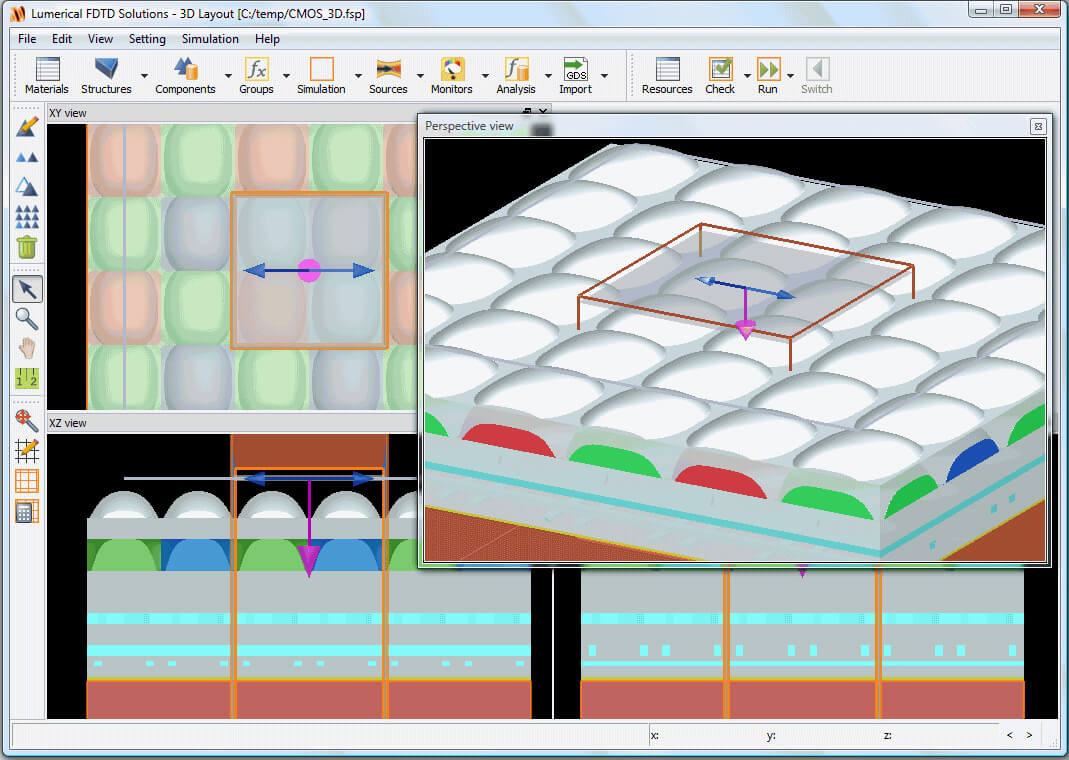
The FDTD (Finite-Difference Time-Domain) module is a core component of ANSYS Lumerical, specialized for simulating the interaction of light with complex structures. It solves Maxwell’s equations numerically in three dimensions, providing detailed insights into optical phenomena such as scattering, absorption, and interference. This module is essential for analyzing nanoscale optical devices and materials where precise electromagnetic field distribution is critical.
MODE Module
The MODE module is dedicated to the analysis of waveguides and guided-wave optics. It allows users to design, analyze, and optimize structures that guide light, such as optical fibers and integrated waveguides. This module is used to calculate modal properties, propagation losses, and mode profiles, which are fundamental for designing efficient optical interconnects and components within photonic circuits.
INTERCONNECT Module
INTERCONNECT is a powerful tool for managing and simulating integrated optical systems. It enables the co-simulation of different photonic components and sub-systems, creating a complete optical circuit model. This module facilitates the analysis of data flow and signal integrity within complex optical networks, streamlining the design process for large-scale integrated photonic designs.
DEVICE Module
The DEVICE module leverages TCAD (Technology Computer-Aided Design) principles for semiconductor device simulation, with a specific focus on optoelectronic components. It allows for the analysis of semiconductor devices that interact with light, such as photodetectors, modulators, and LEDs. By combining optical and electrical simulations, the DEVICE module helps optimize the performance and efficiency of these critical devices.
Advanced Features in ANSYS Lumerical 2024
ANSYS Lumerical 2024 R1 introduces several advanced features and enhancements aimed at improving simulation efficiency and accuracy. These include the BFAST (Broadband FastSweeping) solver for rapid analysis of resonant structures and significant improvements in parametric analysis capabilities. The latest version also offers enhanced tools for simulating complex optical components, enabling engineers to explore design spaces more thoroughly and accelerate the optimization of photonic devices.
Integration and Compatibility
ANSYS Lumerical is designed for seamless integration within broader engineering workflows. It is known for its compatibility with various operating systems commonly used in engineering and research environments. Furthermore, the software can integrate with other ANSYS simulation tools and third-party software, creating a comprehensive simulation ecosystem that supports multi-physics analysis and complex system-level design.
Conclusion and Further Resources
ANSYS Lumerical 2024 R1 provides a robust and versatile platform for photonic and electromagnetic simulations, empowering engineers to push the boundaries of optical and optoelectronic technology. Its modular design, advanced features, and deep integration capabilities make it an indispensable tool for industries focused on innovation in telecommunications, semiconductors, and renewable energy. For more in-depth understanding and to explore the latest advancements, consulting the official ANSYS documentation and technical resources is recommended.
Frequently Asked Questions
What are the key features of ANSYS Lumerical 2024?
ANSYS Lumerical 2024 R1 incorporates advanced modules for 3D electromagnetic simulation (FDTD), waveguide design and analysis (MODE), integrated optical system management (INTERCONNECT), and semiconductor device simulation (DEVICE). These capabilities are designed to enhance the performance, accelerate the design, and optimize the efficiency of photonic systems.
How does ANSYS Lumerical support the design of photonic integrated circuits (PICs)?
ANSYS Lumerical offers powerful simulation capabilities that enable detailed parametric analysis and optimization of PICs. Engineers can leverage these tools to design more efficient, compact, and high-performance photonic systems by simulating complex circuit layouts and their optical behavior.
What industries benefit the most from using ANSYS Lumerical?
Key industries that significantly benefit from ANSYS Lumerical include telecommunications, where it aids in developing advanced optical networking components; renewable energy, particularly in the design of more efficient photovoltaic cells; and the semiconductor manufacturing sector, for creating next-generation optoelectronic devices.








Reviews
There are no reviews yet.