

Download Autodesk Robot Structural Analysis Professional – Advanced Structural Engineering Software
Autodesk Robot Structural Analysis Professional is an advanced structural analysis software developed by Autodesk, Inc. This sophisticated tool is designed for structural engineers and architects, providing comprehensive capabilities for simulating and verifying structural behavior. It plays a critical role in the civil engineering field by enabling precise analysis of complex structures under various demanding conditions, ensuring safety and integrity.
Overview of Autodesk Robot Structural Analysis Professional
Understanding the Software’s Role in Civil Engineering
Autodesk Robot Structural Analysis Professional is a robust structural analysis and design software that empowers civil engineers to assess the behavior of structures under a wide range of loads and environmental factors. It is integral to verifying structural integrity, meeting design code requirements, and optimizing building performance. The software facilitates in-depth analysis, allowing engineers to predict how a structure will respond to stresses, thereby informing critical design decisions and ensuring the safety of built environments.
Key Features and Capabilities
Comprehensive Structural Analysis Tools
This software provides a powerful suite of tools for engineers to conduct thorough analysis of both linear and nonlinear behaviors in structures. It supports the direct analysis method, allowing for accurate simulation of how structures respond to static and transient loads, identifying potential failure modes and areas of concern before construction.
- Extensive tools for analyzing linear and nonlinear behaviors of various structural elements.
- Support for advanced analysis methods, including direct analysis.
- Verification against a broad spectrum of international design codes.
Dynamic Analysis of Complex Structures
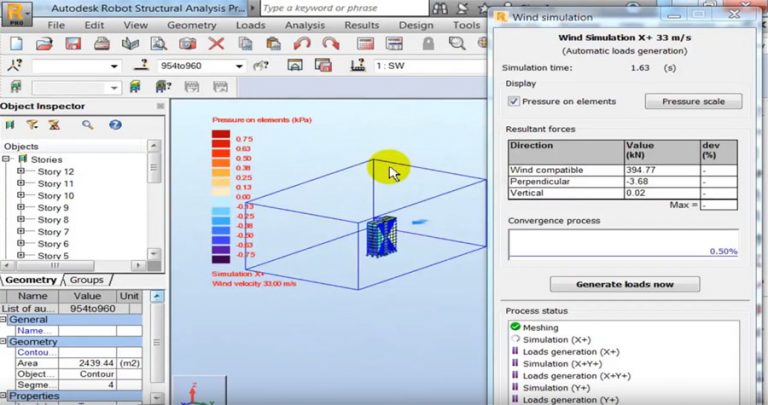
Autodesk Robot Structural Analysis Professional 2026 excels in dynamic analysis, enabling engineers to simulate the effects of seismic events and wind loads on structures. This capability is crucial for designing resilient buildings in earthquake-prone regions or areas susceptible to high winds, ensuring the structure’s ability to withstand such forces safely.
- Detailed simulation of seismic loads and their impact on structural integrity.
- Advanced wind load simulation to assess performance under varying atmospheric conditions.
- Analysis of transient effects to predict structural response over time.
Integration with Autodesk Revit
A significant advantage of Robot Structural Analysis Professional is its seamless two-way integration with Autodesk Revit. This feature allows for direct data exchange, where changes made in Revit can be instantly updated in the analysis model, and vice versa. This collaboration streamlines the design process, reduces errors, and enhances overall project efficiency.
- Enables bidirectional data transfer between Revit and Robot Structural Analysis.
- Facilitates iterative design refinements without manual data re-entry.
- Supports integrated workflows for architectural and structural design phases.
Application in Real-World Engineering Projects
Case Studies and Use Cases
Autodesk Robot Structural Analysis Professional is widely adopted across various civil engineering and construction projects. Its advanced analytical capabilities are applied to the design of high-rise buildings, bridges, industrial facilities, and complex infrastructure projects. By simulating responses to critical environmental factors like wind and seismic forces, engineers can confirm the structural integrity and safety of these vital constructions, ensuring compliance with stringent building standards.
- Used in the structural design of large-scale residential and commercial buildings.
- Applied to the analysis of complex bridge structures and overpasses.
- Facilitates safety assessments for industrial plants and specialized structures.
- Aids in verifying the performance of structures against diverse international codes.
Comparison with Other Structural Analysis Tools
Compared to other structural analysis software, Autodesk Robot Structural Analysis Professional 2026 distinguishes itself through its deep integration with the Autodesk ecosystem, particularly Autodesk Revit. This Revit integration offers unique collaborative advantages for architectural and engineering teams. Furthermore, its direct analysis method and comprehensive support for a vast array of international design codes provide a robust platform for global engineering projects. While other tools may offer specific niche functionalities, Robot Structural Analysis provides a balanced and integrated approach to complex structural modeling and verification.
Future Trends and Developments in Structural Analysis Software
The field of structural analysis software is continually evolving, driven by the demand for more efficient and accurate simulation capabilities. Future trends likely include further advancements in cloud-based analysis, enhanced artificial intelligence for design optimization, and improved simulation of material nonlinearities and environmental interactions. Enhanced integration with Building Information Modeling (BIM) processes, beyond current capabilities, is also anticipated. As computational power increases, software like Robot Structural Analysis will undoubtedly incorporate more sophisticated methods to predict structural behavior with greater precision.
Frequently Asked Questions
What is Autodesk Robot Structural Analysis Professional 2026 used for?
Autodesk Robot Structural Analysis Professional 2026 is designed for structural engineers to analyze complex structural behavior under various loads and conditions. It supports both linear and nonlinear analysis and is integral for ensuring that buildings can withstand environmental stresses such as earthquakes and wind forces.
How does Autodesk Robot Structural Analysis integrate with Revit?
The software allows for a seamless two-way communication with Autodesk Revit, enabling design modifications in Revit to be reflected in structural analysis and vice versa. This integration enhances efficiency and accuracy in structural design workflows.
What are the key advantages of using Robot Structural Analysis for wind load simulations?
Robot Structural Analysis offers specialized tools for simulating wind loads, ensuring that structures are designed to endure various wind conditions. Its advanced analysis capabilities lead to more robust and reliable structural designs.





Reviews
There are no reviews yet.