

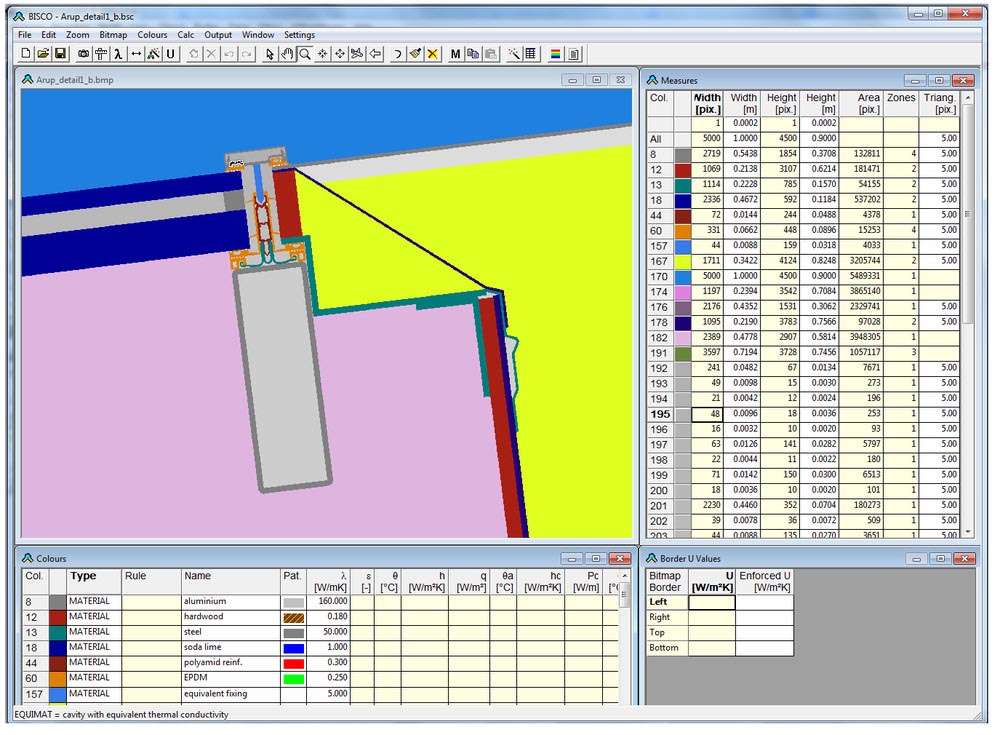
Download BISCO v12.2.03 – 2D Finite Element Heat Transfer Analysis Software
BISCO v12.2.03 is a specialized 2D steady-state finite element heat transfer analysis software developed by Physibel. This professional tool is designed for building physics applications, focusing on the accurate calculation of thermal bridges and U-values within building envelopes. It is widely recognized as an industry standard, particularly for professionals in HVAC, façade engineering, window and frame design, and within certification laboratories that require precise thermal performance data for regulatory compliance.
Overview of Steady-State Heat Transfer in Building Physics
Understanding and mitigating heat transfer through building components is crucial for energy efficiency, occupant comfort, and preventing moisture-related issues. Challenges arise from complex geometries, varied material properties, and the interaction of different heat transfer modes. BISCO addresses these complexities by providing a robust platform for detailed thermal bridge and U-value analysis, ensuring compliance with rigorous international standards. Its application spans optimizing window frame designs, improving façade junction performance, and generating precise data for building energy certifications.
Advanced Thermal Analysis Capabilities
Finite Element Solver and Thermal Models
BISCO employs a powerful finite element solver capable of handling complex thermal models with an unlimited number of nodes. This enables detailed analysis of intricate designs without performance constraints. The software supports both isotropic and orthotropic material properties, allowing for accurate representation of directional thermal conductivity in materials. Furthermore, it accommodates non-linear material behavior, which is essential for advanced simulations where material properties might change with temperature.
Radiative Heat Transfer in Cavities
The software’s RADCON module specifically addresses radiative heat transfer within cavities, a critical factor in the thermal performance of windows and building elements. It utilizes equivalent conductivity methods to simplify complex radiation dynamics and offers sophisticated gas-layer modeling capabilities. This allows for precise simulation of heat exchange by radiation in air gaps and other enclosed spaces, contributing to highly accurate overall U-value and Ψ-value calculations.
Window and Façade Thermal Performance Modeling
Frame Profile and Edge-of-Glass Calculations
BISCO offers specialized tools for calculating the thermal performance of window frames and the edge-of-glass areas. It accurately computes U-values for frames and Ψ-values (linear thermal transmittance) for the junctions between frames, glazing, and spacers. The software ensures compliance with standards such as NFRC 100 and NFRC 500, and it includes detailed modeling options for spacers and sealants, recognizing their impact on overall thermal resistance.
Complete Window Assembly Assessment
Beyond individual components, BISCO enables the assessment of complete window assemblies by combining frame and glass performance data. This provides a holistic view of the window’s thermal behavior. Additionally, the software calculates the surface temperature factor fRsi, a key metric for assessing the risk of surface condensation on interior surfaces, which is vital for maintaining indoor air quality and preventing mold growth.
Building Envelope Thermal Bridge Evaluation
Evaluating thermal bridges in building envelopes is essential for minimizing heat loss and ensuring structural integrity. BISCO excels in calculating linear thermal transmittance (Ψ-values) for various junctions, including corners, floor-wall connections, and wall-roof interfaces. It also computes temperature factors (fRsi values) at these critical points, providing clear indicators of condensation risk and helping designers implement effective thermal bridge mitigation strategies.
Model Creation and Geometry Handling
DXF Import and Automatic Preparation
BISCO streamlines the model creation process by allowing direct import of DXF files from CAD software. Users can assign materials based on imported layers, simplifying the setup for complex geometries. For standardized window and frame analyses, the software includes a dedicated EN 10077 preparation function, automating key steps required by the standard and reducing manual effort.
Bitmap Editor for Pixel-Level Refinement
Complementing its CAD import capabilities, BISCO features an integrated bitmap editor, specifically the BiscoBmp tool. This tool allows for pixel-level refinement of imported raster images or generated geometries. Features such as snap-to-pixel and clean-up functions enable users to ensure the geometric precision required for accurate finite element analysis, especially when dealing with pixelated or imperfect input data.
Visualization of Temperature and Heat Flow Results
The software provides comprehensive visualization tools to interpret simulation results effectively. Users can view detailed color maps illustrating temperature distributions across components and isotherms highlighting lines of equal temperature. Heat-flow vectors visualize the direction and magnitude of heat transfer, offering deep insights into thermal behavior. Additionally, BISCO can visualize condensation zones, clearly indicating areas where moisture may form on surfaces based on calculated temperatures and interior humidity conditions.
Professional Reporting and Data Export
BISCO supports professional reporting by generating results that comply with international standards, including EN ISO and NFRC documentation templates delivered in PDF format. Simulation data can also be exported in CSV or text file formats for further analysis or integration into other workflows. The software’s capability for batch processing and command-line operations enables automation of repetitive tasks and integration into larger simulation pipelines, enhancing efficiency for large-scale projects.
Frequently Asked Questions
What international standards does BISCO comply with?
BISCO v12.2.03 fully supports EN ISO 10077-2, EN ISO 12631, EN ISO 6946, ISO 15099, EN 673, and NFRC 100/500 for accurate U-value, Ψ-value, and thermal bridge calculations. This comprehensive standards coverage ensures that results meet regulatory requirements for building energy performance and product certification globally.
Can BISCO import CAD drawings for model creation?
Yes, BISCO allows direct DXF import with automatic layer-based material assignment and includes an EN 10077 preparation function for standardized window-frame analyses. This feature significantly reduces the time and effort required to set up complex models, leveraging existing design data efficiently.
What’s new in BISCO version 12.2.03?
Version 12.2.03 fixes an issue in the EN 10077 cavity-type setting, restoring full model configurability for TRANSMAT cavity definitions. This crucial bug fix ensures accurate thermal calculations for specific cavity configurations previously affected by the issue.






Reviews
There are no reviews yet.