

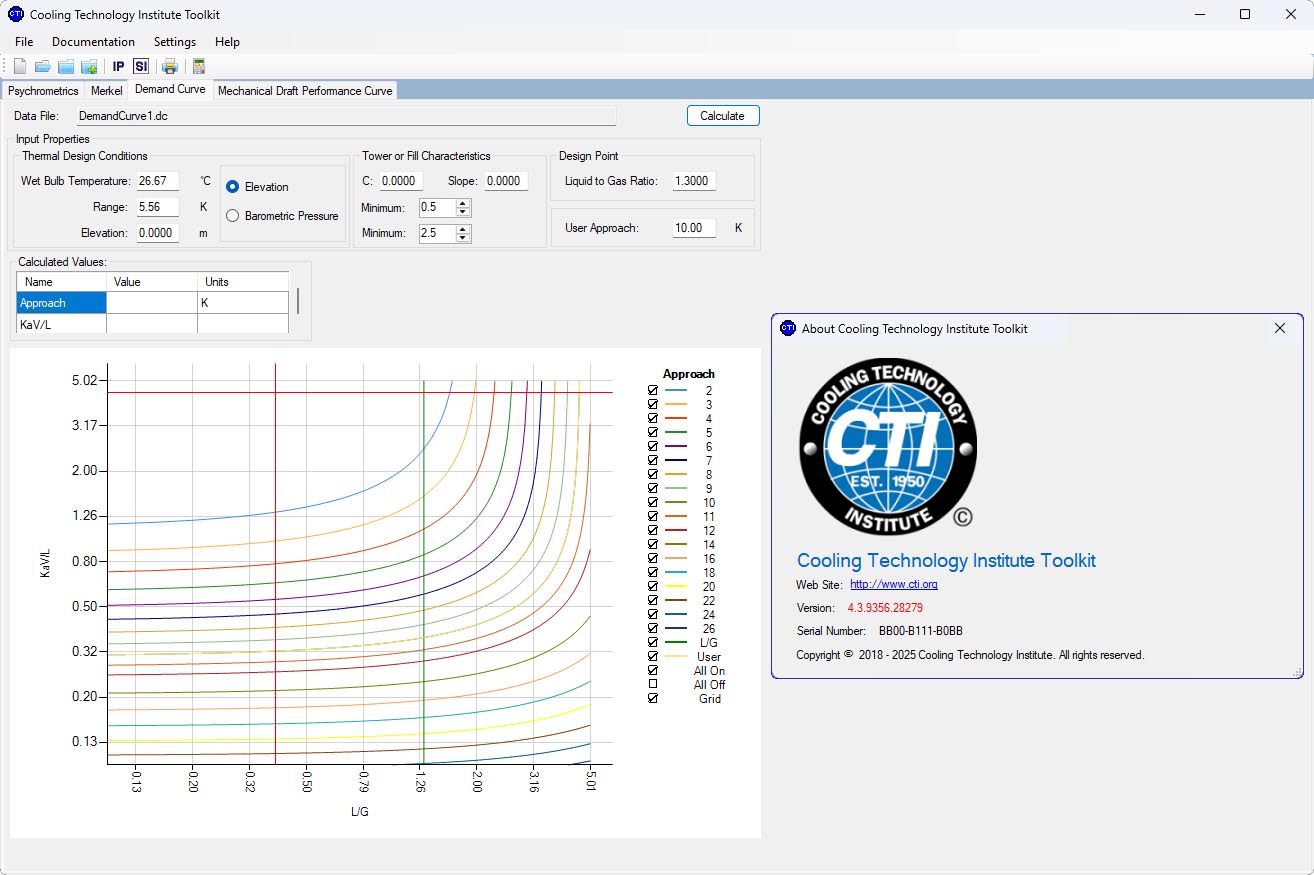
Cooling Technology Institute Toolkit
Cooling Technology Institute Toolkit is the industry-standard software for cooling tower thermal performance prediction, rating, and analysis – based on the rigorous CTI Acceptance Test Code (ATC-105) and CTI Standard 201. Developed by the Cooling Technology Institute (CTI), the leading trade association for cooling tower technology, this toolkit provides engineers with validated algorithms for calculating leaving water temperature, required fan power, evaporation loss, and part-load behavior across a wide range of tower types and configurations. Version v4.3.9 continues CTI’s mission of delivering science-based, peer-reviewed tools to the HVAC and industrial cooling community. Whether selecting a new cooling tower, verifying performance of an existing unit, or troubleshooting operational issues, the CTI Toolkit delivers the accuracy, credibility, and industry acceptance that professional engineers demand.
❄️ Primary Users
This professional cooling tower software is designed for:
-
HVAC Engineers & Cooling Tower Specialists designing, selecting, and rating cooling towers for HVAC and industrial applications.
-
Facility & Plant Engineers evaluating existing cooling tower performance and optimizing energy efficiency.
-
Energy Consultants & Commissioning Agents conducting acceptance tests and performance verification.
-
Cooling Tower Manufacturers & Reps selecting tower models and generating performance curves for proposals.
-
Process & Chemical Engineers integrating cooling towers with heat exchangers, condensers, and industrial processes.
⚡ Key Features & Capabilities
????️ Cooling Tower Thermal Rating
Performance Prediction (CTI Standard 201):
-
Leaving water temperature for given entering conditions (wet-bulb, flow, heat load)
-
Required fan power (BHP – brake horsepower) for specified tower fill and fan type
-
Merkel number (KaV/L) calculation based on tower characteristics
Rating Modes:
-
Rating Mode: User defines tower characteristics; software predicts leaving water temperature
-
Selection Mode: User specifies leaving water temperature; software determines required tower size
-
Off-Design / Part-Load: User varies entering water temperature, flow, or wet-bulb; new leaving water predicted
???? Cooling Tower Types & Configurations
Tower Types:
-
Induced draft (counterflow and crossflow)
-
Forced draft
-
Natural draft (hyperbolic)
-
Closed circuit (fluid cooler)
Fill Media:
-
Film fill (PVC, polypropylene), splash fill (wood, plastic)
-
User-defined fill performance data (KaV/L, Merkel number)
????️ Psychrometric & Thermodynamic Properties
Properties:
-
Wet-bulb temperature, dry-bulb temperature, relative humidity
-
Enthalpy of air-water vapor mixture (I, kJ/kg da)
-
Saturation humidity (W*, kg water/kg dry air)
Altitude Correction:
-
Barometric pressure adjustment for site elevation
???? Evaporation & Makeup Water
Evaporation Loss:
-
Standard evaporation (0.8–1.0% per 10°F range) plus CTI method
-
Drift (windage) loss based on eliminator type
-
Blowdown / cycles of concentration (COC) calculation
Water Chemistry:
-
Langelier Saturation Index (LSI) and Ryznar Stability Index (RSI) calculation
-
pH, conductivity, TDS projection
⚡ Fan & Motor Power (Energy)
Fan Power:
-
Airflow (CFM) and static pressure (inches H₂O)
-
Fan efficiency (propeller, vaneaxial)
-
Belt drive losses
Motor Power:
-
Shaft power (BHP) → motor HP (include service factor)
-
VFD efficiency (part‑load)
???? Acceptance Test & Field Performance Verification (ATC-105)
Instrumentation Requirements:
-
Temperature (entering/exiting water, wet‑bulb)
-
Water flow (ultrasonic, magnetic, pitot)
-
Fan motor kW (power analyzer)
Test Uncertainty:
-
CTI tolerance (±1°F leaving water temperature for thermal)
-
Fan motor power (±5%)




Reviews
There are no reviews yet.