

Download Deep Excavation RetainEX 2025 v25.0 – Advanced Geotechnical FEM Software for Retaining Structures
Deep Excavation RetainEX 2025 v25.0 is a specialized geotechnical analysis and design software engineered for modeling and designing complex deep excavation and retaining structures. Developed for civil and geotechnical engineers, it utilizes the advanced Finite Element Method (FEM) to provide precise simulations of soil-structure interaction, offering superior capabilities over traditional limit equilibrium methods for challenging urban infrastructure projects.
Overview of Deep Excavation RetainEX and Its Application in Civil Engineering
RetainEX 2025 serves as a pivotal tool for professionals engaged in the design of retaining walls and deep excavations. Its primary function is to simulate and analyze the behavior of soil and structural elements under various loading and construction conditions. By employing the Finite Element Method, the software accurately models the complex, non-linear interplay between soil masses and engineered structures, which is crucial for ensuring the stability and safety of deep excavations, particularly in confined urban environments.
Advanced Finite Element Modeling for Soil-Structure Interaction
At its core, RetainEX 2025 leverages the Finite Element Method to perform sophisticated geotechnical analyses. The software supports both 2D plane strain and axisymmetric modeling configurations, allowing for versatile problem representation. It further enhances simulation accuracy by incorporating advanced constitutive soil models, including the widely recognized Mohr-Coulomb model and the more sophisticated Hardening Soil model. These models enable realistic simulation of soil deformation and strength characteristics, capturing non-linear soil behavior critical for accurate predictions of ground movement and structural response.
Comprehensive Structural and Support Element Library for Retaining Systems
RetainEX 2025 offers an extensive library of structural elements and support system components essential for constructing deep excavations and retaining structures. The software accurately models various wall types such as diaphragm walls, secant and tangent pile walls, king post walls, and sheet pile walls. It also includes a wide array of support mechanisms, including struts, anchors, and berms, with the capability to model pre-stressing and temperature effects for enhanced realism in analysis.
Simulating Complex Construction Stages and Load Conditions
A key strength of RetainEX 2025 lies in its ability to meticulously simulate the entire staged construction process. Users can model sequential excavation steps, wall installation, installation and stressing of support elements, and the effects of dewatering systems. The software also accounts for varied external load conditions, including surcharge loads applied to the ground surface and complex water pressure distributions. An optional seismic analysis module is available for evaluating the performance of retaining structures under dynamic earthquake loading.
Visualization, Reporting, and Compliance Features
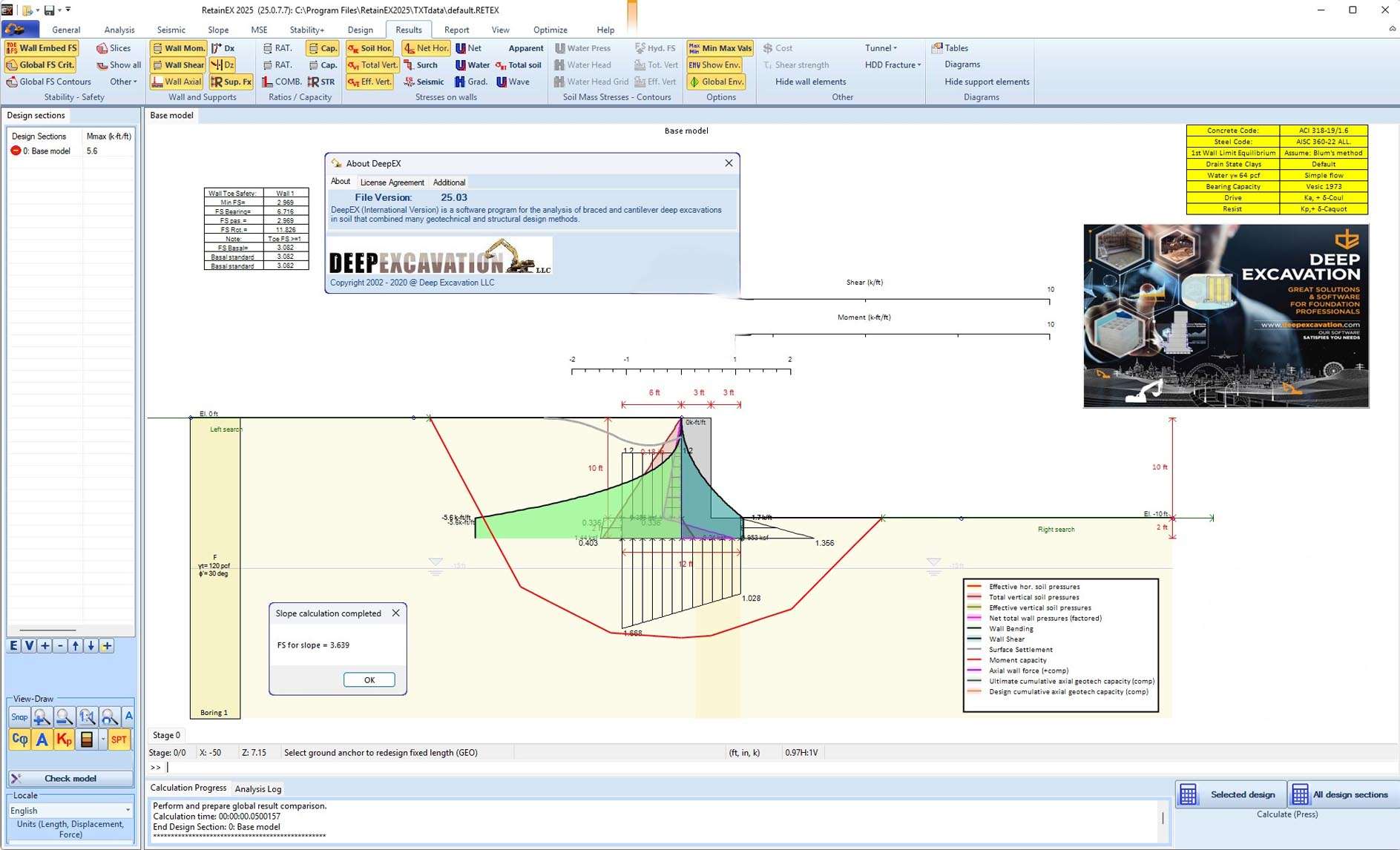
Post-processing capabilities in RetainEX 2025 are designed to provide engineers with clear and actionable insights. The software generates detailed visualizations of analysis results, including displacement contours across the soil mass and structure, as well as bending moment and shear force diagrams for structural elements. It includes automated checks for compliance with major international design codes such as Eurocode, ACI, and AISC, ensuring designs meet regulatory standards. The 2025 release offers enhanced reporting tools and improved CAD interoperability, streamlining the documentation process.
Enhancements and New Features in RetainEX 2025 Release
The RetainEX 2025 version introduces several significant improvements aimed at enhancing user experience and analytical power. These include a modernized user interface for more intuitive operation, substantial solver performance improvements for faster computation times, and an expanded library of soil constitutive models. Additionally, users benefit from enhanced automated reporting features and improved interoperability with standard CAD software, facilitating smoother integration into broader design workflows.
Practical Use Cases and Industry Applications
Deep Excavation RetainEX 2025 is ideally suited for a range of demanding civil engineering projects. Typical applications include the design of multi-propped basement excavations for high-rise buildings in dense urban areas, the analysis of secant pile retaining systems for deep shafts, and the evaluation of diaphragm walls for subway stations and underground infrastructure. Its robust simulation capabilities are particularly valuable for safety-critical projects and for analyzing structures in seismically active regions.
Frequently Asked Questions
How does RetainEX 2025 improve the accuracy of deep excavation analysis compared to traditional methods?
RetainEX 2025 uses advanced Finite Element Method modeling to simulate non-linear soil behavior and soil-structure interaction throughout staged construction, providing insights into wall displacements, bending moments, and stress distributions that simpler limit equilibrium methods cannot achieve.
Can RetainEX 2025 model seismic effects on retaining structures?
Yes, RetainEX 2025 includes an optional dynamic analysis module for simulating seismic loads, enabling engineers to evaluate the structural response of retaining walls and support systems under earthquake conditions.
What types of retaining walls and support systems can RetainEX 2025 analyze?
The software supports a comprehensive range of structural elements including diaphragm walls, sheet piles, secant and tangent pile walls, king post walls, concrete retaining walls, as well as support systems like props (struts), ground anchors, and berms with capabilities to model pre-stressing and temperature effects.






Reviews
There are no reviews yet.