

Download DS Simulia XFlow 2026 – Advanced Computational Fluid Dynamics Software
DS Simulia XFlow 2026 is an advanced Computational Fluid Dynamics (CFD) software developed by DS Simulia, following their acquisition of Next Limit Technologies. This sophisticated application is designed to provide accurate and efficient fluid simulation capabilities for mechanical engineering professionals. It is particularly valuable for tasks involving transient aerodynamics and complex fluid dynamics, serving a wide range of industries that require high precision in their simulation workflows.
Overview of DS Simulia XFlow 2026
XFlow has evolved into a powerful tool within the field of Computational Fluid Dynamics. Originally developed by Next Limit Technologies, its acquisition by DS Simulia integrated it into a broader ecosystem of engineering simulation solutions. The software is built upon a unique methodology that distinguishes it from conventional CFD approaches, focusing on computational accuracy and efficiency. This foundational approach makes DS Simulia XFlow a significant asset for engineers dealing with intricate fluid mechanics problems across diverse industrial sectors.
Key Features of XFlow
Advanced Analysis Capabilities
DS Simulia XFlow 2026 offers robust capabilities for advanced and automatic analysis, enabling users to perform complex simulations with greater accuracy and less manual intervention. The software is designed for seamless integration with other engineering tools; for instance, it supports interoperability with structural analysis software such as MSC Nastran, allowing for coupled multiphysics simulations. This integration capability is crucial for comprehensive product development and validation cycles in demanding engineering environments.
User Interface and Experience
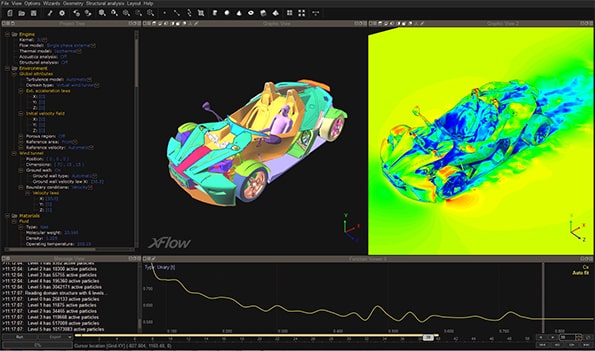
The software boasts a powerful and intuitive user interface, which is a cornerstone of its design philosophy. This emphasis on user experience ensures that complex CFD tasks are manageable, even for users who may not be CFD specialists. The efficient workflow facilitated by the interface streamlines the simulation process, from setup to analysis, thereby enhancing overall productivity for mechanical engineering software users.
Data Structure and Compatibility
XFlow utilizes an efficient and modern data structure, with comprehensive support for the HDF5 (Hierarchical Data Format version 5) format. This specific data handling capability is instrumental in managing large simulation datasets, improving data processing speed, and ensuring robust storage solutions. Its compatibility with HDF5 for fluid simulation results supports deeper analysis and easier data sharing among project teams.
Applications in Various Industries
The versatility of DS Simulia XFlow makes it an indispensable tool across a wide spectrum of industries. Its advanced fluid simulation capabilities are routinely applied in the automotive sector for aerodynamic design and performance optimization, and in the aerospace industry for analyzing flight dynamics and component efficiency. Furthermore, its application extends to civil engineering for modeling environmental flows and structural integrity, and to the design of hydraulic structures, demonstrating its broad utility in addressing complex fluid-related challenges.
Unique Approach to CFD
XFlow distinguishes itself through an innovative approach to Computational Fluid Dynamics that significantly minimizes the need for traditional, often time-consuming, meshing processes. By employing advanced particle-based methods, the software enhances modeling efficiency and accuracy. This unique methodology allows for faster simulation turnaround times and more reliable results, particularly in scenarios involving transient aerodynamics and complex flow phenomena, setting it apart from many conventional CFD software packages.
Real-World Use Cases
In the automotive industry, XFlow has been instrumental in optimizing vehicle aerodynamics, leading to reduced drag coefficients and improved fuel efficiency. For aerospace applications, it has been used to simulate complex airflow patterns around aircraft components, enhancing safety and performance. In civil engineering projects, simulations have helped engineers understand wind loads on large structures and the behavior of water flow in rivers and dams, ensuring structural integrity and efficient design. These practical applications highlight XFlow’s role in advancing design quality and problem-solving in real-world engineering dilemmas.
Frequently Asked Questions
What industries benefit from using DS Simulia XFlow?
DS Simulia XFlow is utilized across multiple industries such as automotive, aerospace, and civil engineering. Its advanced fluid dynamics simulations help improve product design and efficiency by providing detailed insights into fluid behavior under various conditions.
How does DS Simulia XFlow simplify CFD processes?
XFlow adopts a unique approach by reducing reliance on traditional meshing techniques, which streamlines the modeling process and enhances computational efficiency without extensive manual input. This methodology allows for quicker setup and faster simulation execution.
What unique features does XFlow offer compared to other CFD software?
XFlow features advanced modeling capabilities, a user-friendly interface, and supports an efficient data structure with HDF5 compatibility, ensuring improved performance during fluid simulations unlike many traditional CFD tools that may require more complex setups and data management.




Reviews
There are no reviews yet.