

Ensoft APILE 2026.12.1 – Analysis and Design of Axially Loaded Driven Piles
APILE is a specialized software program developed by Ensoft Inc. for computing the axial capacity (skin friction and end bearing) of driven piles as a function of depth . The program uses nonlinear soil models and elastic pile deformation to generate load-settlement predictions .
The Standard Version provides established methods from API RP-2A, USACE, FHWA, and the Revised Lambda Method. The Offshore Version adds four CPT-based methods: NGI, ICP, UWA, and Alm & Hamre (A&H) methods .
Version 2026.12.1 was released on April 28, 2026, as part of Ensoft’s ongoing development cycle
Primary Users
APILE 2026.12.1 is designed for geotechnical engineers, foundation designers, and offshore structure specialists who need to compute the axial capacity of driven piles. It serves professionals who:
-
Analyze axial capacity for driven piles in clay, sand, or mixed-soil profiles
-
Design pile foundations for onshore and offshore structures
-
Compare multiple capacity methods simultaneously for optimal design decisions
-
Perform LRFD analyses for compliance with AASHTO standards
-
Generate load-settlement curves for predicting pile behavior under axial loading
Key Features & Capabilities
Core Computation Methods
-
Standard Methods: API RP-2A, USACE, FHWA (including Tomlinson 1979 Table D for soft clays), and Revised Lambda Method
-
Offshore CPT-Based Methods: NGI, ICP, UWA, Unified CPT-Based (UCPT), and Alm & Hamre (A&H) methods
-
User-Defined Input: Custom unit load transfers for skin friction and end bearing based on site test data
Analysis Capabilities
-
LRFD Implementation: Independent reduction factors for skin friction and end bearing per AASHTO standards
-
Load-Settlement Curves: Short-term prediction using internal t-z and Q-w curves
-
Tensile (Uplift) Loading: Computations with user-specified reduction factors
-
Neutral Plane Analysis: Downdrag analysis per FHWA recommendations
-
Plugging Calculations: Internal computation for open-ended pipe piles (plugged, unplugged, or internally calculated)
Pile Types Supported
-
Circular: Pipe piles (hollow or filled), drilled shafts
-
Non-Circular: Steel shapes, precast concrete, timber, tapered piles (Raymond-type step or uniform taper), FHWA piles of varying sections
Data Input and Visualization
-
CPT Data Import: Read cone penetration test files and convert to equivalent SPT-N values and shear strength
-
3D Visualization: View pile, soil strata, and computed load transfers
-
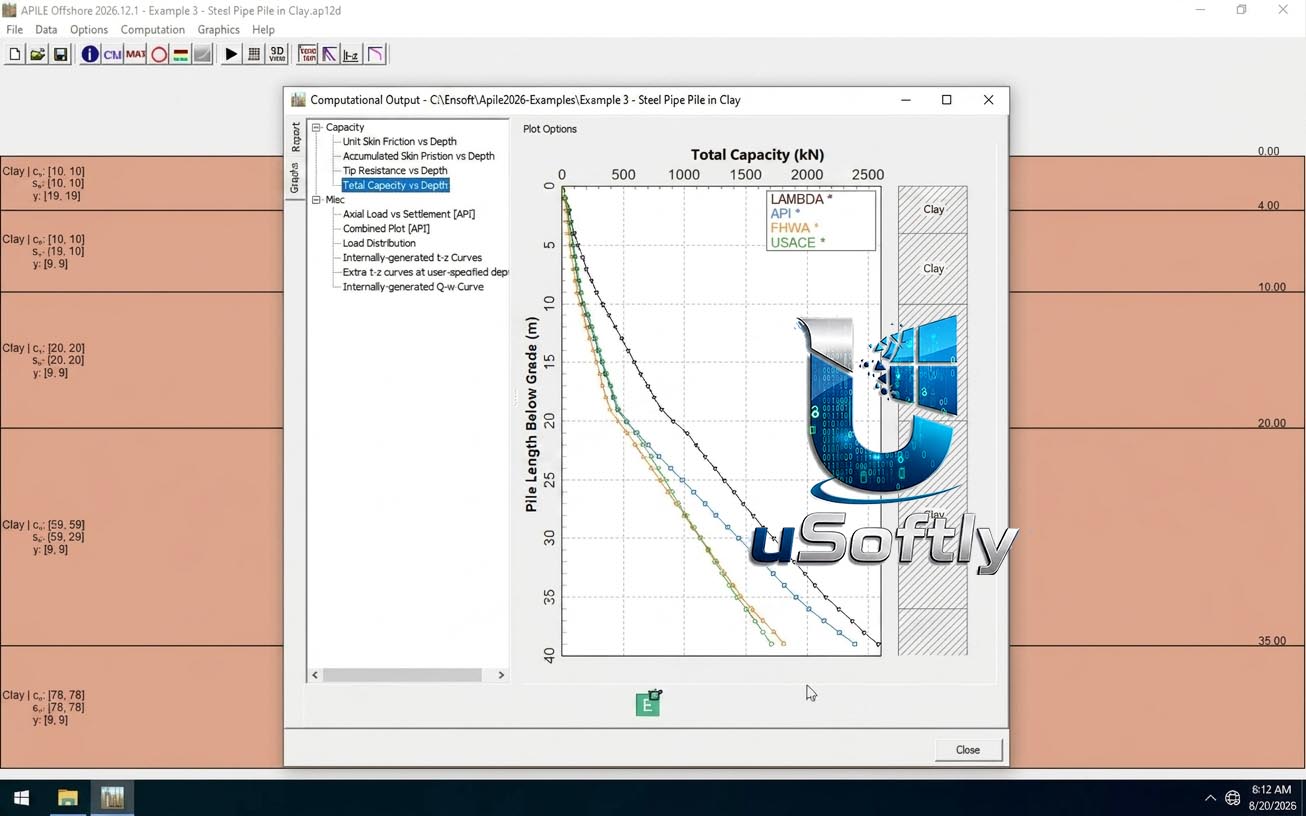
Graphical Output: Load-distribution curves, load-settlement curves, and bearing capacity vs. depth
-
Export to Excel: Direct export of graphs to pre-formatted Excel spreadsheets
Reporting and Integration
-
GRLWEAP Export: Generate input files for dynamic pile driving analysis
-
Custom Output Viewer: Integrated viewer for output text and applicable graphs
-
Formatted Reports: Export to Microsoft Word
-
Command Line Interface: Parametric runs using scripting languages




Reviews
There are no reviews yet.