

Download GEOS Geostab 2025 – Geotechnical Stability Analysis Software
GEOS Geostab 2025 is specialized geotechnical stability analysis software developed by GEOS for civil and geotechnical engineering professionals. It is designed to assess the stability of natural slopes, embankments, retaining structures, and reinforced soil systems. This software is crucial for validating designs and ensuring safety in infrastructure projects, fitting within the broader category of geotechnical analysis software extensively used in civil construction.
Overview of GEOS Geostab 2025 and its Applications in Civil Engineering
GEOS Geostab 2025 serves as a cornerstone tool for geotechnical engineers, providing advanced capabilities for analyzing the stability of earth structures and foundations. The software is integral to projects requiring rigorous safety assessments, such as the construction of new highways, urban developments, and flood defense systems. Its applications span across various facets of civil engineering where understanding soil mechanics and structural integrity under load is paramount.
Comprehensive Stability Modelling Tools in GEOS Geostab 2025
The software offers a robust suite of tools for comprehensive stability modeling. Engineers can analyze diverse scenarios including natural slopes, excavations, embankments, and complex retaining wall systems. GEOS Geostab 2025 supports the evaluation of multiple fracture surface types, such as circular, planar, and spiral shapes, enabling accurate prediction of failure mechanisms. It also accommodates various load conditions, including distributed and point loads, and incorporates seismic analysis through the pseudo-static method.
Advanced Geotechnical Calculation Methods and Safety Standards Compliance
GEOS Geostab 2025 facilitates compliance with stringent international safety standards, notably through its implementation of Eurocode 7 partial safety factor approaches for geotechnical design. The software also integrates specialized calculation methods like the Kranz Method for verifying anchorage mass stability. Further advanced features include handling anisotropic and depth-dependent soil parameters, along with automatic nail length optimization to refine the design of reinforced structures.
Integration and User Interface Features for Efficient Modelling
Efficiency in modeling is enhanced by GEOS Geostab 2025’s user-friendly interface and integration capabilities. The software allows for the import of background plans, including AutoCAD files, providing a familiar and practical environment for design work. Features such as mouse-driven profile creation, a multi-language interface, and the ability to input survey sections streamline the modeling process. Project case management through phase management tools also supports complex engineering workflows.
Force Analysis and Reinforcement Dimensioning with GeoSpar
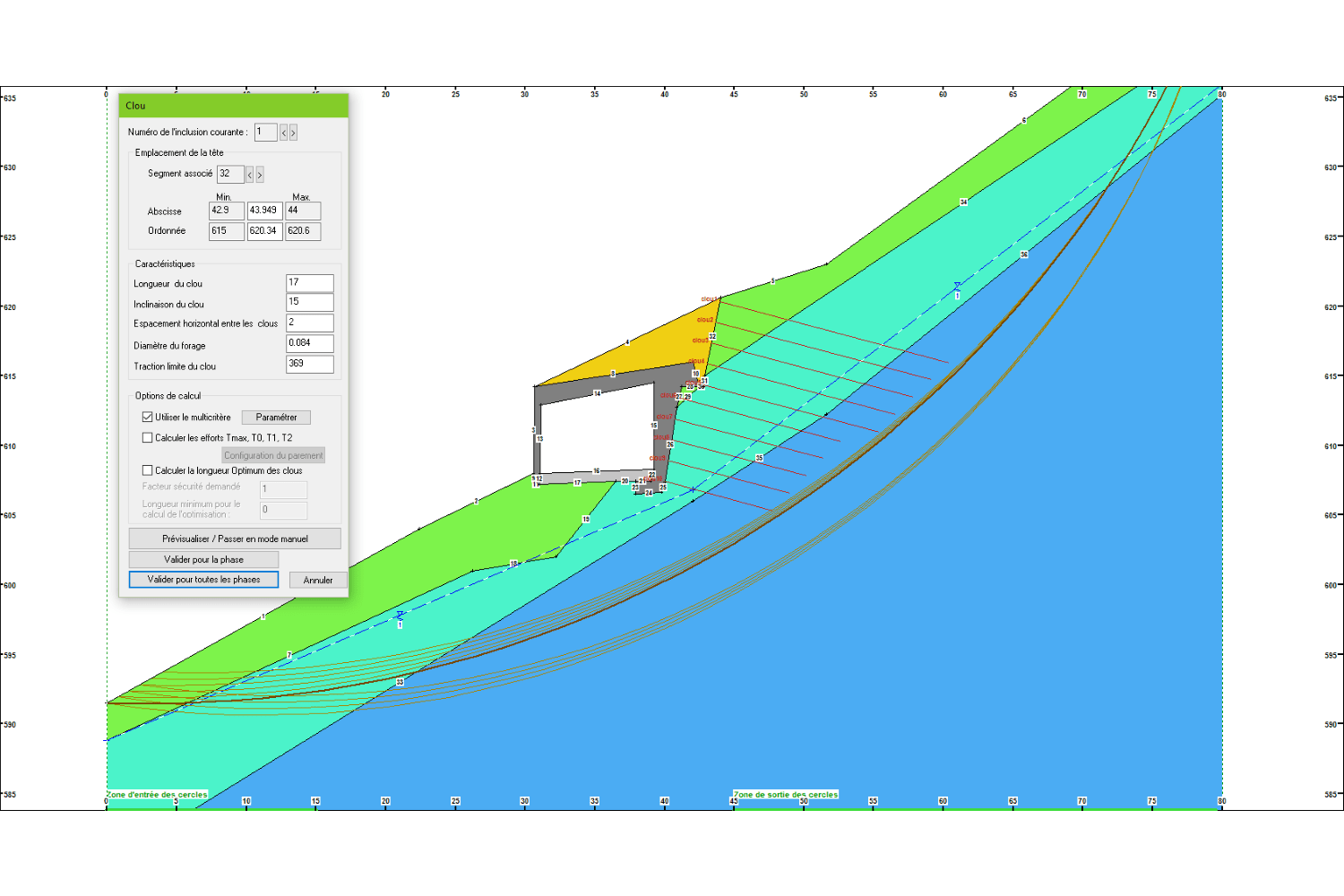
The GeoSpar module within GEOS Geostab 2025 is dedicated to detailed force analysis and the dimensioning of reinforcement elements. It enables the calculation of maximum tensile and shear forces acting on inclusions and facings within reinforced soil structures. This capability is vital for engineers to accurately size reinforcements like pins, nails, and geotextile sheets, ensuring the overall stability and longevity of the constructed system.
Practical Use Cases and Industry Applications
GEOS Geostab 2025 finds extensive application in real-world civil engineering projects. It is utilized for slope stability verification in major infrastructure developments like highways and railways, where the risk of landslides is a significant concern. The software is also instrumental in the design and optimization of retaining walls for urban construction and the safety assessment of slopes reinforced with nailed walls for excavations. Furthermore, its seismic stress evaluation capabilities are critical for projects in earthquake-prone regions, contributing to more resilient infrastructure.
Frequently Asked Questions
How does GEOS Geostab 2025 handle seismic stress analysis for slope stability?
GEOS Geostab 2025 incorporates seismic stresses using the pseudo-static method, allowing engineers to evaluate slope and retaining structure stability under earthquake loading conditions. This enables safer design practices in seismic-prone areas by quantifying potential instability due to seismic forces.
What types of fracture surfaces can GEOS Geostab 2025 analyze?
The software supports various fracture surface geometries including circular, planar, spiral, or combinations thereof. This flexibility helps engineers accurately model complex failure mechanisms in soil and reinforced structures, leading to more precise stability assessments.
Can GEOS Geostab 2025 optimize nail length in nailed wall designs?
Yes, GEOS Geostab 2025 provides automatic nail length optimization, helping engineers design efficient nailed wall reinforcements, save materials, and ensure structural stability. This feature allows for precise dimensioning of required nail lengths based on stability analyses.





Reviews
There are no reviews yet.