

Download IES ConcreteBending 8.00 – Advanced Finite Element Analysis for Reinforced Concrete
IES ConcreteBending 8.00 is a specialized finite element analysis (FEA) software developed by Integrated Engineering Software (IES), designed for advanced nonlinear analysis of reinforced concrete structures. This powerful tool is essential for professionals in civil engineering, structural engineering, and infrastructure design who require detailed insights into the behavior of concrete elements under various load conditions. It moves beyond traditional calculation methods to provide precise modeling capabilities for complex projects such as bridges, buildings, and other critical infrastructure.
In-depth Overview of IES ConcreteBending and Its Applications
IES ConcreteBending serves as a dedicated tool for engineers focused on the structural integrity of reinforced concrete. It addresses the complexities of concrete behavior, including its tendency to crack and the yielding of steel reinforcement, which are crucial factors in determining the real-world performance and safety of structures. The software is utilized across the civil engineering spectrum, from the design of individual structural components to the analysis of large-scale infrastructure projects like bridges and commercial buildings. Its application extends to academic research, where it aids in understanding and validating advanced structural theories.
Advanced Finite Element Modeling of Reinforced Concrete Sections
Nonlinear Material Behavior and Crack Modeling
The software employs sophisticated finite element methods to accurately simulate the nonlinear behavior of reinforced concrete. It meticulously models material properties, including concrete’s response to tensile stresses and its tendency to crack. The analysis incorporates crucial phenomena such as tension stiffening, which accounts for the contribution of concrete between cracks, and the eventual yielding of steel reinforcement under load.
Moment-Curvature and Axial Load Interaction Analysis
IES ConcreteBending is capable of performing detailed moment-curvature analysis, predicting how a concrete section will deform under bending moments. It also calculates axial load-moment interaction diagrams, illustrating the capacity of a member under combined axial forces and bending. These analyses are vital for understanding capacity, serviceability limits, and potential failure modes of beams, columns, and slabs.
Comprehensive Support for International Reinforced Concrete Design Codes
Ensuring global compliance and facilitating standardized design processes, IES ConcreteBending offers robust support for leading international reinforced concrete design codes. It is updated to adhere to the latest editions of standards such as ACI 318, Eurocode 2, and CSA A23.3. This compliance allows engineers to perform design checks and verifications with confidence, ensuring that their analyses meet rigorous regulatory requirements.
Enhanced Modeling Tools and User Interface Improvements in Version 8.00
Version 8.00 of IES ConcreteBending introduces significant enhancements aimed at improving user efficiency and analytical power. The graphical user interface (GUI) has been refined for a more intuitive workflow. Key upgrades include an expanded library of finite elements for greater modeling flexibility, advanced bond-slip modeling to better replicate the interaction between concrete and steel, and notable improvements in solver performance for quicker and more stable analysis of complex models.
Graphical Visualization and Engineering Reporting Capabilities
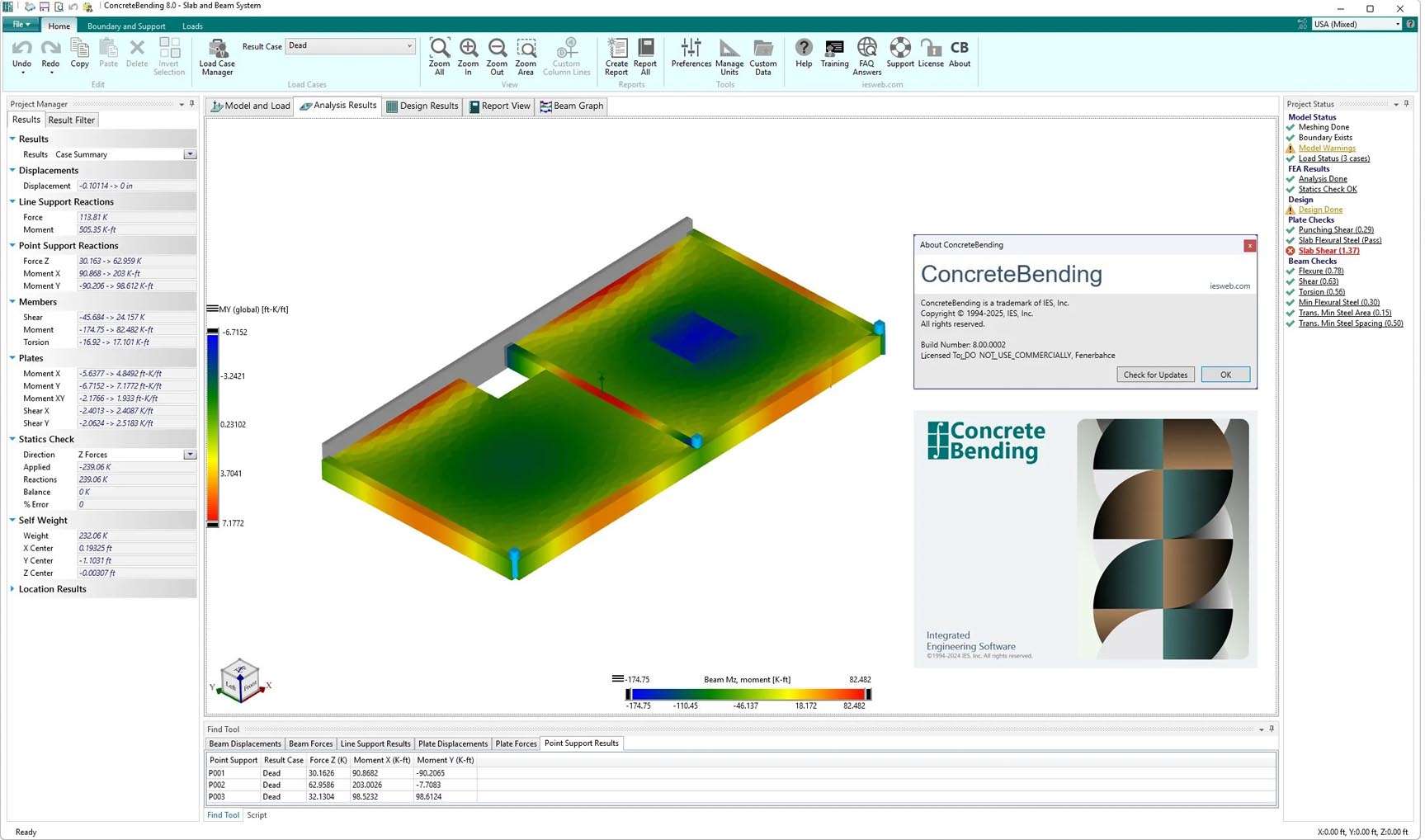
IES ConcreteBending provides powerful tools for visualizing and reporting analysis results. Engineers can generate clear graphical outputs depicting stress distributions, crack patterns, and deflections across the structural elements. The software also produces comprehensive, customizable engineering reports that include all necessary data, calculations, and summaries, facilitating clear communication of design findings and compliance documentation.
Integration with the IES Engineering Software Suite for Multi-Physics Analysis
As a component of the Integrated Engineering Software suite, IES ConcreteBending benefits from interoperability with other specialized modules. This integration allows for advanced multi-physics analyses, enabling engineers to couple structural responses with thermal or electromagnetic phenomena. Such capabilities are invaluable for projects requiring a holistic understanding of complex physical interactions.
Real-World Engineering Projects Benefiting from IES ConcreteBending
This advanced structural analysis software is applied to a wide range of practical engineering challenges. Typical use cases include detailed analysis of bridge components subjected to significant loads, the structural design of building slabs and columns considering nonlinear effects, and performance assessments of various infrastructure elements. Researchers also leverage its capabilities to investigate novel material behaviors and structural forms in reinforced concrete design.
Frequently Asked Questions
How does IES ConcreteBending improve the analysis of reinforced concrete compared to traditional methods?
IES ConcreteBending performs advanced nonlinear finite element analysis that includes cracking behavior, tension stiffening, and reinforcement yielding, providing more accurate predictions of structural response and safety compared to simplified hand calculations. This detailed approach accounts for the complex material properties of concrete and steel under load.
Which international design codes are supported by IES ConcreteBending?
The software supports major codes including the latest editions of ACI 318, Eurocode 2 with National Annexes, and CSA A23.3, ensuring compliance with global design standards during analysis and reinforcement design. This comprehensive support allows engineers to meet varied regulatory requirements.
Can IES ConcreteBending integrate with other engineering analysis software?
Yes, as part of the Integrated Engineering Software suite, it can exchange data with modules for thermal and electromagnetic analysis, enabling comprehensive multi-physics simulations. This interoperability allows for a more holistic approach to complex engineering problems.


Reviews
There are no reviews yet.