

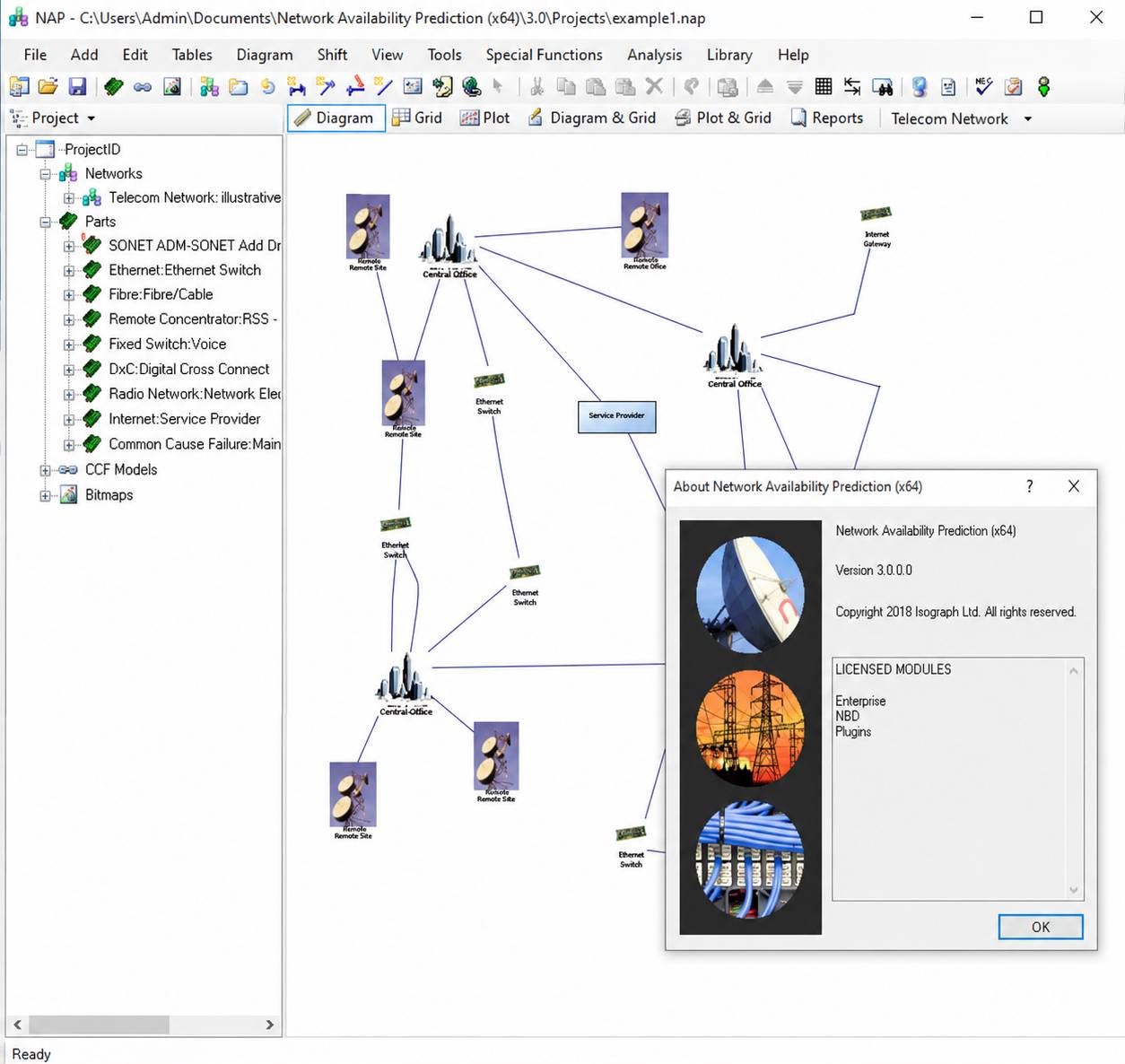
Isograph NAP 3.0: Communication Network Availability & Reliability Software
Isograph NAP (Network Availability Prediction) 3.0 is an advanced analytical tool for evaluating and predicting the availability of complex industrial networks. Using probabilistic modeling and precise analytical algorithms, the software enables analysis of failure impacts, repairs, and alternative path behavior on critical infrastructure. It is recognized as a key tool in energy, transportation, power generation, and critical systems industries for enhancing network reliability.
At its core, NAP implements availability prediction models using network structures and critical path methodologies. Analysts can simulate system behavior under failure, maintenance, and repair conditions, measuring the impact of each node and path on overall network performance. This approach enables decision-makers to identify vulnerable points before failures occur and design optimal service continuity strategies.
A key strength of NAP is its seamless integration with other Isograph family tools, allowing availability analysis results to be easily incorporated into safety, risk, and reliability models. With its precise user interface and modular architecture, the software is designed for large-scale projects and complex systems, capable of meeting advanced technical requirements.
.
???? Primary Users
This professional network analysis software is designed for:
-
Network Reliability & Availability Engineers assessing and predicting availability of complex industrial networks in energy, transportation, power plants, and critical infrastructure sectors
-
Critical Infrastructure Operators analyzing the impact of failures, repairs, and alternative paths on network performance
-
Risk & Safety Analysts integrating availability analysis results with safety and risk models within the Isograph software suite
-
Maintenance & Operations Planners developing preventive maintenance strategies based on quantitative availability predictions
-
System Architects & Design Engineers designing new networks with optimized redundancy and reduced vulnerability points
⚡ Key Features & Capabilities
????️ Complex Industrial Network Modeling
-
Create detailed network models including critical paths, interconnections, and key equipment
-
Model redundant paths, load sharing, standby configurations, and multi-directional dependencies
-
Support for multi-layer and multi-level network analysis with different infrastructure layers
???? Availability Analysis
-
Predict probability of system being operational under failure, repair, and maintenance conditions
-
Calculate steady-state and instantaneous availability metrics
-
Handle repairable and non-repairable components with various maintenance strategies
???? Failure & Maintenance Simulation
-
Evaluate impact of equipment failures and maintenance activities on overall network performance
-
Model different repair policies (as soon as possible, scheduled, deferred)
-
Simulate spare parts availability and logistics delays
???? Key Performance Indicators (KPIs)
-
MTBF (Mean Time Between Failures) – Average time between successive failures
-
MTTR (Mean Time To Repair) – Average time required to restore failed components
-
Availability – Probability that the network is operational at any given time
-
Reliability – Probability that the network operates without failure over a specified period
???? Sensitivity & Scenario Analysis
-
Investigate the effect of parameter changes and operational conditions on network performance
-
Identify critical nodes, links, and paths that most significantly impact overall availability
-
Run “what-if” scenarios for different failure rates, repair times, or maintenance policies
???? Integration with Isograph Suite
-
Share data and results with other Isograph tools (Reliability Workbench, Availability Workbench, FMECA)
-
Seamless integration for comprehensive risk, safety, and maintenance analysis
-
Leverage existing component libraries across the Isograph ecosystem
???? Advanced Analytical Reporting
-
Generate detailed technical and management reports for regulatory authorities and industrial safety consultants
-
Customizable report templates with charts, graphs, and tabular data
-
Export to PDF, Excel, and other standard formats
????️ Network Data Management
-
Structured storage and organization of nodes, paths, and equipment information
-
Centralized component library for reuse across multiple projects
-
Version control and audit trail for regulatory compliance
???? Operational Decision Support
-
Analytical data for maintenance planning and service continuity improvement
-
Risk-based decision making for capital investments and network upgrades
-
Identification of cost-effective availability improvement strategies
???? Technical Capabilities
Network Topology Support
-
Series, parallel, and complex interconnected configurations
-
Mesh, ring, star, and hybrid topologies
-
Multi-source, multi-sink networks
-
Directional and bidirectional links
Component Modeling
-
Nodes (routers, switches, servers, control systems)
-
Links (fiber optics, copper cables, wireless connections)
-
Power supplies and backup systems
-
Support for user-defined component types
Failure & Repair Models
-
Constant failure rate (exponential distribution)
-
User-defined failure distributions (Weibull, lognormal)
-
Multiple repair distributions
-
Common cause failures (CCF)
Calculation Methods
-
Minimal cut-set analysis
-
Fault tree-based availability calculation
-
Monte Carlo simulation for complex configurations
-
Rapid approximate methods for large networks





Reviews
There are no reviews yet.