

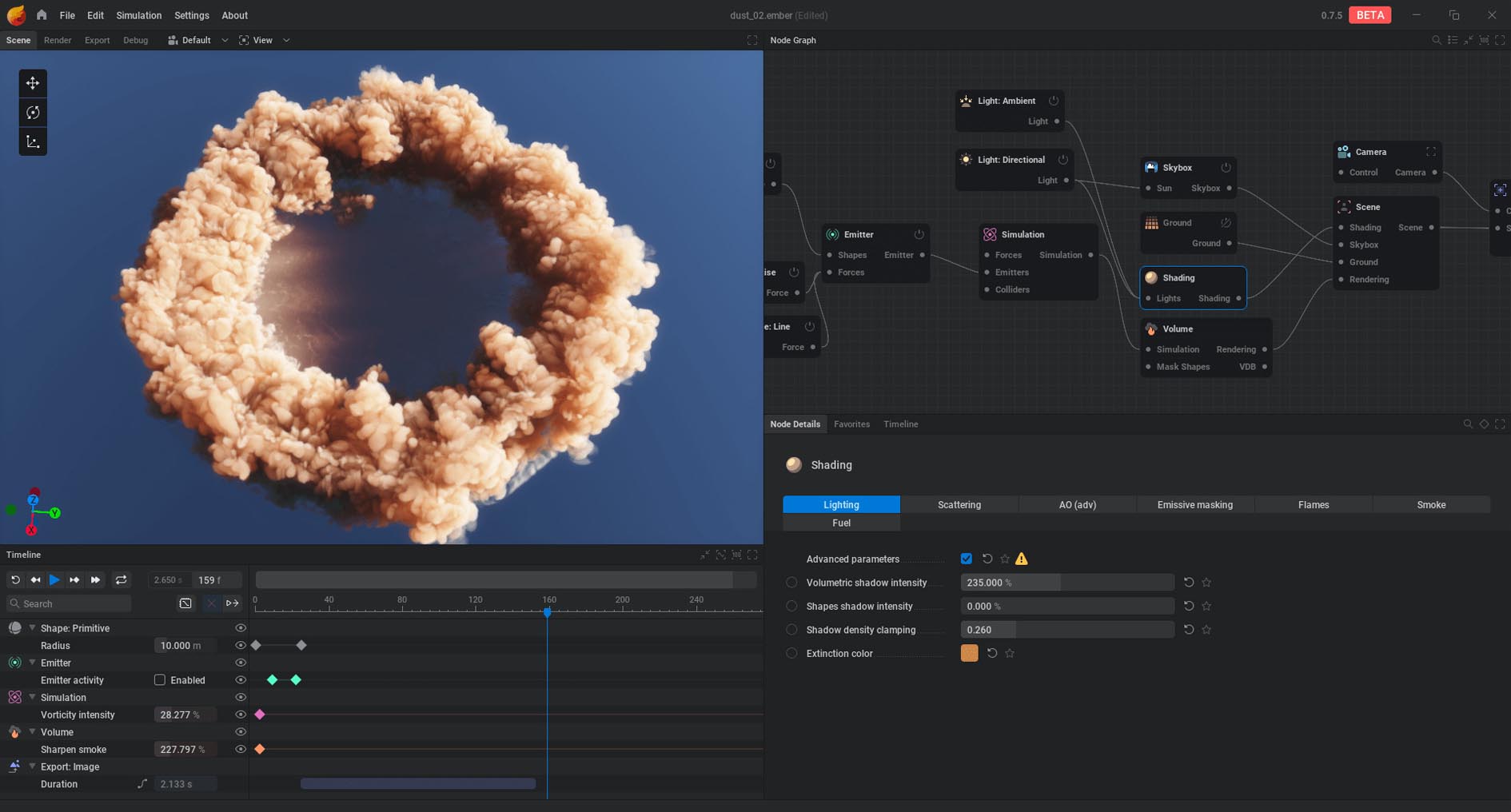

Download JangaFX EmberGen 1.2.6 – Real-Time Volumetric Fluid Simulation for VFX and Games
JangaFX EmberGen 1.2.6 is a specialized GPU-accelerated real-time volumetric fluid simulation software designed for creating complex fire, smoke, and explosion effects. It serves visual effects artists, game developers, and motion graphics professionals by enabling rapid, interactive simulation and rendering directly on modern graphics hardware. Key industries benefiting from EmberGen include film and television production, game development, and real-time simulation rendering.
Overview of EmberGen’s Role in Visual Effects and Real-Time Simulation
EmberGen positions itself as a powerful tool for the creation of volumetric fluid effects, leveraging the immense parallel processing power of GPUs. This focus on real-time performance allows artists to achieve instant visual feedback on their simulations, drastically speeding up the iterative process of effect design. Its primary applications lie in accelerating workflows for VFX in film and games, where dynamic and realistic fire, smoke, and other fluid phenomena are essential.
Advanced Simulation Capabilities Expanding Fluid Effects
Real-Time Fire, Smoke, and Explosion Simulations
At its core, EmberGen excels at simulating dynamic phenomena such as fire, smoke, and explosions. By utilizing GPU computing, the software generates these complex volumetric effects at interactive frame rates. This means artists can make adjustments to parameters, forces, or emitters and see the results immediately, enabling a highly responsive and artistic approach to effect creation without lengthy render times for previews.
Introducing Liquid Simulation Beta in Version 1.2.6
Version 1.2.6 introduced the beta phase for liquid simulation capabilities within EmberGen. This significant update expands the software’s scope beyond gaseous fluids to include the simulation of liquid droplets and splashes. The addition of liquid simulation further diversifies the range of fluid effects that artists can create and iterate on in real time, enhancing EmberGen’s utility for broader VFX applications.
Node-Based Procedural Workflow for Creative Fluid Dynamics
EmberGen employs a node-based procedural workflow, allowing users to construct complex simulation setups through a visual graph. This system enables non-destructive editing and sophisticated control over fluid behavior. Artists can combine various nodes to introduce forces, turbulence, collisions, and other phenomena, shaping the simulation dynamically and achieving intricate effects through a modular and organized procedural approach.
Export Formats and Pipeline Integration for Production-Ready Assets
Flipbook and Image Sequence Exports
For integration into real-time engines like those used in game development, EmberGen provides versatile export options. Users can output simulations as flipbook animations, typically in formats like PNG or EXR image sequences. This allows for easy playback and rendering within game engines and provides a quick method for previews or simpler VFX integration where full simulation data is not required.
OpenVDB and Alembic Support
Professional VFX pipelines often require robust data exchange formats, and EmberGen supports key industry standards. It can export volumetric data in the OpenVDB format, which is widely adopted for its efficiency in storing sparse volumetric datasets and is crucial for advanced compositing workflows in software like Houdini or Nuke. Furthermore, EmberGen supports the use of Alembic files (.abc) for defining collision objects within simulations, ensuring compatibility with leading 3D content creation tools such as Maya and Blender.
Rendering Enhancements and Post-Processing Flexibility
Version 1.2.6 features an improved real-time ray marching renderer designed to produce higher-fidelity volumetric visuals. This enhancement includes more accurate rendering of effects like multiple scattering for smoke and realistic blackbody radiation for accurate fire coloration. Additionally, EmberGen incorporates integrated post-processing nodes, such as bloom, color grading, and curve adjustments, allowing artists to refine and finalize the visual output directly within the application before exporting.
Extending Workflow with Python Scripting and Automation
EmberGen offers a Python API that provides scripting capabilities for advanced users and pipeline TDs. This allows for the automation of repetitive tasks, customization of simulation parameters programmatically, and deeper integration of EmberGen into larger studio production pipelines. The Python interface empowers users to streamline workflows, manage assets, and extend the functionality of the software to meet specific production demands.
Recent Improvements and Performance Optimizations in EmberGen 1.2.6
Version 1.2.6 of EmberGen brings several improvements focused on usability and performance. The update includes refinements to the user interface and timeline controls for a smoother experience. New noise and distortion nodes have been added to augment creative control over simulations. The software has also undergone broad performance optimization, specifically targeting modern NVIDIA GPUs to ensure sustained real-time simulation and rendering speeds, making it a highly efficient tool for demanding visual effects work.
Frequently Asked Questions
What types of fluid simulations can EmberGen 1.2.6 perform in real time?
EmberGen 1.2.6 supports real-time GPU-accelerated simulations of fire, smoke, explosions, and introduces beta support for liquid droplets and splashes. This range allows creation of diverse volumetric fluid effects suitable for VFX and game projects.
How does EmberGen integrate with other VFX and 3D software pipelines?
EmberGen exports simulation data as flipbook image sequences for game engines and OpenVDB files for advanced compositing workflows. It also supports Alembic files as collision objects, enabling seamless interoperability with industry tools like Houdini, Maya, and Blender.
What are the hardware requirements to run EmberGen efficiently?
EmberGen requires a powerful, modern NVIDIA GPU (minimum GTX 1070 or RTX 2060 recommended, with RTX 3070/4070 preferred) along with a multi-core CPU and at least 16 GB RAM. The software relies heavily on GPU acceleration to deliver real-time simulation performance.




Reviews
There are no reviews yet.