


Download MSC SimManager 2025.1 – Enterprise Simulation Process and Data Management Software
MSC SimManager 2025.1, developed by Hexagon Manufacturing Intelligence, is an enterprise-grade Simulation Process and Data Management (SPDM) solution specifically designed for engineering simulation-centric industries. It serves as a central digital hub for managing the lifecycle of Computer-Aided Engineering (CAE) data, automating complex workflows, and ensuring traceability across diverse simulation tools and global teams. Professionals in the automotive, aerospace, heavy machinery, and energy sectors leverage this software to streamline product development and maintain rigorous engineering standards.
Overview of MSC SimManager in Engineering Simulation Management
MSC SimManager functions as a cornerstone for governing simulation processes and managing simulation data throughout its lifecycle. It provides a unified platform that orchestrates complex CAE activities, ensuring that all simulation-related information, from initial models to final results, is securely stored, version-controlled, and easily accessible. This systematic approach enhances collaboration among multidisciplinary engineering teams and guarantees the integrity and traceability of simulation outcomes, which is critical for meeting stringent quality and compliance requirements in highly regulated fields like automotive and aerospace engineering.
Automating and Orchestrating Complex Simulation Workflows
The software excels in automating and orchestrating intricate simulation workflows, encompassing pre-processing, solving, and post-processing stages. It connects to High-Performance Computing (HPC) resources to efficiently run simulations. MSC SimManager supports integration with a wide array of industry-standard solvers, including but not limited to MSC Nastran, Adams, Marc, Abaqus, and ANSYS. This broad compatibility ensures that teams can leverage their existing toolchains while benefiting from a managed and automated simulation process, thereby accelerating the product development cycle and improving overall engineering efficiency.
Centralized Repository for Secure CAE Data Management
MSC SimManager provides a centralized and secure repository for all simulation artifacts, including models, meshes, simulation results, and reports. Advanced version control capabilities ensure that users can track changes, revert to previous states, and maintain a clear history of their simulation data. The platform implements robust audit trails, offering complete traceability for every action performed on the data. This meticulous data governance is essential for adhering to compliance standards such as ISO 26262 and ASPICE, providing confidence in the accuracy and reliability of simulation data for critical design decisions.
Web Client Interface and Advanced Analytics for Simulation Monitoring
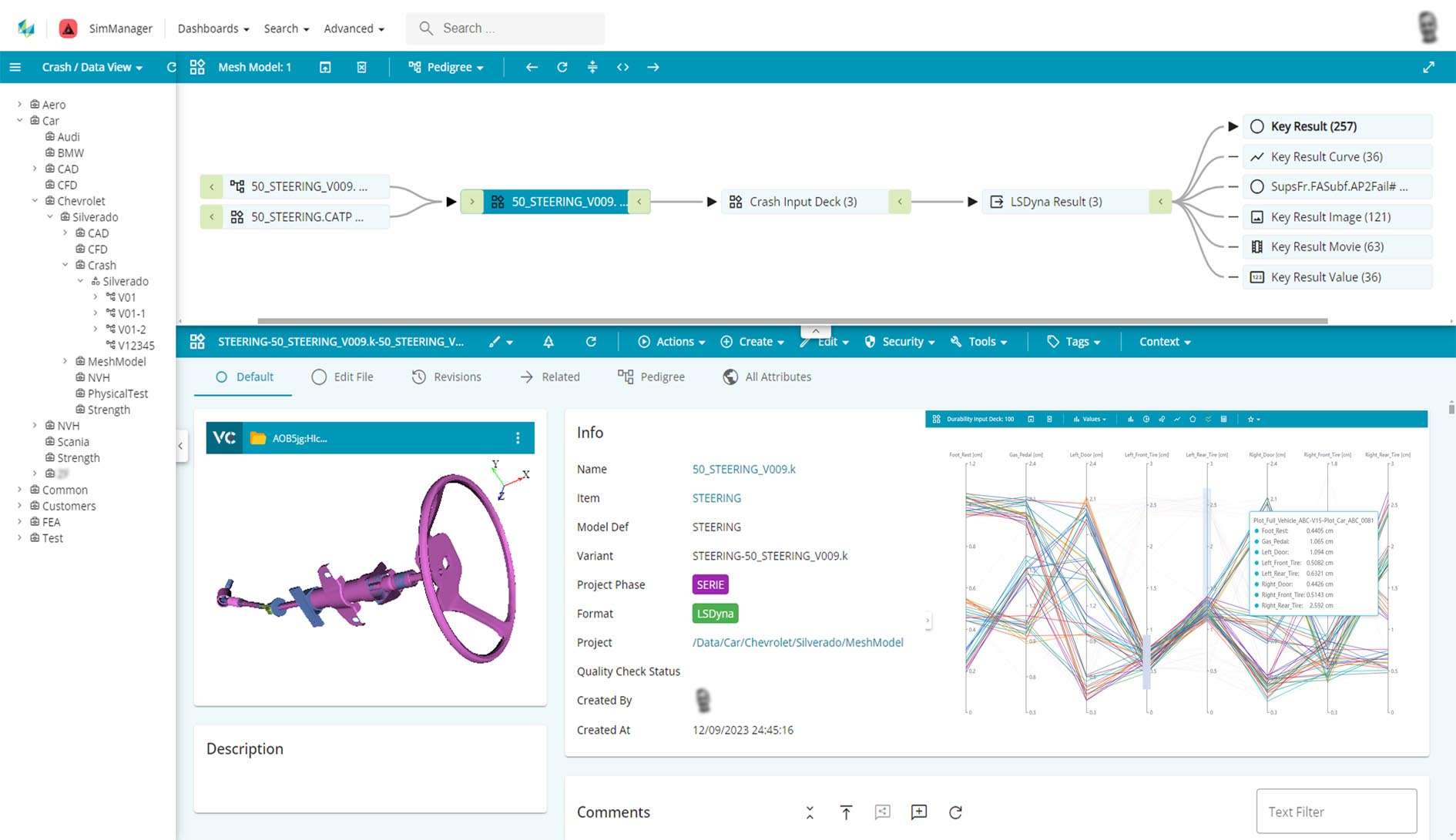
The 2025.1 release of MSC SimManager features a refined user experience through an intuitive, role-based web client. This interface provides tailored dashboards for different user types, offering easy access to simulation data and workflow management tools. Advanced analytics capabilities allow users to visualize simulation results directly within the browser and track key performance indicators (KPIs). These analytics tools are instrumental in monitoring simulation health, resource utilization, and project progress, enabling proactive management and optimization of simulation activities across the enterprise.
Scalability and Ecosystem Integration for Enterprise Deployment
Engineered for enterprise-level deployment, MSC SimManager offers significant scalability to support multi-site global operations with high availability. Its architecture is designed to handle vast amounts of simulation data and complex workflows efficiently. The software integrates seamlessly within the Hexagon ecosystem, providing deep connectivity with platforms such as MSC Apex for upfront CAE simulation, Cradle CFD for computational fluid dynamics, and the Atmosphere IoT platform. Furthermore, it offers robust connectivity with external Product Lifecycle Management (PLM) systems (e.g., Teamcenter, Windchill) and Enterprise Resource Planning (ERP) systems via REST APIs, creating a unified digital thread across engineering and manufacturing.
Applicable Industries and Use Cases of MSC SimManager 2025.1
MSC SimManager 2025.1 is instrumental in accelerating simulation-driven product development across various demanding industries. In the automotive sector, it is used for managing crash, durability, and NVH simulations, ensuring compliance with safety regulations. Aerospace companies utilize it for optimizing aircraft designs through complex aerodynamic and structural analyses while maintaining stringent certification requirements. Heavy machinery and energy sector clients leverage MSC SimManager for managing extensive simulation campaigns related to structural integrity, thermal performance, and fluid dynamics, all while underpinning these applications with reliable data traceability and workflow governance.
Frequently Asked Questions
What types of simulation workflows does MSC SimManager support?
MSC SimManager supports end-to-end automation of simulation workflows including pre-processing, solver execution, and post-processing across various CAE tools such as MSC Nastran, Adams, Marc, Abaqus, and ANSYS. This enables streamlined process orchestration across distributed computing resources.
How does MSC SimManager ensure data traceability and compliance?
MSC SimManager maintains a centralized, secure simulation data repository with version control, full audit trails, and traceability features. This supports compliance with engineering standards like ISO 26262 and ASPICE, essential for regulated industries.
Can MSC SimManager integrate with other engineering and enterprise software?
Yes, MSC SimManager provides deep integration within the Hexagon software ecosystem including MSC Apex and Cradle CFD, and offers REST APIs for connectivity with PLM systems like Teamcenter, Windchill, ERP, and custom in-house tools to unify simulation data workflows.






Reviews
There are no reviews yet.