

Download MSC Simufact Welding – Advanced Welding Simulation Software
MSC Simufact Welding, developed by MSC Software Corporation, is a specialized simulation application designed for advanced analysis of various welding and joining processes. It aids manufacturing and mechanical engineers in understanding, anticipating, and optimizing complex welding operations. This software is particularly valuable in industries that rely heavily on precision joining techniques.
Overview of MSC Simufact Welding
Introduction to Welding Simulation
The manufacturing sector increasingly relies on sophisticated simulation tools to streamline production and ensure product quality. Welding simulation software plays a critical role by enabling engineers to virtually test and refine welding procedures before committing to physical prototypes. MSC Simufact Welding, part of MSC Software’s simulation portfolio, provides robust capabilities for analyzing heat transfer, material phase transformations, and mechanical stresses inherent in welding. Developed by MSC Software, a company with a long history in engineering simulation, Simufact Welding leverages years of expertise in computational mechanics to offer accurate and insightful predictions for a wide range of welding scenarios.
Core Features and Capabilities
Advanced Welding Operation Simulation
MSC Simufact Welding supports a comprehensive suite of welding methodologies, allowing engineers to accurately model and analyze a variety of joining techniques. This enables detailed evaluation of different welding conditions and their impact on the final product. The software’s capabilities extend to various commonly used industrial processes, facilitating thorough process planning and optimization.
- Arc Welding: Simulation of various arc welding techniques to predict heat distribution and material behavior.
- MIG/MAG Welding: Detailed analysis of Metal Inert Gas (MIG) and Metal Active Gas (MAG) welding processes, considering filler material and shielding gas effects.
- Laser Welding: Advanced simulation for high-energy density laser welding, predicting weld pool dynamics and thermal effects.
- Electron Beam Welding (EBW): Modeling of electron beam welding, crucial for high-precision applications requiring deep penetration.
Visualization Tools and Graphical Analysis
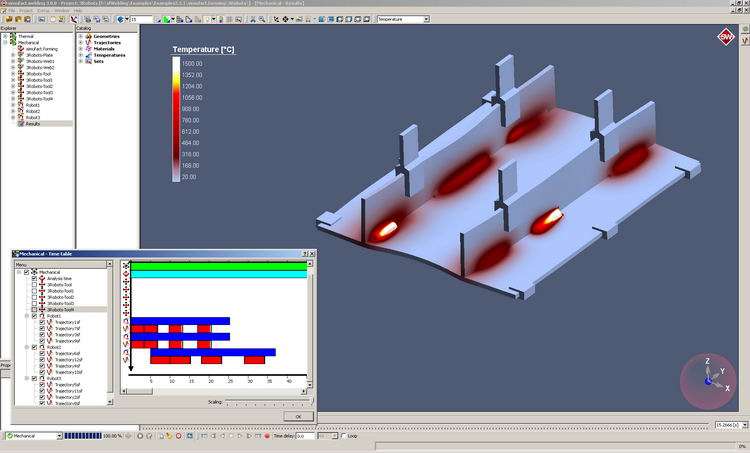
Effective visualization is key to understanding the complex phenomena involved in welding. MSC Simufact Welding provides powerful graphical tools to interpret simulation results, translating intricate data into actionable insights for engineers and designers. These visualizations help in identifying potential defects and optimizing process parameters for superior weld quality.
- Cross-sectional Views: Detailed analysis of weld bead geometry and heat-affected zones (HAZ) through dynamic cross-sections.
- Distortion Analysis: Comprehensive visualization of part deformation and residual stresses resulting from the welding process.
- Residual Gap Visualization: Identification and quantification of potential gaps or voids within the weld joint, a critical factor in structural integrity.
- Problem Visualization: Highlighting areas prone to defects, stresses, or incorrect heat distribution for targeted intervention.
Use Cases in Industry
Application Across Manufacturing Sectors
The precision and predictive power of MSC Simufact Welding make it an indispensable tool across numerous manufacturing sectors. By simulating welding processes, companies can ensure the integrity and performance of their products, reduce manufacturing waste, and optimize production timelines. The software’s adaptability allows it to address the unique challenges faced by different industries.
- Automotive: Optimizing welding for chassis components, body structures, and exhaust systems to ensure durability and safety.
- Aerospace: Simulating specialized welding techniques for aircraft components and structural elements where performance and reliability are paramount.
- Metalworking and Fabricators: Enhancing efficiency and predictability in general metal fabrication, pipe welding, and heavy equipment manufacturing.
- Shipbuilding: Analyzing large-scale welding operations to manage heat input and prevent structural distortions in ship hulls and modules.
Case Studies and Success Stories
While specific user case studies are not detailed here, companies in the automotive and aerospace sectors have historically leveraged simulation software like MSC Simufact Welding to significantly improve their welding operations. By predicting outcomes such as weld distortion and residual stresses, manufacturers can reduce the need for expensive physical testing and rework, leading to substantial cost savings and faster product development cycles. The ability to virtually validate welding parameters before production ensures higher quality welds and more efficient manufacturing processes.
Integration with Other Tools
Collaborative Features and Software Compatibility
MSC Simufact Welding is designed to integrate seamlessly within a broader simulation ecosystem, enhancing its utility and contribution to the overall product development workflow. Compatibility with other MSC offerings and external systems allows for a more holistic approach to manufacturing simulation and process control.
- Integration with Simufact.forming: Enables a comprehensive simulation workflow from forming processes through to welding, providing a connected product lifecycle analysis.
- Compatibility with MSC CAE Software: Works within the broader MSC Software ecosystem, facilitating data exchange and combined analyses with other simulation tools.
- External Robotic Control Software: Potential for integration with robotic welding control systems, allowing simulation results to inform real-world automated welding paths and parameters.
Technical Support and Documentation
Resources for Engineers and Designers
MSC Software Corporation provides comprehensive support and extensive documentation to ensure users can effectively leverage the capabilities of MSC Simufact Welding. These resources empower engineers and designers to maximize their productivity and achieve accurate simulation results.
- User Manuals: Detailed guides covering software operation, feature explanations, and best practices for simulation setup.
- Online Knowledge Base: Access to articles, tutorials, and FAQs for quick problem-solving and deeper understanding of simulation concepts.
- Technical Support Channels: Direct access to MSC Software’s technical experts for assistance with complex issues or specific project requirements.
- Training Programs: Structured courses designed to help users master the software and apply advanced simulation techniques.
Frequently Asked Questions
What types of welding processes can MSC Simufact Welding simulate?
MSC Simufact Welding is capable of simulating a range of welding processes including Arc Welding, MIG, MAG, Laser Welding, and Electron Beam Welding (EBW). This allows engineers to evaluate different welding methods and their effectiveness in various applications, ensuring the chosen process aligns with desired outcomes.
How does MSC Simufact Welding help in reducing manufacturing costs?
By simulating welding operations prior to execution, MSC Simufact Welding helps identify potential issues such as distortions and residual gaps. This proactive approach significantly reduces the need for costly physical trials and rework, leading to substantial time and financial savings in the manufacturing process.
Is there a graphical interface for visualizing welding operations in MSC Simufact Welding?
Yes, MSC Simufact Welding features a powerful graphical environment that allows users to visualize welding processes in detail. This includes features such as cross-sectional views and comprehensive analysis of welding conditions, greatly enhancing understanding and troubleshooting capabilities.



Reviews
There are no reviews yet.