
Download Polar Instruments Si9000 25.01.01 – Advanced PCB Controlled Impedance Design Software
The Polar Instruments Si9000 25.01.01 is a specialized software application designed for precise controlled impedance modeling of Printed Circuit Board (PCB) traces. Developed by Polar Instruments, a company recognized for its expertise in PCB impedance measurement and design solutions, this software is indispensable for PCB Design Engineers and Signal Integrity Engineers. It utilizes advanced 2D field solvers, specifically employing boundary element methods, to accurately calculate critical parameters crucial for high-speed digital and RF circuit design industries, ensuring signal integrity and performance in complex electronic systems.
Overview of Polar Instruments Si9000 and Its Role in PCB Design
The Polar Instruments Si9000 25.01.01 is engineered to address the stringent requirements of modern high-speed electronics by providing meticulous control over PCB trace impedance. Accurate impedance control is fundamental to preventing signal reflections, reducing crosstalk, and ensuring signal integrity in demanding applications. The software’s core technology relies on sophisticated 2D field solvers that implement the boundary element method, offering a scientifically rigorous approach to modeling. This precision makes it a vital tool for professionals in signal integrity, RF/microwave design, and PCB fabrication, enabling the design of boards that perform reliably at high frequencies.
Precision Transmission Line Modeling for Complex PCB Structures
Si9000 facilitates the accurate design and simulation of PCB traces through an extensive library of over 40 transmission line models. This comprehensive set includes standard configurations such as surface microstrip, embedded microstrip, and various stripline variants (symmetric, asymmetric, offset, dual). Additionally, it supports diverse coplanar waveguide configurations, essential for many advanced high-frequency applications. By enabling engineers to select and configure these precise models, Si9000 ensures that the calculated impedance and propagation delays closely match the physical characteristics of the PCB traces.
Multi-Layer Stack-up Design and ‘What-if’ Analysis Capabilities
This software empowers engineers to meticulously define multi-layer PCB stack-ups, incorporating a wide array of dielectric materials with varying dielectric constants (Dk) and copper weights. The Si9000 allows for dynamic recalculations of impedance and other parameters as changes are made to the stack-up geometry or material properties. This ‘what-if’ analysis capability is crucial for optimizing board performance and cost, as engineers can quickly assess the impact of different design choices on signal integrity before committing to a physical layout. It supports the creation of detailed stack-up definitions required for modern complex electronic devices.
Advanced Impedance and Loss Calculations for High-Speed Interfaces
Modern high-speed digital and RF interfaces demand precise impedance matching to maintain signal integrity. The Polar Instruments Si9000 software provides advanced calculations for characteristic impedance, differential impedance, and common-mode impedance, critical for interfaces such as DDR memory modules, PCIe links, USB, and Ethernet. Furthermore, it extends beyond simple impedance to calculate essential signal loss parameters, including conductor and dielectric losses. Understanding and controlling these losses is paramount for ensuring reliable data transmission and maintaining signal quality at multi-gigabit speeds.
Fabrication Tolerance Impact Analysis and Documentation Features
Recognizing that real-world manufacturing processes introduce variability, the Si9000 includes robust tolerance analysis tools. These features help engineers understand how potential variations in PCB fabrication—such as changes in dielectric thickness or trace width—might affect the final impedance and signal integrity. The software also provides comprehensive reporting and detailed documentation capabilities, allowing for the generation of precise stack-up specifications and impedance reports. This ensures clear communication of design requirements to PCB manufacturers, minimizing errors and improving yield.
Enhancements Introduced in Version 25.01.01
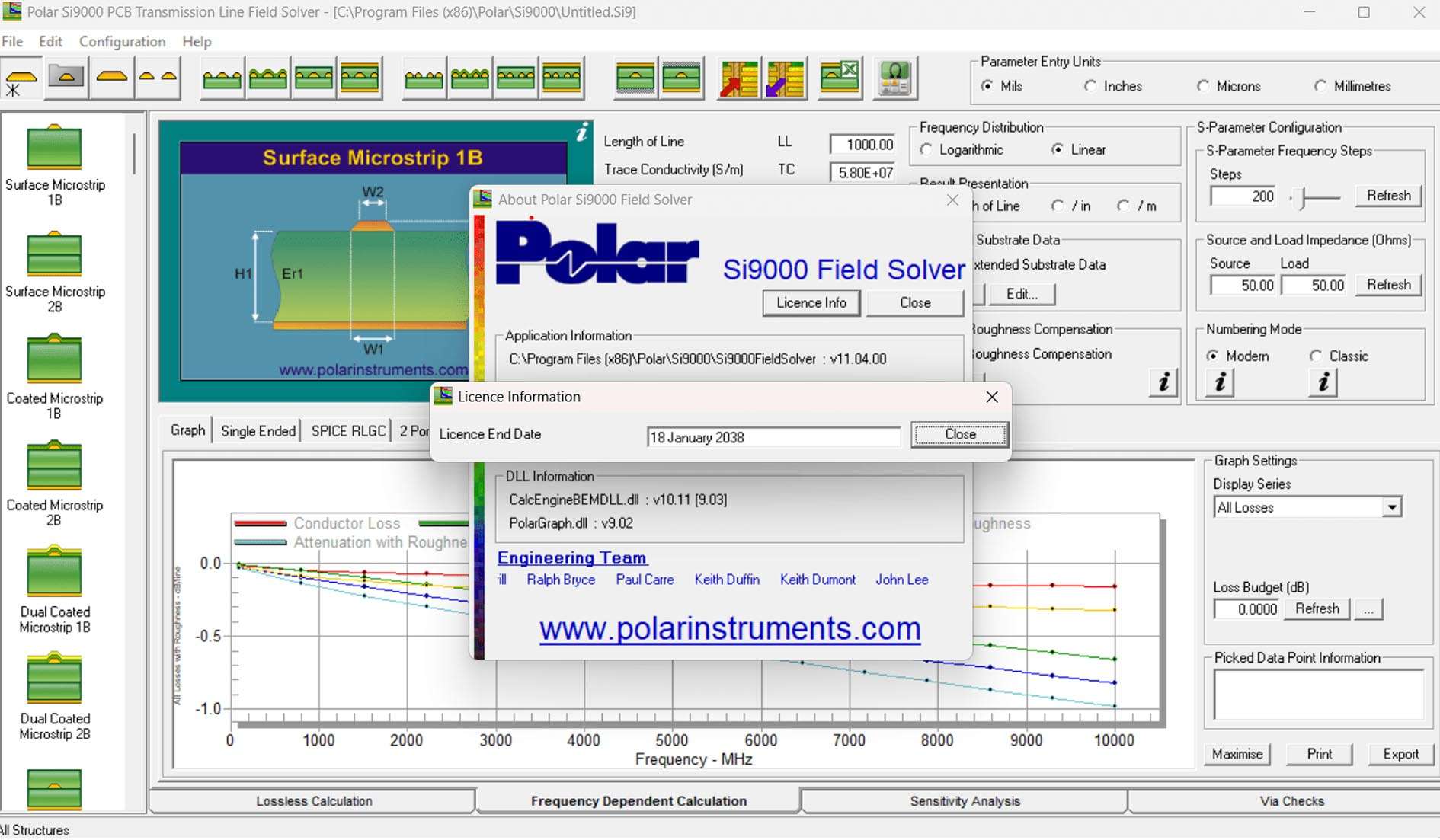
The latest iteration, version 25.01.01, brings significant advancements designed to meet the evolving needs of the electronics industry. Key improvements include enhanced 2D field solver accuracy, particularly notable for millimeter-wave (mmWave) frequencies and more complex trace structures. The software also features expanded dielectric material libraries, a completely redesigned and modernized user interface for improved usability, and more sophisticated loss calculations. Additionally, version 25.01.01 offers better integration with popular PCB CAD tools, streamlining the import and export of design data and facilitating smoother design-to-fabrication workflows.
Industrial Applications and Use Case Examples
The Polar Instruments Si9000 25.01.01 finds extensive application across various high-technology sectors. For instance, it is used to design the precise stack-ups required for DDR memory channels, ensuring high-speed data transfers between processors and memory. Engineers designing PCIe high-speed links rely on Si9000 for calculating the exact trace dimensions needed to maintain signal integrity over these critical data paths. Similarly, it is employed in the design of USB and Ethernet differential pairs, where balanced impedance is key to reliable connectivity. RF and microwave circuit designers also utilize the software to ensure accurate impedance matching for antennas, filters, and transmission lines, critical for optimal performance in wireless communication systems.
Frequently Asked Questions
How does Polar Instruments Si9000 improve PCB signal integrity design?
The Si9000 utilizes advanced 2D field solver technology to precisely calculate characteristic and differential impedance on PCB traces, ensuring designs meet target impedance values. This accuracy is vital for maintaining signal integrity in high-speed digital and RF interfaces by minimizing signal reflections and crosstalk.
What types of transmission line models does Si9000 support?
The software supports over 40 transmission line models including surface and embedded microstrip, symmetric and asymmetric stripline, offset and dual stripline, and various coplanar waveguide configurations. This extensive library allows for modeling of virtually any PCB trace geometry.
What are the new features in Polar Instruments Si9000 version 25.01.01?
Version 25.01.01 introduces enhanced solver accuracy for mmWave frequencies, a modernized user interface, expanded dielectric material libraries, advanced loss calculations, and improved CAD data import and export capabilities. These updates aim to increase precision, usability, and integration within design workflows.





Reviews
There are no reviews yet.