
Download SEISMOGRAPH PSHA Tool 2023 – Site-Specific Probabilistic Seismic Hazard Analysis
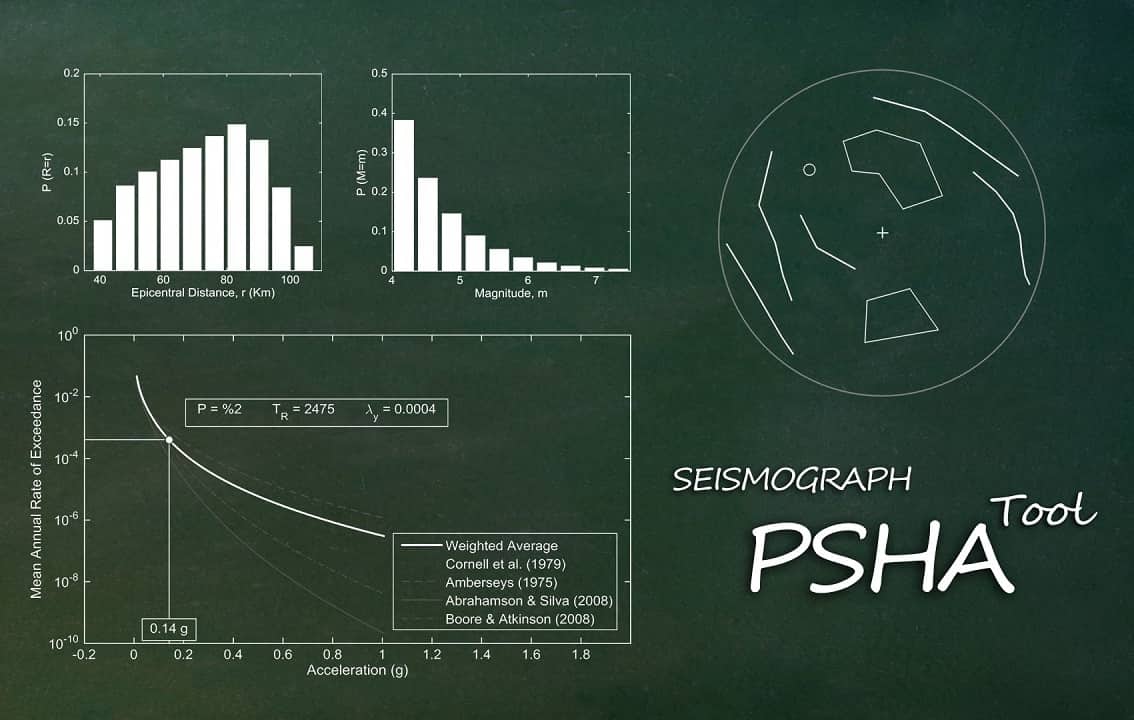
The SEISMOGRAPH PSHA Tool 2023 is a specialized application designed for performing site-specific Probabilistic Seismic Hazard Analysis. This tool is developed to assist seismologists, civil engineers, and geotechnical engineers in accurately assessing seismic risks and potential earthquake impacts. By leveraging advanced analytical techniques, it provides critical data for infrastructure planning and risk mitigation strategies in seismically active regions.
Overview of SEISMOGRAPH PSHA Tool
SEISMOGRAPH PSHA Tool 2023 offers a robust platform for engineers and seismologists to conduct comprehensive seismic hazard assessments. It enables users to perform site-specific analyses, crucial for designing resilient structures and ensuring public safety in earthquake-prone areas. The software consolidates complex seismological data into actionable insights, making it an invaluable asset for professionals in civil and geotechnical engineering.
Core Features and Capabilities
Attenuation Models
The software incorporates a significant library of 29 distinct attenuation models. This extensive selection includes state-of-the-art NGA14 models, alongside other established models, providing users with exceptional flexibility. This variety allows for tailored analyses to suit different geological settings and seismic characteristics, enhancing the accuracy of ground motion predictions.
Source Types
SEISMOGRAPH PSHA Tool 2023 supports the modeling of seismic hazards originating from four fundamental source types. These include Point sources for localized seismic activity, Line sources for fault ruptures, Area sources for distributed seismicity zones, and 3D Fault sources for capturing complex fault geometries. This broad support ensures a thorough representation of potential seismic event origins.
Analysis Cases
To accommodate diverse analytical needs, the tool supports multiple analysis case configurations. Users can perform single analysis cases for straightforward assessments, multiple analysis cases to explore various scenarios, or logic tree analyses for detailed probabilistic evaluations. This tiered approach supports both standard and complex seismic hazard assessment methodologies.
Application in Seismic Hazard Analysis
The primary application of SEISMOGRAPH PSHA Tool 2023 lies in its ability to provide critical data for seismic design and risk management. Civil engineers utilize its outputs for determining design ground motions, which are essential for ensuring the structural integrity of buildings, bridges, and other critical infrastructure. Geotechnical engineers can employ the hazard curves generated by the tool to assess soil liquefaction potential and seismic slope stability. Furthermore, urban planners and environmental agencies benefit from these analyses for risk mitigation and disaster preparedness strategies.
Advanced Tools for Seismic Assessment
Advanced Source Editor Tool
The integrated Advanced Source Editor Tool empowers users with precise control over seismic source parameters. This editor facilitates detailed input and modification of data related to fault locations, rupture characteristics, and seismic activity rates. Professional users can define complex source geometries and associated parameters to achieve highly specific and accurate seismic hazard models.
Magnitude Conversion and Declustering
Managing seismic data effectively is crucial for accurate analysis. SEISMOGRAPH PSHA Tool 2023 includes capabilities for automatic magnitude conversion, ensuring consistency across different measurement scales. It also features algorithms for seismic data declustering, which systematically removes foreshocks and aftershocks. This process isolates main seismic events, preventing their overrepresentation and leading to more reliable probabilistic hazard estimations.
Comparison with Existing Seismic Hazard Tools
Compared to other seismic hazard assessment software, SEISMOGRAPH PSHA Tool 2023 distinguishes itself through its comprehensive suite of 29 attenuation models and its flexible support for multiple source types, including 3D Fault models. While many tools can perform probabilistic seismic hazard analysis, the depth of model integration and advanced editing capabilities offered by SEISMOGRAPH PSHA Tool 2023 provides a more detailed and adaptable framework for complex seismic risk assessments.
Conclusion and Future Directions
SEISMOGRAPH PSHA Tool 2023 serves as an indispensable instrument for professionals engaged in seismic hazard assessment and risk mitigation. Its extensive features, including a wide array of attenuation models and sophisticated source definition capabilities, enable thorough and accurate analyses. As seismic science evolves, tools like SEISMOGRAPH PSHA Tool are expected to incorporate further advancements in ground motion prediction equations and source characterization, continuing to play a vital role in enhancing structural resilience and public safety.
Frequently Asked Questions
What is the purpose of the SEISMOGRAPH PSHA Tool 2023?
The SEISMOGRAPH PSHA Tool 2023 is designed to perform site-specific Probabilistic Seismic Hazard Analysis, providing engineers and seismologists with the necessary tools to assess seismic risk effectively. It aids in understanding the likelihood and intensity of ground shaking at a particular location, which is vital for disaster preparedness and infrastructure design.
What types of source models does SEISMOGRAPH PSHA Tool support?
The tool supports four source types: Point, Line, Area, and 3D Fault, allowing for a comprehensive analysis of seismic sources affecting a given site. This flexibility enables the modeling of various geological phenomena, from localized seismic events to complex fault rupture zones.
How does the SEISMOGRAPH PSHA Tool handle multiple analysis cases?
The tool provides capability for single, multiple, and logic tree analysis cases, facilitating varying complexity levels in seismic hazard assessments. This allows users to explore a wide range of scenarios and uncertainties, enhancing the robustness of their seismic risk evaluations.





Reviews
There are no reviews yet.