
Download SEISMOGRAPH SMDA 2023 – Strong-Motion Data Analyzer
SEISMOGRAPH SMDA 2023 is a specialized software application designed for the analysis of strong-motion seismic data. It is primarily utilized within the fields of seismology, structural engineering, and civil engineering to evaluate seismic events and ensure structural safety. The software processes and analyzes critical seismic records, calculating essential ground motion parameters and response spectra, making it an indispensable tool for professionals in these demanding industries.
Introduction to SEISMOGRAPH SMDA 2023
Overview and Applications
The accurate analysis of strong-motion data is crucial for understanding the impact of seismic events on structures and infrastructure. SEISMOGRAPH SMDA 2023 plays a vital role by providing robust tools for managing and interpreting this complex data. Its applications span from individual structural safety assessments to broader urban planning and risk management, aiding engineers in designing resilient buildings and infrastructure capable of withstanding significant seismic forces.
Key Functionalities of SEISMOGRAPH SMDA 2023
Managing Multiple Records
Effective data management is foundational for accurate seismic analysis. SEISMOGRAPH SMDA 2023 offers comprehensive tools for organizing seismic records:
- Editing capabilities to modify existing seismic data points.
- Sorting and filtering options to quickly locate specific events or time frames.
- Features for adding new seismic events and deleting irrelevant ones.
- Database-building functionalities to maintain an organized collection of seismic records for future reference and analysis.
Ground Motion Parameter Computation
Understanding the characteristics of ground motion is essential for predicting structural response. This software allows for the computation of various key ground motion parameters:
- Calculation of seismic durations, which indicate the length of time ground shaking persists.
- Computation of Arias intensity, a measure of the energy content of the ground motion.
- Analysis of power and intensity to characterize the amplitude and frequency content over time.
- Determination of peak values for acceleration, velocity, and displacement, providing critical design inputs.
Elastic and Inelastic Response Spectra
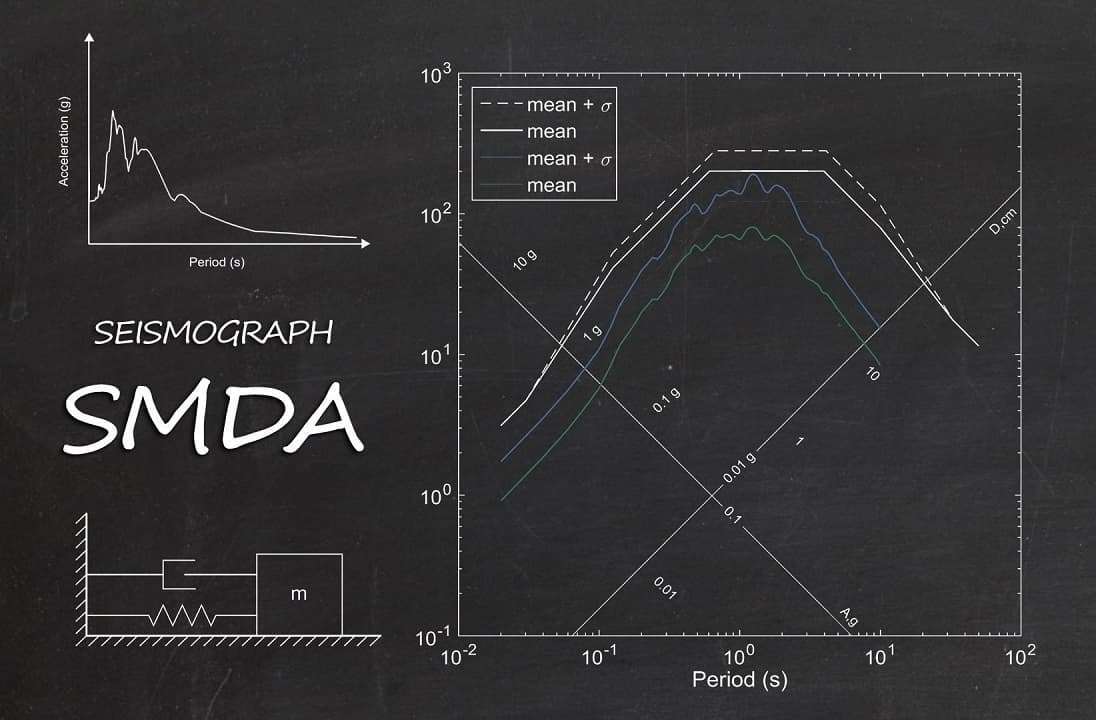
Response spectra are fundamental tools in seismic design, illustrating the potential response of a single-degree-of-freedom system to ground motion. SEISMOGRAPH SMDA 2023 provides capabilities for analyzing both elastic and inelastic response spectra:
- Elastic Response Spectra: These illustrate the maximum response of a linear elastic system subjected to seismic loading, based on various damping ratios.
- Inelastic Response Spectra: This advanced analysis considers the nonlinear behavior of structures, offering a more realistic assessment of seismic performance for systems that yield.
Advanced Analysis Tools
SDF Analyzer Tool
The SDF Analyzer Tool within SEISMOGRAPH SMDA 2023 provides advanced capabilities for evaluating structural behavior under seismic conditions, focusing on nonlinear analysis:
- Nonlinear Analysis: Facilitates the simulation of structural behavior beyond the elastic limit, accounting for material yielding and damage.
- Damping Calculations: Enables precise computation of damping ratios, a critical factor in controlling structural oscillations.
- Live Simulations: Offers the ability to perform real-time simulations of structural response to seismic inputs.
- Safety Parameter Evaluation: Assesses key safety parameters such as ductility ratio and normalized yield strength to determine overall structural resilience.
Spectral Matching and Accelerogram Generation
For detailed seismic hazard analysis, SEISMOGRAPH SMDA 2023 includes sophisticated tools for spectral matching and artificial accelerogram generation:
- Spectral Matching: This process adjusts artificial ground motion records to match a target response spectrum, ensuring the simulated events align with specific seismic design requirements.
- Accelerogram Generation: The software can generate synthetic accelerograms that represent plausible seismic events, critical for scenarios where actual recorded data is scarce or insufficient. This process is essential for robust seismic risk assessment.
Recent Enhancements in SMDA 2023
The SEISMOGRAPH SMDA 2023 release introduces significant improvements aimed at enhancing the precision and utility of seismic data analysis. A key addition is the Accelerogram Rotation Tool:
- Accelerogram Rotation Tool: This new feature allows engineers to rotate seismic acceleration records. This capability is valuable for identifying the directionality of seismic waves and optimizing the analysis of their impact on structures from various orientations, leading to more accurate structural safety assessments.
Conclusion and Future Directions
SEISMOGRAPH SMDA 2023 stands as a critical software solution for civil and structural engineers engaged in seismic analysis. Its comprehensive suite of tools for managing strong-motion data, computing ground motion parameters, and performing advanced analyses like nonlinear simulations and spectral matching, reinforces structural safety and reliability in earthquake-prone regions. Future developments may focus on incorporating more sophisticated artificial intelligence algorithms for predictive analysis and expanding the library of seismic events for broader application in disaster preparedness and mitigation efforts.
Frequently Asked Questions
What is SEISMOGRAPH SMDA 2023 used for?
SEISMOGRAPH SMDA 2023 is used for analyzing strong-motion seismic data to assess ground motion parameters and ensure structural safety during seismic events. It provides tools for data management and various analytical capabilities, including response spectra, which are vital for seismic design and risk assessment.
How does the SDF Analyzer Tool work in SEISMOGRAPH SMDA 2023?
The SDF Analyzer Tool facilitates nonlinear analysis by allowing users to calculate damping ratios, perform live simulations, and evaluate safety parameters such as ductility ratio and normalized yield strength of structures in seismic conditions. This tool is essential for understanding how structures behave beyond their elastic limits under seismic forces.
What are the new features in SEISMOGRAPH SMDA 2023 compared to previous versions?
The 2023 version introduces enhancements such as the Accelerogram Rotation Tool, which allows for more refined analysis of seismic data by enabling the rotation of acceleration records to better understand seismic wave directionality. This improves the software’s functionality for engineers and researchers seeking more precise seismic data interpretation.





Reviews
There are no reviews yet.