

Download SeismoStruct 2025.1 – Advanced Structural Analysis and Seismic Simulation Software
SeismoStruct 2025.1 is an advanced structural analysis software developed by Seismosoft, specifically designed for civil and structural engineers focusing on seismic engineering. This application is engineered to predict the nonlinear structural behavior of buildings and other structures under static and dynamic loading conditions, with a particular emphasis on earthquake simulations. Its robust capabilities and validated accuracy make it an indispensable tool for professionals engaged in seismic design, assessment, and advanced structural research.
Overview of SeismoStruct and its Role in Civil Engineering
SeismoStruct stands as a specialized software solution for performing nonlinear structural analysis under static and dynamic loads. Developed by Seismosoft, it caters to the intricate demands of earthquake engineering, providing engineers with the means to simulate complex structural responses with high fidelity. The software’s design allows for detailed modeling of both material and geometric nonlinearities, which are critical for accurately predicting structural behavior during seismic events. Its credibility is further bolstered by validation against experimental data and competitive benchmarking, establishing its role in both professional practice and academic research within the civil engineering domain.
Capabilities in Modeling and Material Behavior
Nonlinear Material Models: Concrete, Steel, FRP, and Smart Materials
SeismoStruct offers comprehensive nonlinear material models essential for simulating realistic structural behaviors under stress. The software supports detailed modeling of conventional materials like concrete and steel, along with advanced composites such as fiber-reinforced polymers (FRP). Furthermore, it extends its capabilities to smart materials, including shape memory alloys (SMA), allowing engineers to explore innovative structural designs and performance characteristics under load. This granular material modeling is fundamental for accurate seismic response prediction.
Geometric Nonlinearity and Large Displacement Modeling
Accurate simulation of structural performance during seismic events necessitates the explicit consideration of geometric nonlinearities. SeismoStruct excels in this area by incorporating sophisticated algorithms to handle large displacement effects and second-order geometric phenomena. This capability is crucial for structures that undergo significant deformations, ensuring that the analysis accounts for changes in stiffness and load paths as the structure deforms, thereby providing a more realistic outcome representative of extreme loading scenarios.
Diverse Structural Analysis Methods Supported
Static, Dynamic, and Time History Analysis Techniques
The software provides a robust suite of analysis methods to cater to various engineering requirements. Users can perform static analyses, including monotonic loading and advanced pushover analyses, to understand fundamental structural responses. For dynamic assessments, SeismoStruct supports time history analysis, enabling the simulation of structural behavior over time under specific ground motion records. Response spectrum analysis is also available, offering a means to estimate peak structural responses based on spectral characteristics of seismic events.
Innovative Adaptive Pushover and Incremental Dynamic Analysis
SeismoStruct distinguishes itself with advanced analysis techniques such as adaptive pushover and incremental dynamic analysis (IDA). Adaptive pushover allows for more realistic simulation by updating structural properties based on evolving damage states, overcoming limitations of traditional pushover methods. IDA involves performing a series of nonlinear time history analyses using ground motions scaled to different intensity levels, providing a comprehensive understanding of structural performance and collapse potential across a range of seismic severities.
Load Application and Convergence Strategies for Stability
Ensuring analysis stability and accuracy, especially in nonlinear simulations, requires intelligent load application and convergence strategies. SeismoStruct employs advanced numerical techniques to manage load increments and solve nonlinear equilibrium equations, facilitating stable convergence even for complex structural models exhibiting significant inelasticity and large deformations. This meticulous approach to numerical stability is critical for obtaining reliable analysis results.
Industry Standards Compliance and Validation
Adherence to established industry standards and rigorous validation are cornerstones of SeismoStruct’s reliability. The software is compliant with numerous international seismic design codes, including NTC-08 and KANEPE, ensuring that analyses meet regulatory requirements. Its computational accuracy and performance are further substantiated through successful participation in and validation against results from international competitions and extensive laboratory testing data, providing engineers with confidence in its predictive capabilities.
Visualization, Reporting, and Integration Features
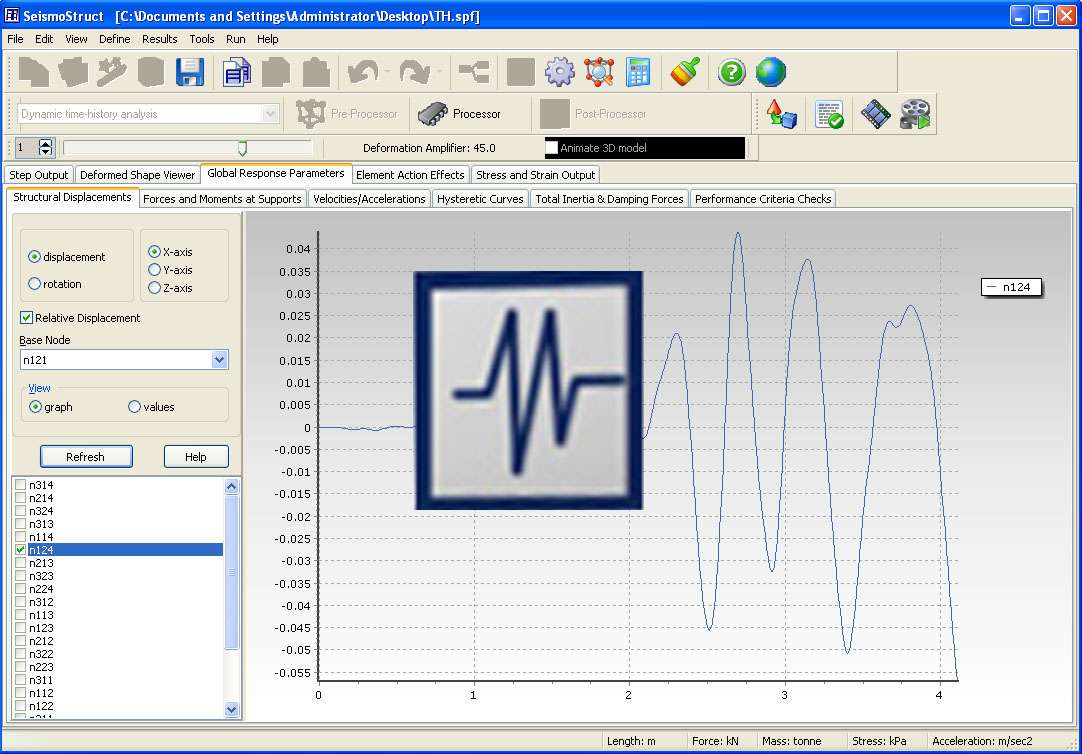
SeismoStruct enhances the analysis workflow with powerful visualization and reporting tools. Users can create and manipulate 3D models of structures, and visualize deformations, yielding critical insights into anticipated structural behavior. The software supports the generation of AVI movie files from analysis results, facilitating dynamic visualization of structural response. Seamless integration with the Windows environment allows for straightforward export of results to widely used applications like Microsoft Excel and Word for further processing, documentation, and reporting, streamlining the overall engineering workflow.
Use Cases in Research and Engineering Practice
SeismoStruct is extensively utilized in various practical and research applications within civil and earthquake engineering. It serves as a vital tool for the seismic design of new structures, ensuring they meet performance objectives under expected earthquake scenarios. For existing structures, it supports detailed seismic assessment and the evaluation of retrofitting strategies by accurately simulating performance under different seismic intensities and damage accumulation scenarios. Researchers leverage SeismoStruct for validating novel structural systems, material behaviors, and advanced analysis methodologies against experimental data and theoretical models.
Frequently Asked Questions
What types of structural materials can SeismoStruct model for seismic analysis?
SeismoStruct can model nonlinear behavior of concrete, steel, fiber-reinforced polymer composites, and smart materials such as shape memory alloys, providing detailed simulation capabilities for seismic structural analysis. This comprehensive material library allows for highly accurate representation of structural components under seismic loading.
How does SeismoStruct handle nonlinear geometric effects in structural analysis?
The software accurately models large displacements and geometric nonlinearities, enabling engineers to simulate structural behavior under extreme loads and deformations typically experienced during earthquakes. This explicit consideration of geometric changes is crucial for structures undergoing significant deformations.
What advanced analysis methods does SeismoStruct support for earthquake engineering?
SeismoStruct supports static and dynamic time history analysis, conventional and adaptive pushover methods, incremental dynamic analysis, and response spectrum analysis, offering comprehensive tools for assessing structural seismic performance. These methods provide progressively deeper insights into a structure’s behavior under various seismic conditions.


Reviews
There are no reviews yet.