

Download Silvaco TCAD 2024 Linux – Advanced Semiconductor Process and Device Simulation
Silvaco TCAD 2024 Linux, developed by Silvaco Group, Inc., is an advanced technology computer-aided design (TCAD) suite. It provides crucial physics-based process and device simulation tools for the semiconductor industry. This sophisticated software is essential for semiconductor manufacturing, device design and analysis, and is widely adopted in research laboratories, academia, and electronic design automation (EDA) environments. The Linux version is optimized for high-performance computing environments, enabling complex simulations required for next-generation semiconductor technologies.
Overview of Silvaco TCAD and Its Role in Semiconductor Development
Silvaco TCAD is a foundational tool for semiconductor professionals, enabling the simulation of both fabrication processes and the physical behavior of semiconductor devices. Unlike tools that rely on simplified compact models, Silvaco TCAD employs fundamental physics-based models derived from material properties and process parameters. This approach is indispensable for research into new materials and device architectures, predicting fabrication outcomes, and understanding intricate failure mechanisms. The primary users are engineers and researchers in semiconductor fabrication facilities, fabless semiconductor companies, and academic institutions focused on advancing semiconductor technology.
Detailed Semiconductor Process Simulation with Victory Process
The Victory Process module within Silvaco TCAD offers comprehensive simulation capabilities for the entire semiconductor fabrication sequence. It allows engineers to meticulously model and predict the outcomes of critical manufacturing steps:
- Implantation and Diffusion: Simulates dopant profiles resulting from ion implantation and thermal diffusion processes, crucial for controlling device electrical characteristics.
- Etching and Deposition: Models plasma etching and chemical vapor deposition (CVD) to predict feature shaping and thin-film growth.
- Lithography and Optical Proximity Correction (OPC): Simulates the photolithography process, including masks, light sources, and resist behavior, as well as OPC to ensure pattern fidelity on the wafer.
- Process Integration: Enables the simulation of multi-step processes, allowing for the optimization of process flows for complex device structures.
By accurately predicting the physical and electrical impacts of these processes, engineers can refine manufacturing steps to enhance yield, performance, and reliability.
Comprehensive Device Simulation Through Victory Device
Victory Device provides advanced simulation of semiconductor device behavior by solving fundamental carrier transport equations. This tool supports a broad spectrum of silicon and emerging materials, facilitating deep analysis of electrical and optical characteristics:
- Advanced Transport Models: Incorporates drift-diffusion, hydrodynamic, and quantum transport models to accurately capture device physics across various scales and operating conditions.
- Material Support: Simulates devices made from silicon, silicon-germanium (SiGe), wide bandgap semiconductors like Silicon Carbide (SiC) and Gallium Nitride (GaN), and emerging 2D materials.
- Electrical and Optical Analyses: Conducts DC, transient, AC, noise, and small signal RF analyses to characterize device performance, timing, and response.
- Material Property Integration: Leverages detailed physical and electrical properties of materials for highest simulation fidelity.
This capability is vital for designing novel devices, understanding operating limits, and debugging performance issues.
Innovations in TCAD 2024: Next-Generation Transistor and 3D Integration Support
The Silvaco TCAD 2024 release incorporates significant advancements to support the leading edge of semiconductor technology. The focus is on enabling the design and analysis of increasingly complex and high-performance devices and architectures:
- GAA Nanosheet and CFET Modeling: Enhanced modeling capabilities for Gate-All-Around (GAA) nanosheet transistors and Complementary FETs (CFET), which are critical for future high-density logic scaling.
- 3D Heterogeneous Integration: Tools designed to simulate complex multi-chip modules, chiplets, and Through-Silicon Vias (TSVs), essential for advanced packaging solutions.
- New Transistor Architectures: Support for emerging transistor designs and materials that push the boundaries of performance and power efficiency.
These new features empower engineers to tackle the challenges of designing for the next era of integrated circuits.
Accelerating Semiconductor Modeling with AI/ML and Scalability Enhancements
Silvaco TCAD 2024 significantly boosts engineer productivity through AI/ML integration and substantial scalability improvements for high-performance computing environments:
- AI/ML-Accelerated Calibration: Integration of artificial intelligence and machine learning techniques, particularly within SmartSpice, dramatically speeds up the calibration of device models against experimental data.
- HPC and Cloud-Native Execution: Optimized for Linux High-Performance Computing (HPC) clusters, the software now offers enhanced cloud-native support, enabling large-scale simulations that can be distributed across many cores or nodes.
- Solver Performance: Improvements to parallel solvers, utilization of advanced CPU instructions like AVX-512, and robust GPU support further accelerate simulation times for demanding tasks.
These enhancements allow engineers to perform more extensive simulations and iterations in a shorter time frame.
Specialized Modules for Reliability, Lithography, and Visualization
Beyond core process and device simulation, Silvaco TCAD offers specialized modules to address critical aspects of semiconductor design and analysis:
- Reliability Simulation: Modules for simulating phenomena such as electromigration (EM) and thermal stress within devices and interconnects, crucial for ensuring long-term operational stability.
- Advanced Lithography and DFM: Tools that go beyond basic lithography simulation to include Design for Manufacturability (DFM) considerations, helping to predict and mitigate fabrication issues early in the design cycle.
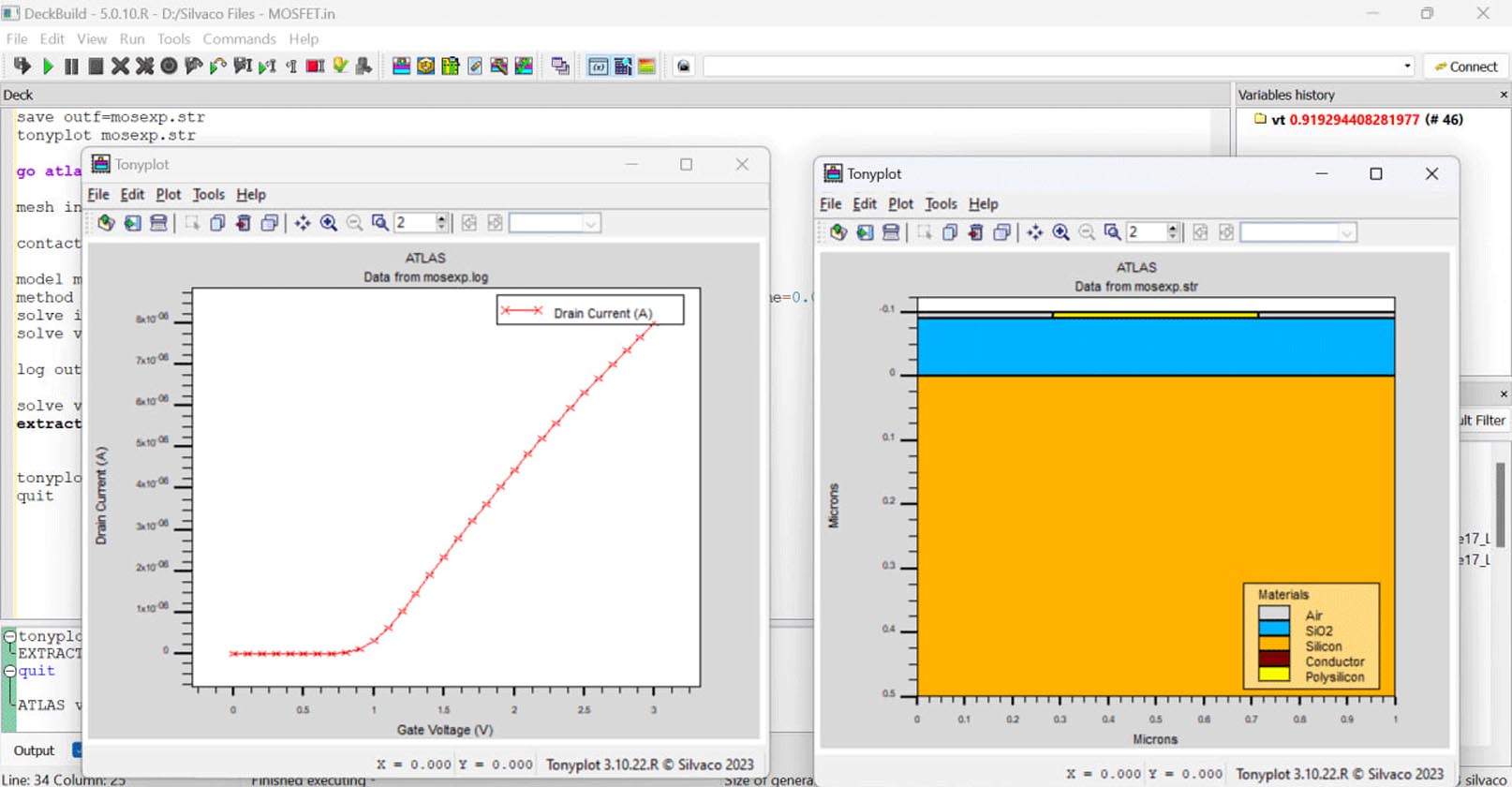
- Simulation Workflow and Visualization: Integrated GUI tools like DeckBuild for managing simulation flows and scripts, and TonyPlot for sophisticated visualization and analysis of simulation results, including 2D and 3D data representation.
These modules provide a more holistic approach to semiconductor technology development and validation.
Linux Compatibility and High-Performance Hardware Recommendations
Silvaco TCAD 2024 Linux is engineered for robust performance on modern Linux operating systems. Careful consideration of system architecture is necessary for effective deployment, especially for large-scale 3D simulations:
- Supported Distributions: Compatible with major Linux distributions commonly used in scientific computing and HPC environments.
- Software Dependencies: Requires specific library versions for full functionality, typically managed through the Linux environment.
- Hardware Requirements: For extensive 3D simulations, significant resources are recommended: multi-core CPUs, substantial RAM (128GB+), fast storage (SSDs), and potentially GPU acceleration for compatible solvers.
- Cloud and GPU Support: Leverages cloud platforms and GPU computing to distribute computational load and reduce simulation turnaround times.
Optimizing hardware configurations is key to maximizing the performance benefits of Silvaco TCAD on Linux clusters.
Frequently Asked Questions
What types of semiconductor devices can I simulate with Silvaco TCAD 2024 Linux?
Silvaco TCAD 2024 supports simulation of a wide range of devices including CMOS, FinFET, Gate-All-Around nanosheet transistors, complementary FETs (CFET), high-electron-mobility transistors (HEMT), diodes, memory devices, and power devices such as SiC MOSFETs and GaN HEMTs. Its comprehensive physics-based models allow for thorough analysis of advanced and conventional semiconductor structures.
How does Silvaco TCAD differ from traditional circuit simulation tools?
Unlike circuit simulators that use compact models, Silvaco TCAD simulates semiconductor devices from first principles by solving fundamental physics equations, providing deep insight into device behavior based on detailed material properties and fabrication processes. This is crucial for new technology development and detailed physical analysis, offering a level of detail unobtainable with simplified circuit models alone.
What new features does the 2024 release offer for simulation and model calibration?
The 2024 release introduces enhanced support for advanced nodes like GAA nanosheets and CFETs, new tools for modeling 3D heterogeneous integration, and AI/ML-powered calibration frameworks that significantly reduce model setup time. It also improves solver scalability and cloud HPC integration for large simulations, enabling more efficient design exploration.








Reviews
There are no reviews yet.