

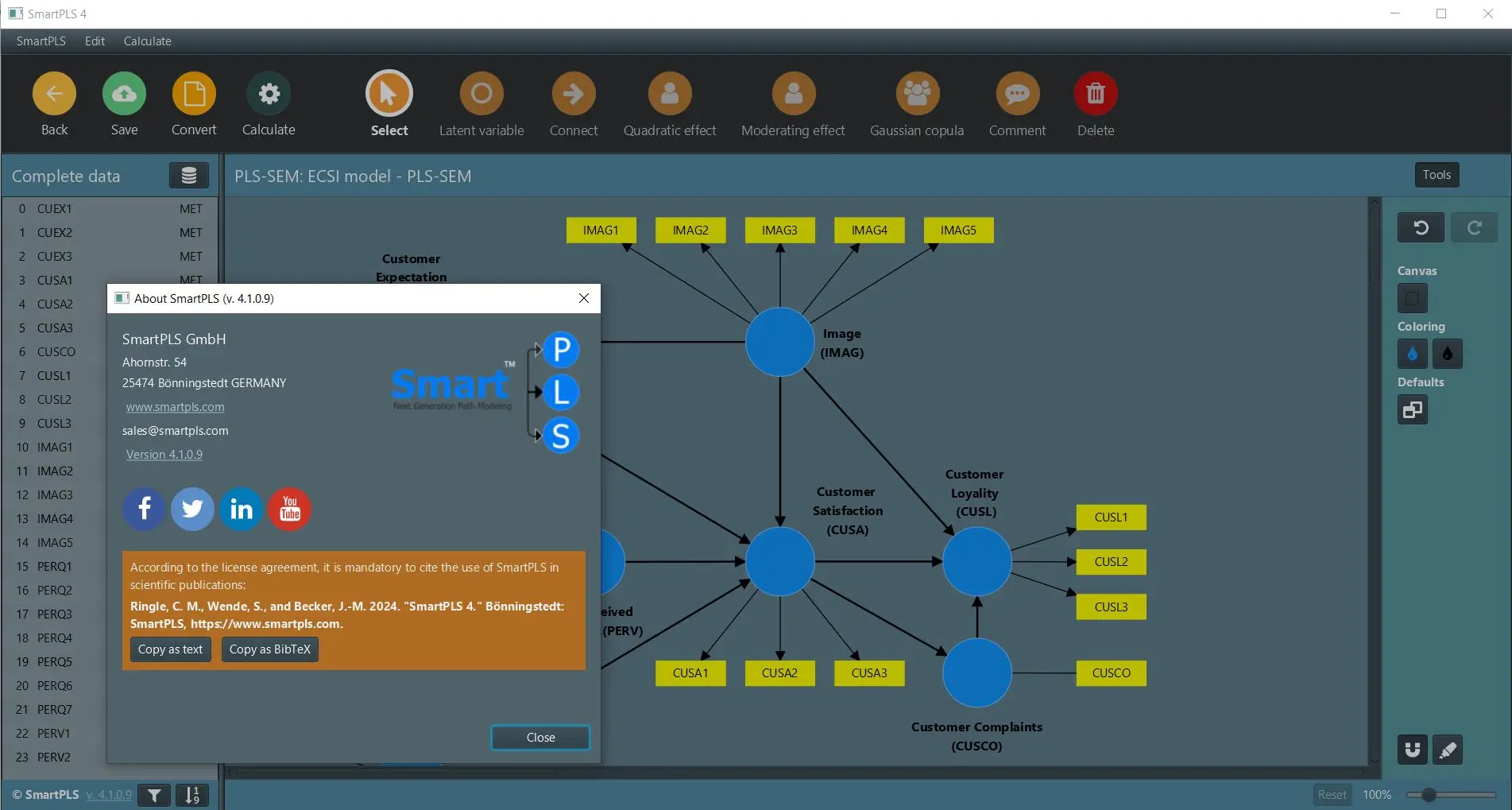
Download SmartPLS Professional 4.1.0.9 – Powerful Software for Structural Equation Modeling
SmartPLS Professional 4.1.0.9 is a specialized software application for variance-based structural equation modeling (SEM) using the partial least squares path modeling method. Developed by SmartPLS and co-founded by Christian M. Ringle, this tool is highly regarded in research, academia, business analytics, and social sciences for its ability to estimate complex models efficiently. It provides researchers with a robust platform for data analysis and model validation, simplifying intricate statistical procedures.
Overview of SmartPLS and Its Applications in Research
SmartPLS is an industry-leading tool for researchers and analysts requiring sophisticated structural equation modeling capabilities. Its primary focus on variance-based SEM, particularly the partial least squares path modeling (PLS-PM) approach, makes it suitable for a wide range of research applications. The software empowers users to analyze complex causal relationships between observed and latent variables, offering flexibility and depth in analytical outcomes relevant to academic studies and business decision-making.
Key Capabilities of SmartPLS
- Facilitates the estimation of complex models with numerous variables and relationships.
- Supports advanced statistical analyses crucial for academic research and business analytics.
- Provides comprehensive criteria for assessing both measurement and structural models, ensuring robust results.
- Offers a user-friendly environment that simplifies the execution of advanced statistical techniques.
Graphical User Interface and Usability Features
SmartPLS is recognized for its intuitive graphical user interface (GUI), designed to streamline the complex process of structural equation modeling. This user-centric approach allows professionals to focus on model conceptualization and interpretation rather than struggling with intricate command-line interfaces or difficult setup procedures. The visual workflow enables quicker model building and adjustment, enhancing overall research productivity.
Types of Modeling Techniques Supported
PLS-SEM and Weighting Algorithms
The software incorporates a variety of algorithms to support different modeling needs within the PLS-SEM framework. This includes foundational PLS-SEM, alongside advanced methods such as Weighted PLS (WPLS) and consistent PLSc-SEM. This flexibility in algorithmic selection allows researchers to tailor their analysis to specific model requirements and data characteristics, ensuring methodological rigor.
Comprehensive Model Assessment Criteria
SmartPLS places significant emphasis on thorough model assessment, providing users with a suite of tools for evaluating the reliability and validity of their SEM models. This includes detailed criteria for assessing reflective and formative measurement models, as well as the structural model. The software facilitates rigorous validity tests and reliability assessments, offering insights into the overall quality and predictive power of the research models.
Reporting and Project Management Capabilities
Effective project management and clear reporting are critical components of any analytical workflow. SmartPLS offers robust capabilities in these areas, allowing users to organize their research projects efficiently and generate comprehensive reports. The software facilitates the export of results in various formats, including HTML and Excel, enabling seamless integration with other documentation and presentation tools.
Comparison with Other SEM Software
Compared to traditional SEM software like IBM SPSS Amos or LISREL, SmartPLS offers distinct advantages, particularly in its approach to model estimation and user experience. Its variance-based methodology is often favored for predictive modeling and works well with smaller sample sizes or data that does not follow a normal distribution. The user-friendly interface and the ability to conduct a broader range of hypothesis tests contribute to its appeal for many researchers.
Real-World Use Cases and Applications
SmartPLS is widely applied across various disciplines for complex data analysis. In business analytics, it is used to model customer satisfaction, brand loyalty, and the impact of marketing strategies. In social sciences, researchers leverage SmartPLS for studies on educational outcomes, social media influence, and psychological constructs. Its flexibility also makes it a valuable tool in fields like healthcare management and information systems research for exploring intricate relationships between variables.
Frequently Asked Questions
What is SmartPLS used for?
SmartPLS is utilized for structural equation modeling (SEM), particularly using the partial least squares method, which allows researchers to analyze complex relationships among sets of variables effectively. This approach is beneficial for exploring theoretical models and understanding how multiple factors influence outcomes in research studies.
How does SmartPLS differ from SPSS Amos and LISREL?
SmartPLS is noted for its user-friendly graphical environment and the ability to work with smaller sample sizes, making it a preferred choice for testing structural models with non-normal data. Unlike covariance-based methods often employed by Amos and LISREL, PLS-SEM prioritizes prediction and handles a wider variety of model specifications.
Is SmartPLS suitable for beginners in data analysis?
Yes, SmartPLS is designed with a user-friendly interface that simplifies complex modeling processes, making it accessible even for those new to structural equation modeling. Its visual approach and clear workflows help users build and interpret models with greater ease.




Reviews
There are no reviews yet.