

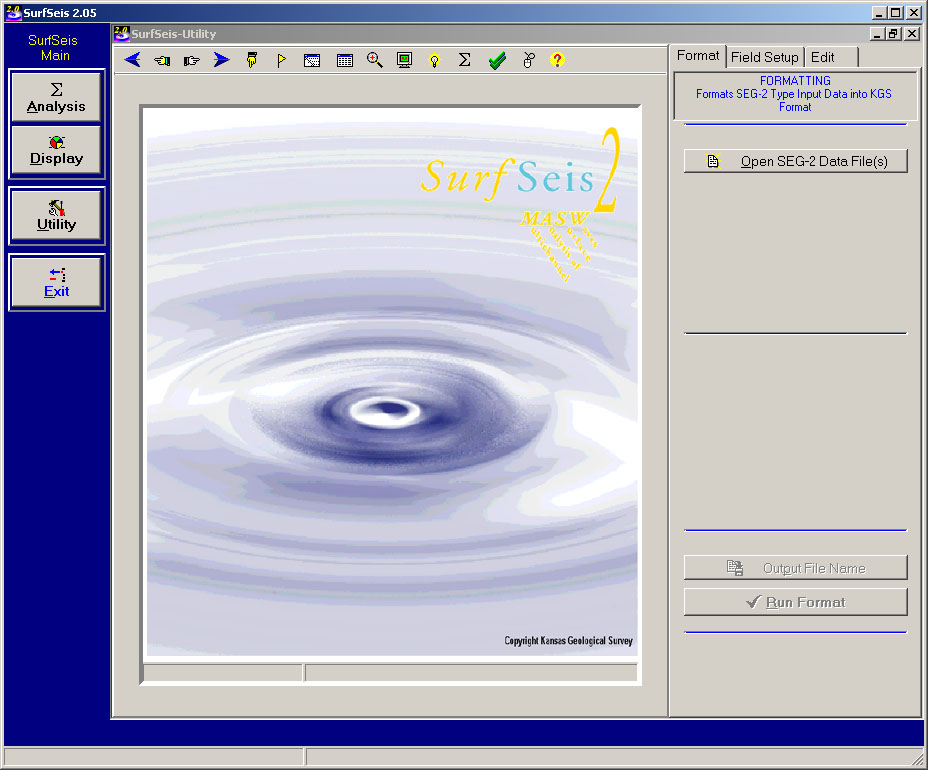
Download SurfSeis 2.0 – Advanced Seismic Data Analysis Software
SurfSeis 2.0 is a specialized software application developed by the Kansas Geological Survey (KGS) for advanced seismic data analysis. This tool is specifically designed for geophysical analysis and seismic data interpretation, catering to professionals engaged in environmental and earth sciences. It leverages the multichannel analysis of surface waves (MASW) methodology to provide deeper insights into subsurface geological structures.
Introduction to SurfSeis 2.0 and Its Applications
Overview of MASW Methodology
The multichannel analysis of surface waves (MASW) is a critical geophysical technique for understanding the shallow subsurface. It involves analyzing seismic wave propagation along the Earth’s surface to determine shear-wave velocity (Vs) profiles, which are crucial for geotechnical and geological assessments. SurfSeis 2.0 builds upon earlier versions, evolving to incorporate both active and passive MASW techniques, offering a more comprehensive solution for geophysical surveys.
Key Features of SurfSeis 2.0
Forward Dispersion-Curve Modeling
SurfSeis 2.0 includes sophisticated forward dispersion-curve modeling capabilities. This feature allows users to predict theoretical dispersion curves based on assumed subsurface models. By comparing these modeled curves with actual observed data, geophysicists can refine their understanding of material properties and validate geophysical interpretations.
Monte Carlo Inversion Techniques
The software incorporates advanced Monte Carlo inversion techniques for seismic data interpretation. This probabilistic approach enables users to explore a wide range of possible subsurface models and their associated dispersion curves. Employing Monte Carlo methods enhances the robustness of the inversion process, leading to more reliable estimates of subsurface velocities and reduced ambiguities in data analysis.
Active vs. Passive MASW Approaches
SurfSeis 2.0 supports both active and passive MASW approaches, providing flexibility in seismic data acquisition. Active MASW uses a controlled source, such as a sledgehammer or weight drop, to generate seismic waves, suited for detailed near-surface investigations. Passive MASW utilizes ambient seismic noise from sources like wind or traffic, which is valuable for larger-scale surveys or in areas where active sources are impractical. SurfSeis 2.0’s ability to process data from both methods makes it a versatile tool for diverse geophysical challenges.
Integration with Other Geophysical Tools
While specific integration details may vary, SurfSeis 2.0 is designed to complement other geophysical workflows. Its output, such as processed dispersion curves and inversion results, can often be utilized in conjunction with other geological modeling software or geographic information systems (GIS). This interoperability allows for a more holistic approach to subsurface characterization, where seismic data can be correlated with other geological, hydrological, or environmental datasets.
Real-World Applications and Case Studies
Professionals in geophysics utilize SurfSeis 2.0 across various critical sectors. In civil engineering, it aids in assessing soil conditions for infrastructure projects, such as building foundations, bridges, and roads, by determining shear-wave velocities important for seismic site characterization. The oil and gas industry employs MASW techniques facilitated by SurfSeis for shallow subsurface exploration and hazard assessment. Furthermore, its application extends to environmental studies, including investigating groundwater resources and characterizing contaminated sites based on subsurface properties.
Comparison with Other Geophysical Software
SurfSeis 2.0 distinguishes itself through its specialized focus on MASW and the advanced analytical features it offers. Unlike more general seismic processing software, SurfSeis 2.0 provides integrated forward modeling and Monte Carlo inversion specifically tailored for surface wave analysis. Its development by the Kansas Geological Survey, an institution with deep roots in earth science research, also lends it credibility. While other software may offer broader geophysical analysis capabilities, SurfSeis 2.0 excels in depth and precision for MASW-based subsurface investigations.
Conclusion and Benefits of Using SurfSeis 2.0
SurfSeis 2.0 represents a significant advancement in seismic data interpretation, particularly for MASW analysis. Its sophisticated features, including advanced dispersion-curve modeling and Monte Carlo inversion, empower geophysicists to achieve more accurate and reliable subsurface velocity models. Developed by the Kansas Geological Survey, this software offers professionals a powerful tool for applications ranging from civil engineering and environmental assessments to resource exploration, solidifying its importance in the field of geophysics.
Frequently Asked Questions
What is the multichannel analysis of surface waves (MASW) and how does it work?
MASW is a method used in geophysics to analyze surface wave data from seismic signals to infer subsurface geological conditions. The technique employs both active and passive seismic sources to collect data which is then processed to generate dispersion curves, revealing how wave velocity changes with frequency and thus with depth.
How does SurfSeis 2.0 improve accuracy in seismic data interpretation?
SurfSeis 2.0 enhances accuracy through advanced features such as forward dispersion-curve modeling and random Monte Carlo inversion, which allow users to better estimate subsurface velocities and validate their analysis results by comparing theoretical models with observed data.
Is SurfSeis 2.0 suitable for beginners in geophysical analysis?
While SurfSeis 2.0 is designed for users with prior experience in seismic data acquisition and processing, it may present a learning curve for beginners. Comprehensive understanding of MASW principles and geophysical methods will greatly assist new users in effectively leveraging the software’s advanced capabilities.





Reviews
There are no reviews yet.