

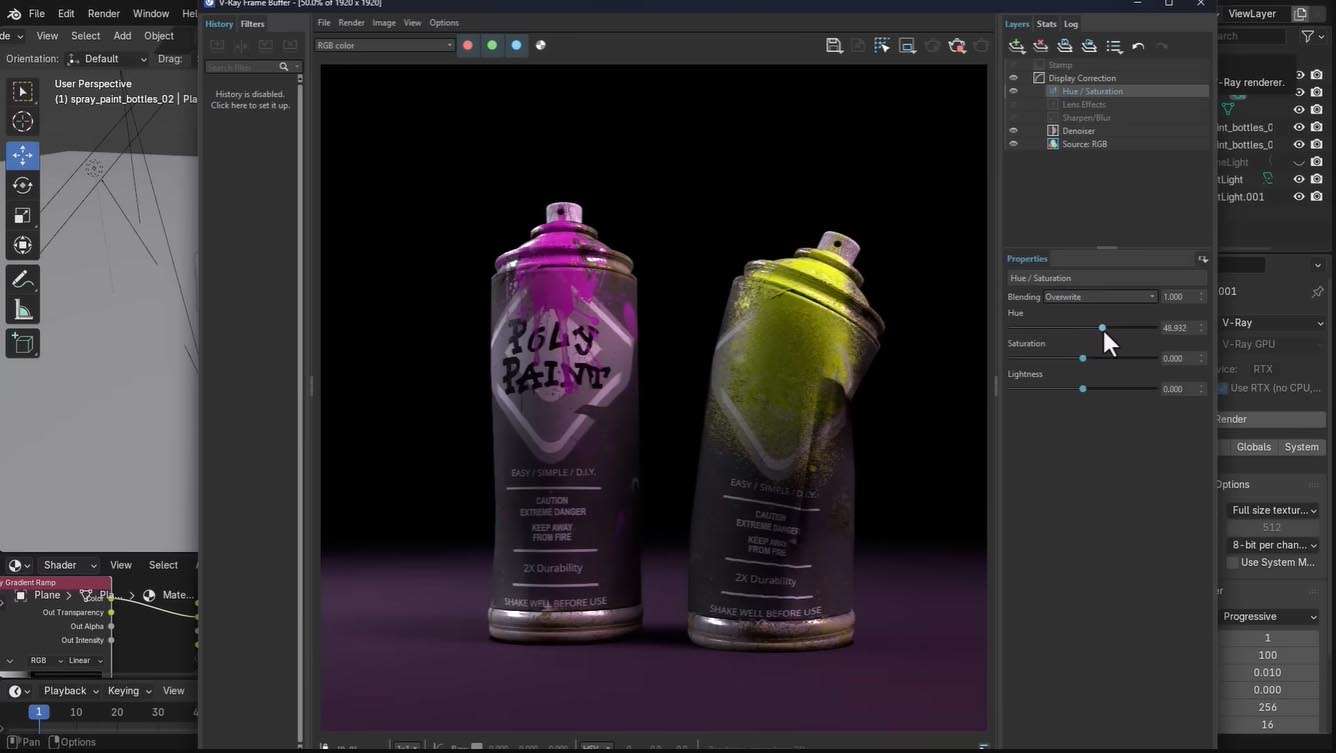
Download V-Ray 7.10.01 for Blender 4.2-4.5 – Advanced Photorealistic Rendering Plugin
V-Ray 7.10.01 for Blender is an advanced photorealistic rendering plugin developed by Chaos, integrating industry-leading rendering technology into the open-source 3D creation suite. This powerful plugin enhances Blender’s native capabilities, offering sophisticated rendering solutions tailored for professionals in architecture, product design, film and animation, advertising, visual effects (VFX), and comprehensive 3D visualization. By combining Chaos’s renowned rendering engine with Blender’s versatile platform, V-Ray for Blender empowers artists and designers to achieve unparalleled levels of realism in their digital projects.
Integrating Industry-Leading Rendering Technology into Blender
V-Ray has long been a cornerstone of professional rendering, celebrated for its ability to produce highly realistic images and animations. Its integration into Blender provides users of this popular open-source 3D software with access to these advanced photorealistic rendering capabilities. This synergy allows for a streamlined workflow, enabling users to move from modeling and scene setup directly into high-quality rendering without significant disruption. The target industries benefiting from this integration include architectural visualization, where intricate details and realistic lighting are paramount, product design for creating compelling marketing imagery, and the film and animation sectors, where visual fidelity is crucial for storytelling and visual effects.
Advanced Lighting and Material Systems for Realistic Visualization
Achieving photorealism relies heavily on accurate light simulation and material representation. V-Ray 7.10.01 for Blender excels in this domain with its comprehensive suite of physically-based lighting tools and an extensive material and shader library. The plugin employs sophisticated global illumination algorithms to simulate how light behaves in the real world, producing natural-looking illumination, soft shadows, and realistic reflections. It supports advanced features like caustics, enabling the accurate rendering of light passing through transparent or refractive objects, and offers complex layered shaders that mimic the nuanced properties of real-world materials. This deep control over light and material interaction is essential for creating convincing visualizations across all supported industries.
Performance Optimization with Hybrid CPU and GPU Rendering
Speed and efficiency are critical in professional rendering pipelines, and V-Ray 7.10.01 addresses this through its hybrid rendering architecture. This system intelligently leverages both CPU and GPU processing power, allowing users to choose the most efficient rendering method for their specific scene and hardware. The plugin has expanded its GPU feature parity with CPU rendering, ensuring that a wider range of V-Ray’s advanced capabilities are available for faster GPU-accelerated renders. Furthermore, the integrated AI denoiser significantly speeds up the rendering process by intelligently removing noise from images, often in real-time during interactive rendering, and through efficient post-processing, without compromising visual quality.
Innovative Tools for Enhanced Creative Control and Efficiency
Version 7.10.01 introduces several new tools designed to enhance creative control and streamline workflows within Blender. The V-Ray Enmesh tool allows users to create complex, repeating geometric patterns directly within their scenes, ideal for intricate architectural facades or detailed textures. V-Ray Decal provides a non-destructive method for projecting textures and materials onto surfaces, simplifying complex surface detailing without altering the underlying geometry. Enhancements to Blender integration include improved compatibility with Geometry Nodes, the ability to manage render assets directly within Blender’s asset browser, and a more cohesive user experience that feels native to the 3D creation suite.
Seamless Cloud Collaboration with Chaos Cloud Integration
For projects requiring significant rendering power or distributed collaboration, V-Ray 7.10.01 integrates directly with Chaos Cloud. This cloud-based rendering service allows users to offload computationally intensive rendering tasks to a network of cloud servers, significantly reducing render times. Chaos Cloud also facilitates teamwork, enabling multiple users within a studio to contribute to rendering tasks simultaneously or for remote teams to collaborate on rendering projects. This offers immense flexibility for both individual artists and large production pipelines, ensuring that projects can be completed on schedule, regardless of local hardware limitations.
Real-World Use Cases and Professional Applications
V-Ray 7.10.01 for Blender finds extensive application across various professional fields. Architectural visualizers use it to create photo-realistic visualizations of buildings and interiors, helping clients make informed design decisions. Product designers leverage its capabilities to produce high-quality renders for marketing materials and product development. In the film and animation industry, VFX artists employ V-Ray for creating complex visual effects, realistic environmental assets, and character renders. Studio technical directors depend on its robust features and scripting capabilities to integrate V-Ray into larger production pipelines, while motion graphics artists utilize it for creating dynamic and visually engaging animated content.
Frequently Asked Questions
What versions of Blender are compatible with V-Ray 7.10.01?
V-Ray 7.10.01 supports Blender versions 4.2 through 4.5, providing advanced rendering features compatible with the latest Blender releases. This ensures that users running recent versions of Blender can seamlessly integrate V-Ray for their photorealistic rendering needs.
How does V-Ray improve rendering performance in Blender?
V-Ray utilizes a hybrid rendering architecture combining CPU and GPU power, alongside AI denoising, to accelerate photorealistic rendering while maintaining high quality and flexibility. This approach allows for faster render times, especially on scenes with complex lighting and materials, without sacrificing the visual fidelity required for professional output.
What new features are introduced in V-Ray 7.10.01 for Blender?
The latest version introduces V-Ray Enmesh for complex repeating geometric patterns, V-Ray Decal for non-destructive texture projection, enhanced GPU feature parity with CPU rendering, improved Blender integration, and direct rendering capabilities with Chaos Cloud. These additions aim to enhance user workflow, creative control, and overall production efficiency.




Reviews
There are no reviews yet.