
Download ZondRes 3D v7.5 – Advanced Electrical Tomography Software
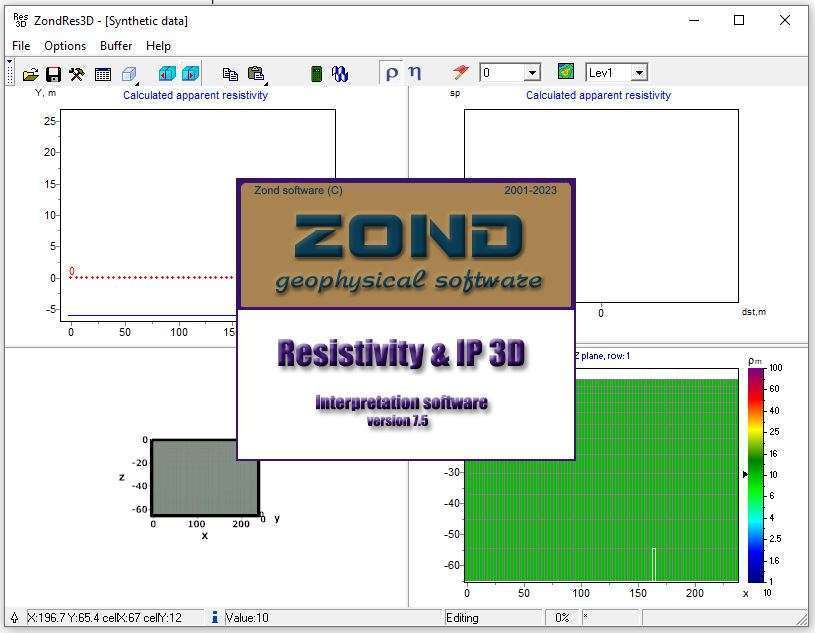
ZondRes 3D v7.5 is a specialized geophysics software developed by Zond Geophysical Software. It is designed for the advanced interpretation of three-dimensional electrical tomography data, specifically focusing on resistivity and induced polarization analysis. This software is crucial for professionals in geophysics, environmental sciences, and geological exploration, enabling detailed subsurface imaging and analysis of geoelectric structures.
Introduction to ZondRes 3D
ZondRes 3D represents a significant advancement in geophysical data interpretation, offering sophisticated tools for 3D electrical tomography. Its primary function is to process and model subsurface electrical properties, providing critical insights for geological and environmental projects. By utilizing advanced computational techniques, ZondRes 3D aids geophysicists in understanding complex underground formations and anomalies.
Core Applications in Geophysics
The software is predominantly utilized for detailed subsurface investigations. Its core applications involve mapping variations in electrical resistivity and analyzing induced polarization (IP) effects within the earth’s subsurface. These capabilities are vital for:
- Geological Exploration: Identifying mineral deposits, groundwater resources, and subsurface geological structures.
- Environmental Assessments: Mapping contaminant plumes, studying soil properties, and monitoring underground infrastructure.
- Geotechnical Engineering: Analyzing ground conditions for construction and infrastructure development projects.
Key Features and Capabilities
Advanced Inversion Techniques
ZondRes 3D incorporates robust mathematical algorithms to perform geophysical inversions. These methods transform raw field data into meaningful subsurface models, accounting for the complex relationship between surface measurements and underground electrical properties. Key inversion techniques include:
- Smooth Inversion: This method aims to obtain a geoelectrically smooth distribution of resistivity or IP parameters, useful for general subsurface imaging.
- Focusing Inversion: Designed for enhanced detail, this technique helps delineate sharper boundaries and highlight specific anomalies within the subsurface model.
- Block Inversion: Applied for creating discrete models with distinct geoelectric blocks, beneficial for interpreting layered earth structures or distinct geological features.
Mathematical Modeling Tools
The software is built upon sophisticated mathematical principles to facilitate accurate geophysical interpretation. It supports various electrode configurations and advanced meshing techniques, allowing for the creation of detailed 3D geoelectric models. These tools are instrumental in translating field measurements into reliable representations of subsurface conditions.
Data Visualization Options
ZondRes 3D offers comprehensive tools for visualizing processed geophysical data. Users can explore their 3D subsurface models through intuitive interfaces, including:
- 3D isosurfaces to represent specific resistivity or IP value ranges.
- 2D vertical and horizontal cross-sections for detailed slice analysis.
- Customizable color maps and rendering styles for clarity.
- Effective export options for models and images compatible with standard GIS and CAD software.
Performance and Computational Efficiency
Handling large, three-dimensional geophysical datasets requires significant computational power. ZondRes 3D is designed to efficiently process and invert extensive datasets, utilizing optimized algorithms to minimize computation time. While demanding, its performance is geared towards providing timely results for complex subsurface modeling tasks in geophysics and environmental studies.
Comparison to Other Geophysical Tools
Compared to other geophysical interpretation software, ZondRes 3D distinguishes itself through its dedicated focus on 3D electrical tomography. While many tools offer 2D capabilities or broader geophysical analysis, ZondRes 3D excels in providing robust 3D inversion for resistivity and induced polarization data. Its advanced mathematical modeling and focusing inversion techniques offer unique advantages for detailed geological exploration and environmental assessment projects where high-resolution subsurface imaging is paramount.
Real-World Applications and Case Studies
ZondRes 3D has been applied in numerous practical scenarios within geological and environmental science. For instance, it has been instrumental in:
- Identifying potential groundwater sources in arid regions by mapping subsurface resistivity anomalies indicative of water-bearing strata.
- Detecting and delineating buried geological faults and fracture zones through their distinctive electrical signatures.
- Monitoring the spread of underground contaminants in environmental impact studies, visualizing plume boundaries using resistivity inversion.
- Supporting mineral exploration efforts by identifying subsurface targets with anomalous resistivity or IP responses.
Frequently Asked Questions
What is ZondRes 3D used for?
ZondRes 3D is used for the advanced interpretation of electrical tomography data, including resistivity and induced polarization analysis, primarily in geological and environmental assessment tasks. It enables the creation of detailed three-dimensional models of subsurface electrical properties.
How does ZondRes 3D handle data visualization?
The software provides extensive data visualization options, allowing users to view geological models in various formats such as isosurfaces and sections, along with customizable export options to popular file types. This facilitates a clear understanding of the subsurface structures revealed by the data.
What are the main inversion methods available in ZondRes 3D?
The software supports multiple inversion methods, including smoothing inversion for achieving smooth distributions and focusing inversion for detailed geoelectric parameter estimation at depth. These distinct methods cater to different analytical needs, from broad imaging to pinpointing specific anomalies.




Reviews
There are no reviews yet.