

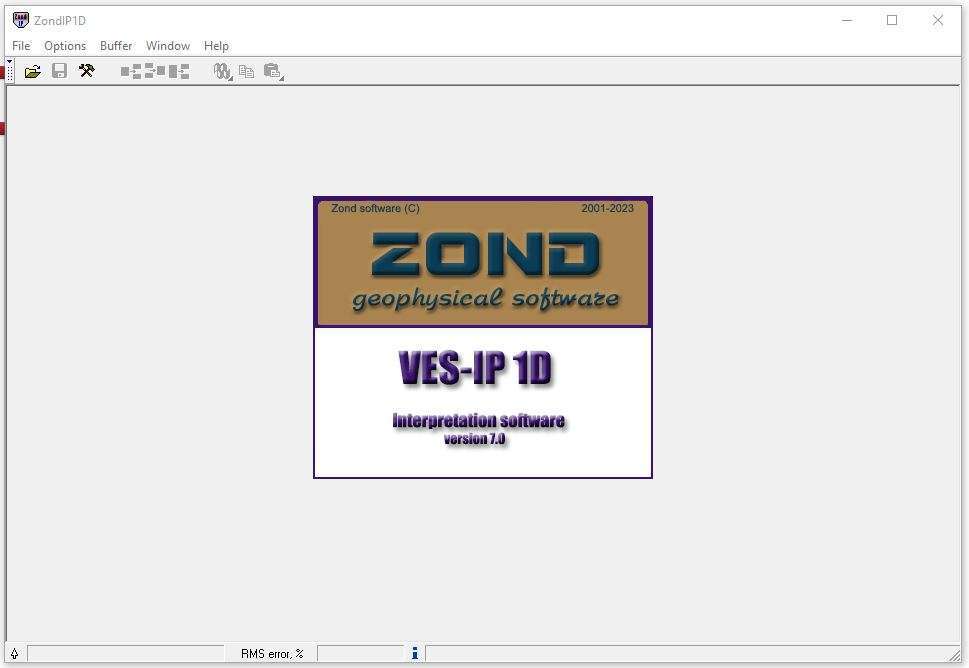
Download ZondVES IP 1D v7.0 – Advanced Geophysical Interpretation Software
ZondVES IP 1D v7.0 is a specialized geophysical interpretation software developed by Zond Software. It is designed for professionals working in geophysical exploration, environmental engineering, and underground resource investigation. The software plays a crucial role in analyzing one-dimensional resistivity and induced polarization data, particularly through the vertical electrical sounding (VES) method, a fundamental technique in geophysical data processing.
Introduction to ZondVES IP 1D
Overview of Geophysical Methods
Geophysical methods are essential for subsurface exploration, providing non-invasive techniques to understand geological structures and material properties. Among these, electrical prospecting methods, specifically resistivity and induced polarization (IP) surveys, are widely employed. These methods measure the electrical properties of the Earth’s subsurface by introducing electrical currents and observing the resulting potential differences. Vertical electrical soundings (VES) represent a key application within these methods, allowing for the determination of geoelectric parameters to depths determined by the electrode spacing. ZondVES IP 1D v7.0 offers advanced capabilities to interpret the data acquired from these surveys, supporting geophysicists in detailed geological modeling and resource assessment.
Key Features and Capabilities
ZondVES IP 1D v7.0 provides a robust suite of tools designed for comprehensive geophysical data interpretation. Its functionality supports a wide range of electrode configurations, allowing flexibility to match various field survey designs. The software is capable of processing data based on different sampling frequencies and employs multiple inversion algorithms for detailed analysis. Key features include:
- Support for extensive electrode arrays including Schlumberger, Wenner, Pole-Dipole, and arbitrary configurations.
- Advanced data processing options for cleaning and preparing field measurements.
- A variety of state-of-the-art inversion algorithms tailored for 1D resistivity and IP data.
- Interactive visualization tools for presenting inversion results, including geoelectric cross-sections and parameter distributions.
- User-friendly interface facilitating efficient data import, manipulation, and interpretation.
Applications in Geophysical Research
The software finds extensive application across several domains within the geophysical sciences. Its primary utility lies in detailed subsurface investigation for both academic research and commercial projects. Real-world use cases demonstrate its effectiveness in:
- Environmental Engineering: Mapping contaminant plumes, identifying groundwater sources, and assessing subsurface conditions for infrastructure development.
- Resource Exploration: Locating mineral deposits, oil and gas reservoirs, and geothermal energy sources by analyzing variations in electrical properties.
- Geological Surveys: Investigating subsurface stratigraphy, identifying fault lines, and understanding geological structures in regional mapping projects.
- Archaeological Investigations: Detecting buried structures or anomalies that exhibit different electrical characteristics compared to their surroundings.
Data Interpretation Algorithms
Types of Inversion Methods
Accurate geophysical interpretation heavily relies on sophisticated inversion algorithms, and ZondVES IP 1D v7.0 offers several methods to achieve this. These algorithms work to model the subsurface resistivity and IP properties based on the observed field data. The software includes:
- Smoothed Inversion: This common technique seeks a subsurface model that minimizes the difference between observed and calculated data while simultaneously constraining the model to be smooth, often leading to geologically plausible continuous layers.
- Focusing Inversion: Algorithms that promote blocky or layered models, effectively isolating distinct geological zones with different resistivity or IP values rather than producing overly smooth transitions.
- IP-specific Inversion: Specialized algorithms designed to handle the complexities of induced polarization data, which involves measuring both resistivity and chargeability.
These inversion methods allow users to select the most appropriate approach based on the survey objectives and the geological context, thereby enhancing the reliability of geophysical data processing.
Integration with Other Geophysical Tools
ZondVES IP 1D v7.0 is designed to be a component within a larger geophysical workflow. While it offers comprehensive 1D interpretation, its findings can be augmented by integrating with other specialized software. For instance, results from ZondVES IP 1D can serve as input or validation for 2D or 3D modeling software, providing a more complete picture of subsurface heterogeneity. Cross-referencing with tools like IPI2WIN, which also specializes in resistivity data inversion, can offer comparative analysis. This synergistic approach allows for more robust geophysical interpretation, especially in complex geological settings.
User-Friendly Interfaces and Functionality
A key aspect of ZondVES IP 1D v7.0 is its focus on usability and efficient workflow management. The software’s interface is structured to guide users through the data interpretation process logically. Data import functionalities support common geophysical data formats, simplifying the transition from field acquisition to processing. The results are presented through intuitive graphical displays, including layered models, apparent resistivity curves, and parameter plots, allowing for clear visual analysis. Customization options during interpretation, such as setting inversion constraints or model parameters, provide users with control over the modeling process, ensuring that the final interpretations are tailored to specific project requirements.
Conclusion and Future Developments
ZondVES IP 1D v7.0 stands as a valuable tool for geophysicists and environmental engineers, providing advanced capabilities for the interpretation of 1D resistivity and induced polarization data. Its flexible electrode configuration support, diverse inversion algorithms, and user-friendly interface make it a reliable choice for geophysical interpretation software. As geophysical exploration continues to advance, users can anticipate further refinements and potential new features in future versions aimed at enhancing accuracy, expanding methodological options, and improving integration capabilities within the broader field of geophysical data processing.
Frequently Asked Questions
What is ZondVES IP 1D used for?
ZondVES IP 1D is primarily used for interpreting one-dimensional resistivity and induced polarization data in geophysical surveys. It facilitates the vertical electrical sounding (VES) method, allowing users to analyze underground geoelectric properties effectively.
How does ZondVES IP 1D handle different electrode configurations?
The software supports various electrode arrays, including traditional configurations like Schlumberger and Wenner, as well as arbitrary layouts. This flexibility allows users to adapt the software to their specific survey needs and improve data accuracy.
What types of inversion methods does ZondVES IP 1D offer?
ZondVES IP 1D includes several inversion techniques, such as smooth inversion and focusing inversion, which help in accurately modeling geoelectric sections based on the collected data. The choice of method can significantly influence interpretation outcomes.





Reviews
There are no reviews yet.