

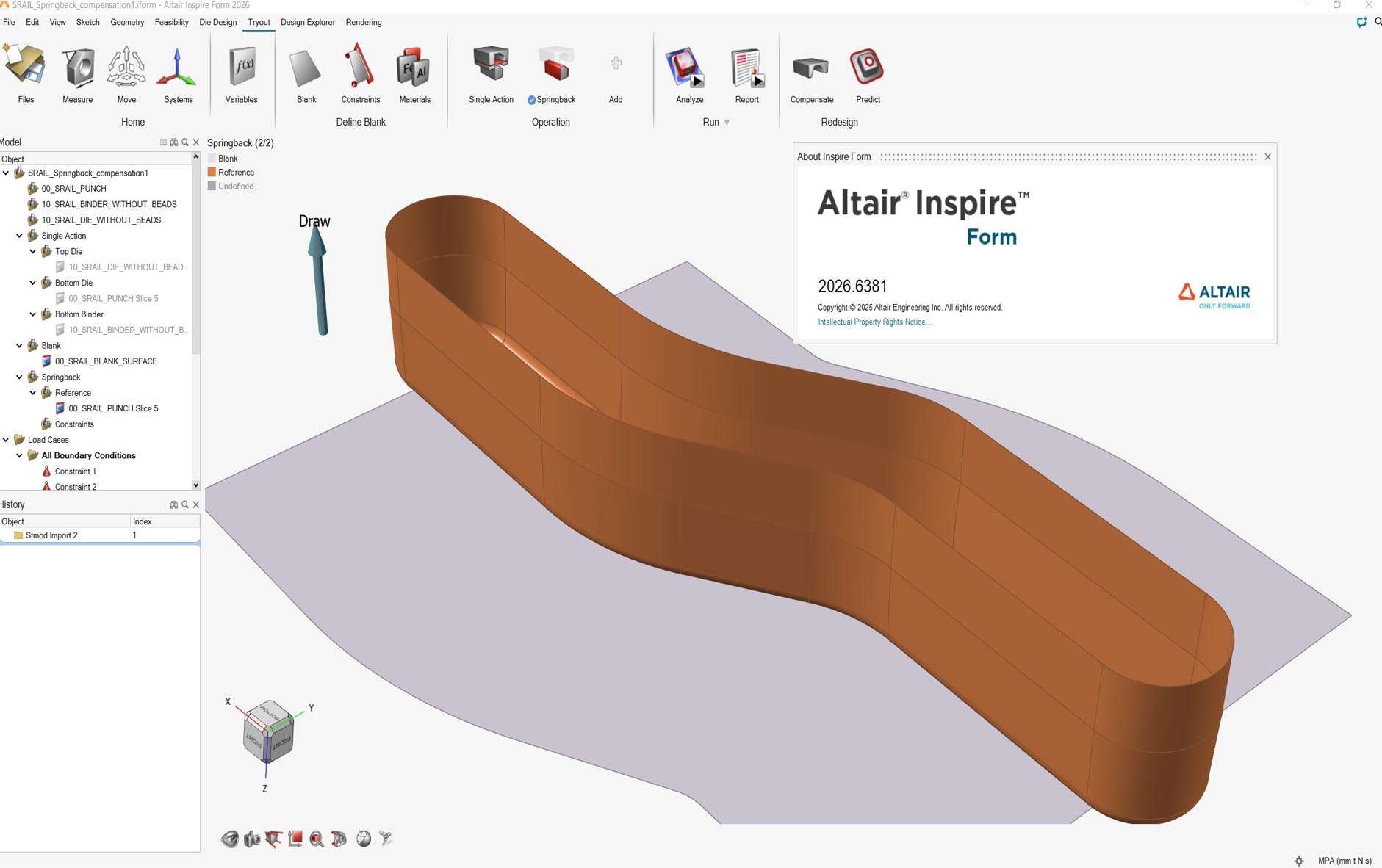
Download Altair Inspire 2026 – Generative Design and Simulation-Driven Optimization Software
Altair Inspire 2026 is a sophisticated generative design and simulation platform developed by Altair Engineering, Inc. This software is designed to revolutionize mechanical and manufacturing engineering workflows by integrating advanced AI-driven generative design with robust physics-based simulation. It is particularly valuable for professionals in the automotive, aerospace, and industrial design sectors aiming to create lighter, more efficient, and structurally optimized components.
Innovative Generative Design for Mechanical and Manufacturing Engineering
Altair Inspire 2026 redefines traditional computer-aided design (CAD) processes by integrating artificial intelligence with simulation tools. This approach enables engineers to rapidly explore a wide range of design possibilities that are optimized for performance and material efficiency. The software significantly impacts industries such as aerospace, automotive, and general product manufacturing by facilitating the creation of innovative, lightweight components that might not be conceived through conventional design methods.
Advanced Topology Optimization and Shape Generation Tools
At its core, Altair Inspire 2026 offers powerful tools for topology optimization and AI-assisted shape generation, transforming conceptual ideas into refined designs.
AI-Assisted Design Alternatives
The software employs advanced AI algorithms to generate numerous manufacturable design options. These alternatives are derived from defined engineering constraints and specific load cases, offering engineers a diverse set of optimized solutions to choose from.
Smooth Geometry with PolyNURBS
Altair Inspire 2026 facilitates a seamless transition from simulation results to editable CAD geometry. Its PolyNURBS technology allows users to convert complex optimization outcomes into smooth, precise surfaces that are readily usable in downstream CAD applications and manufacturing processes.
Manufacturing Constraints Integration
To ensure practical application, Altair Inspire 2026 enables the integration of realistic manufacturing constraints. Users can define guidelines specific to processes like casting, extrusion, and additive manufacturing (3D printing), ensuring that the optimized designs are not only efficient but also feasible for production.
Comprehensive Simulation and Analysis Capabilities
Beyond design generation, Altair Inspire 2026 provides a comprehensive suite of simulation and analysis tools essential for validating product performance.
Structural and Dynamic Analysis
The platform supports detailed structural and dynamic analysis, including linear and nonlinear stress analysis, modal frequency analysis for identifying resonant frequencies, buckling analysis for structural stability, and rigid body dynamics for simulating the motion of unconstrained components.
Electromechanical Multi-Physics Enhancements
A significant advancement in the 2026 release is the enhancement of multi-physics simulation capabilities. This includes sophisticated electromechanical analysis, which accurately models the coupling between structural, thermal, and electric phenomena, providing a more holistic understanding of component behavior in complex operating environments.
Motion Analysis for Mechanism Simulation
Altair Inspire 2026 incorporates motion analysis tools that allow engineers to simulate forces and motions within mechanisms. This capability is crucial for generating realistic load cases that accurately reflect real-world operational conditions, thereby improving the fidelity of structural and dynamic simulations.
Direct Modeling and Conceptual Design Tools
Complementing its optimization and simulation features, Altair Inspire 2026 includes efficient direct modeling and conceptual design tools.
History-Free 3D Modeling
The software features a history-free direct modeler that empowers users with flexible and rapid geometry creation and modification capabilities. This approach is ideal for quick concept development and iterative design changes, allowing engineers to manipulate geometry without being constrained by a feature history.
Specialized Sheet Metal Design Functions
Dedicated tools for sheet metal design are integrated within Altair Inspire 2026. These functions support the pattern design, bending, and unfolding processes specific to sheet metal components, streamlining workflows for products utilizing this material form.
Integration with Altair Ecosystem and Workflow Efficiency
Altair Inspire 2026 is designed to integrate seamlessly within the broader Altair technology ecosystem. This connectivity allows for efficient data exchange and workflow continuity between Inspire and other Altair simulation, optimization, and data analytics tools, ultimately accelerating product development cycles and enhancing overall engineering efficiency.
Practical Applications and Industry Use Cases
The capabilities of Altair Inspire 2026 are applied across various engineering disciplines to achieve tangible benefits. Real-world usage includes the design of lightweight automotive components that improve fuel efficiency, the creation of high-strength yet mass-reduced aerospace parts, and the optimization of industrial product designs for enhanced performance and material savings.
Frequently Asked Questions
What are the new AI features in Altair Inspire 2026?
Altair Inspire 2026 introduces AI-driven shape suggestions that generate multiple manufacturable design alternatives based on engineering constraints and load cases, enhancing creativity and speeding up the design process.
Can Altair Inspire 2026 handle multi-physics simulations?
Yes, the 2026 release enhances multi-physics simulation, including electromechanical analysis that couples structural, thermal, and electric effects, enabling more accurate real-world behavior predictions.
How does Altair Inspire support manufacturability in design?
The software allows users to apply manufacturing constraints such as casting, extrusion, symmetry, and 3D printing rules directly during the generative design process, ensuring optimized designs are practical and manufacturable.






Reviews
There are no reviews yet.